
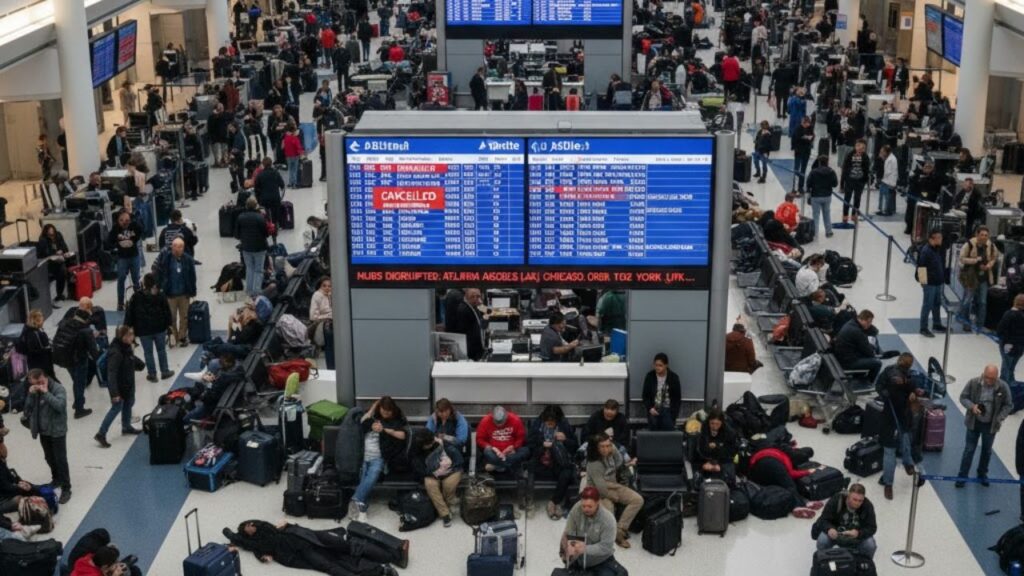
Just after sunrise at Atlanta’s Hartsfield-Jackson airport, the departures board began filling with red warning labels. One cancellation became several, then entire columns flipped to “DELAYED” in bold letters. At Gate B18, a mother distracted her children with airport snacks while nearby a business traveler stared blankly at his inbox. Information came in fragments — system issues, crews timing out, a network-wide ripple effect. By midday, the scale was clear: thousands of passengers stranded, hundreds of flights scrapped, and nearly 5,000 journeys frozen in place.
How a Small Disruption Snowballed Nationwide
What first seemed like a rough start for a handful of flights quickly spread. Delta halted departures from Atlanta, American slowed operations, while JetBlue and Spirit postponed boarding. The chain reaction was swift. Roughly 470 flights were canceled across the United States, and close to 5,000 faced delays. The impact stretched from New York and Chicago to Dallas and Los Angeles, transforming routine connections into overnight waits on terminal floors as aircraft and crews fell out of position.
Inside Terminals Where Time Stood Still
At Los Angeles International Airport, usually smooth by midday, Terminal 5 resembled an emergency shelter. A Delta flight to Atlanta was delayed repeatedly before being canceled when the crew reached federal work limits. Nearby, a JetBlue flight to Boston cycled through delay after delay, with agents repeating the same apologies. By late afternoon, passengers swapped chargers and rumors, clinging to any scrap of information that might help them move.

The Real Reasons Behind the Meltdown
Behind the scenes, the causes were less dramatic than the scenes suggested. Technology outages, tight staffing after years of cuts, summer storms in critical corridors, and aircraft stuck in the wrong cities all collided. When a major hub like Atlanta falters, the entire network feels it. Once crews time out and planes miss scheduled slots, recovery becomes a slow, complex puzzle that no quick fix can solve.

How Passengers Actually Get Through Days Like This
When departure boards turn red, the travelers who manage best are those who act quickly. The moment a flight changes status, they use multiple channels at once: airline apps, phone lines, and gate agents. While others wait in lines, they search for alternate routes, nearby airports, or ground transport that could still get them close to their destination.

Practical Survival Rules for Disruption Days
- Document everything: capture screens, messages, and receipts to support rebooking or compensation requests.
- Move early: waiting passively often means losing the best alternatives.
- Know your options: nearby airports or partner airlines can save hours.
- Use priority lines: elite or credit card numbers often reach agents faster.
- Prioritize rest: a hotel and sleep can matter more than another argument at the counter.
What Widespread Cancellations Reveal About US Air Travel
Days like this expose the fragile structure of modern air travel in the United States. On paper, systems are optimized to the minute. In reality, a single glitch or storm can ripple nationwide. Headlines focus on the numbers — hundreds canceled, thousands delayed — but the deeper issue is how thin the margin for error has become.
The Quiet Cost for Travelers
Beyond inconvenience, repeated disruptions reshape how people plan their lives. Weddings, funerals, interviews, and long-awaited trips now come with a lingering question: what if the system fails again? Some travelers adapt by booking earlier flights or avoiding tight connections, while others quietly choose trains or road trips instead. These shifts rarely appear in statistics, but they reflect a growing hesitation beneath the surface.
When Airports Become Temporary Communities
During long delays, strangers share snacks, watch each other’s bags, and trade stories of missed milestones and narrow escapes. In the space between “boarding soon” and “canceled,” airports turn into temporary villages. Each nationwide disruption either erodes trust further or rebuilds it, depending on how openly and humanely the chaos is handled.

Key Takeaways for Travelers
- Nationwide disruption scale: About 470 cancellations and nearly 5,000 delays show how quickly travel plans can unravel.
- Immediate passenger strategy: Using apps, phone lines, and gate agents together can make a bad day survivable.
- System fragility: Thin staffing and tight schedules mean small problems can trigger massive ripple effects.
