A shiver moves through the crowd well before the sky begins to dim. On a low rise near a calm Italian town, people unroll blankets, twist tripods into the earth, and share plastic eclipse glasses as casually as festival bands. Above them, the sky remains a bold, innocent blue, the kind that usually signals an unremarkable afternoon. Still, every face is tilted upward, tense, as if something delicate is about to crack. Children keep repeating, “When does it begin?” No one answers confidently, because everyone feels it too: we are about to see the Sun vanish in the middle of the day, and this time, it will linger.
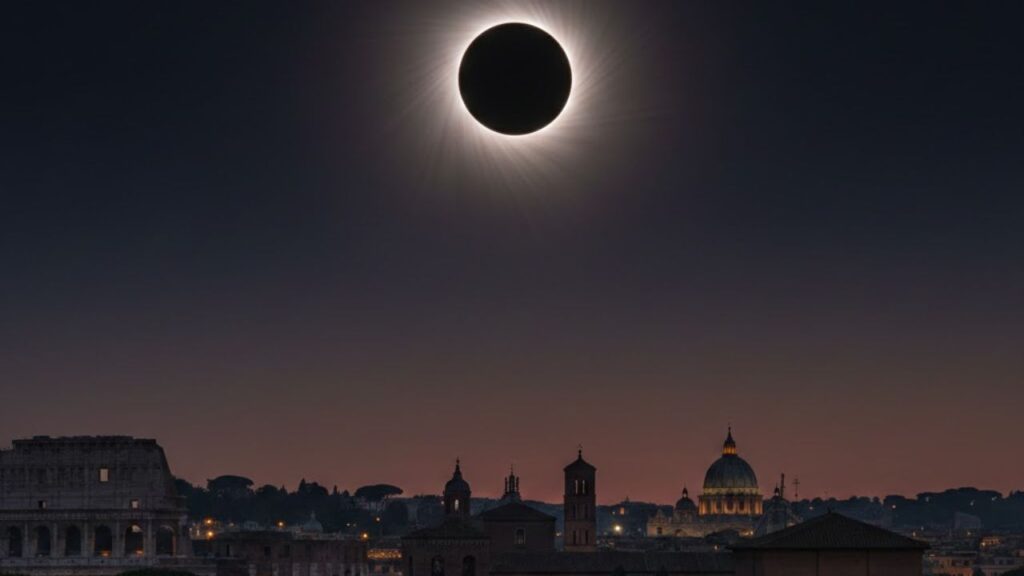
Italy prepares for a midday turned into night
This total solar eclipse over Italy is not the fleeting moment many eclipses are known for. It will deliver more than six uninterrupted minutes of darkness, a rare celestial shutdown unmatched until 2114. Unusually, Italy sits at the heart of the spectacle rather than its margins. Sections of the country fall directly beneath the path of totality, where the Moon aligns perfectly with the Sun and daylight drains into an eerie twilight. Birds will fall silent, temperatures will dip, and streetlights may glow in confused response.
Totality feels theoretical until you witness the Sun narrowing into a fragile crescent. During this event, that crescent will disappear entirely for longer than most people can comfortably hold their breath. Picture standing on a Sicilian balcony or a Puglian beach as stars surface at noon and the horizon darkens. Tourists will gasp and laugh, phones will lift instinctively, and someone nearby will murmur, “I remember the last one.” In minutes, an ordinary day will be divided forever into before and after.
 Sorry, the Matrix doesn’t exist: new mathematical proofs suggest the universe cannot be a simulation
A generational eclipse written in precise geometry
Astronomers already describe this as a once-in-a-generation eclipse. The alignment must be exact: the Moon close to Earth, the Sun at the perfect angle, and the shadow slicing across the planet in a narrow band. When everything clicks, totality stretches into those legendary six minutes that even seasoned eclipse chasers find overwhelming. This is why people cross oceans to stand under a moving shadow. For Italy, hosting it at home is a rare blend of timing, location, and cosmic chance.

How to truly experience six minutes without sunlight
If you have never seen a total eclipse, assuming you can improvise is the biggest mistake. Once the Moon takes its first bite from the Sun, time behaves strangely and accelerates. Choose your viewing spot early: a place with an open southern view, few buildings, and minimal artificial light. Hilltops near Florence, rural Emilia-Romagna, or sea-facing balconies in Calabria all work well. Bring proper eclipse glasses for the partial phases and test them beforehand. They come off only when the Sun is fully covered, not a moment sooner.
Veterans repeat the same advice: don’t live the eclipse through your phone. Photos matter, and messages will be sent, but when totality arrives, the world changes so completely that watching through a shaky screen feels hollow. Most eclipse videos are forgotten within days. Instead, set one device on a tripod, press record, and step back. Look at the people around you. Watch expressions shift between awe, fear, and nervous laughter as the light drains away.
The simple truth is that six minutes can feel endless and painfully brief at the same time when the Sun is gone.

- Choose your city early: accommodation and transport in the path of totality will fill quickly.
- Pack layers: even in summer, the temperature drop can be surprising.
- Practice with eclipse glasses: avoid fumbling when the first shadow appears.
- Decide your focus: watching or photographing—splitting attention often disappoints.
- Create a small ritual: a countdown or shared silence helps fix the moment in memory.
Between calculation, fear, and shared wonder
Watching a total solar eclipse from Italy also means standing inside centuries of belief. For generations, sudden daytime darkness signaled omens and warnings, carefully recorded in old chronicles. Today, we understand the mechanics: a precise orbital dance, nothing supernatural. Yet when the light drains away and a cold wind sweeps a crowded piazza, it becomes clear why people once knelt in fear. Science explains the process, but your body reacts to the experience in real time.
We all recognize that sensation when nature does something so strange that the mind lags behind. An eclipse intensifies that feeling instantly. Even surrounded by telescopes and predictions, the body responds as if something essential has gone wrong. Some people cry without reason. Others cheer as if at a match. The Moon glides on, indifferent, while human reactions become part of the spectacle itself.
For children in Italy, this eclipse may become their most vivid memory of the sky. One day they will casually say, “I was there when the Sun disappeared for six minutes,” while their own children wait for the next long eclipse in 2114. That sense of continuity may be the eclipse’s greatest gift. It is not just an astronomical date, but a shared meeting with the future, a reminder that the same shadow will return long after today’s stories fade.
When daylight slowly returns
The light will not snap back instantly. Colors will seep in gradually, like pigment returning to a faded photograph. People will blink, check their phones, and complain they pressed record too late. Some will already search for the next eclipse path, joking about distant travel. The spell loosens, but it does not vanish. Part of you remains attached to that impossible ring of darkness that briefly replaced the Sun.
This six-minute total solar eclipse over Italy will echo through daily life in subtle ways. New superstitions will form, new profile pictures will appear, and unexpected friendships or romances may begin on shared rooftops. Schools will recount the day lessons paused because the sky went dark. Future worries may feel smaller after watching a star disappear and return precisely on time. You may even find yourself glancing upward more often, spotting the Moon on ordinary nights, quietly remembering how it once stole the Sun and then gave it back.
 7-minute chair routine after 60 rebuilds core strength better than planks and protects your back
Why this eclipse matters
- Historic duration: more than six minutes of totality, unmatched until 2114, making it worth planning time and travel around.
- Visibility from Italy: the path of totality crosses parts of the country, offering a rare near-home experience.
- Best way to experience it: preparation, safe viewing, and mindful observation maximize impact and reduce frustration.