
High on a frozen ridge in Hawaii, the night sky appeared calm enough to sip from. Inside a control room filled with the scent of coffee and cold electronics, a small group of astronomers watched lines of greenish code flicker beside a star-filled black display. Then one point of light began acting oddly. It refused to follow the smooth, familiar arcs traced nightly by thousands of known asteroids. Instead, it cut across them, like a stranger pushing through a slow crowd. Someone whispered, “That can’t be right.” The room fell silent. Moments like this feel as if the universe itself has tapped on the glass.
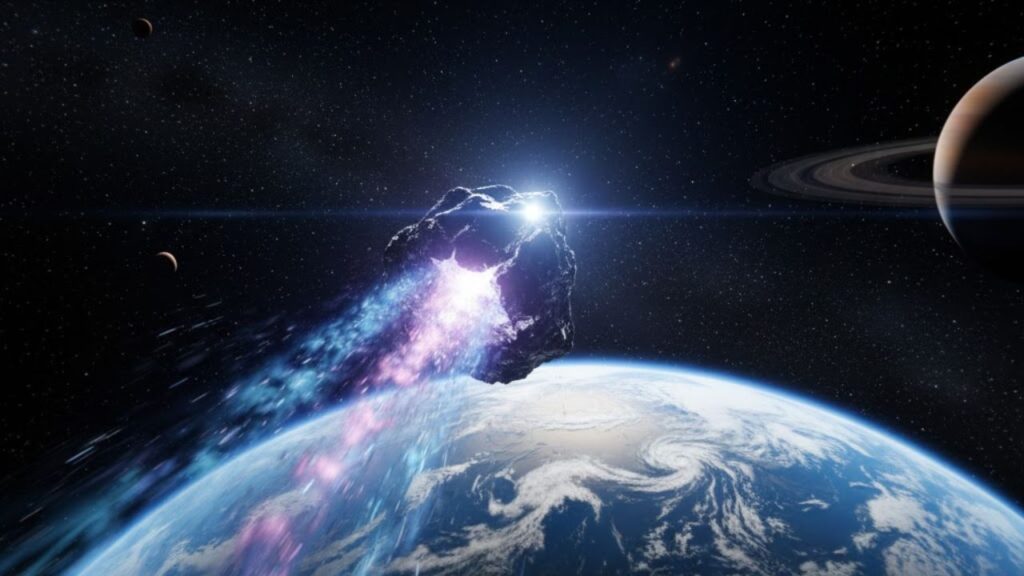
An unexpected cosmic projectile from deep space
The first alert looked almost like a software glitch: a speck no bigger than a pixel streaking far too quickly across survey images. Astronomers regularly track near-Earth objects, but this one carried a different energy, racing through the solar system as if flung from a distant galactic slingshot. Once calculations settled, its path told a clear story. The object did not loop around the Sun. It sliced through on a steep, hyperbolic trajectory, like a visitor with no intention of staying. This is not the orbit of something born here. It belongs to a traveler from far away.
Speed, shape, and a troubling set of numbers
What truly unsettled scientists was the velocity. The object moved at tens of kilometers per second, fast enough to cover the Earth–Moon distance in only a few hours. Telescopes revealed a faint, elongated body, dark as charcoal, with light patterns suggesting a tumbling, uneven shape. It was no tidy sphere, but more like a jagged shard spinning end over end. Observatories across continents scrambled for brief glimpses before it vanished again, a chase one researcher compared to “photographing a bullet with a smartphone.”

The math left little room for doubt. Its incoming speed was far too high for the Sun’s gravity to claim it. Figures like these only make sense if the object has wandered between stars for millions, perhaps billions, of years.

- Hairstyles after 70: the worst mistake that ages the face, according to a hairdresser
- 9 habits to keep at 70 so people say, “I hope I’m like that someday”
- Fishermen report sharks biting anchor lines after orcas surround their boat
- A washing machine trick that makes clothes smell divine or angers neighbours
- Boiling rosemary: a grandmother’s tip that transforms home atmosphere
- 3,000 liters of hot water daily with no electricity, oil, or gas
- Wood stove owners: a low-cost accessory promising comfort and savings
- Aluminum foil in the freezer: a simple hack winning over households
Tracing a long exile from another star
Astrophysicists ran simulations backward, watching the digital trace glide past the outer planets, through the hazy boundary of the Oort Cloud, and out into the cold between suns. Some models suggest the object may have been expelled from another planetary system long ago, flung outward when giant planets shifted their orbits. This makes the story bigger than a fast rock grabbing headlines. It becomes the tale of an ancient exile, briefly passing through our neighborhood after an unimaginably long journey.
What an interstellar visitor can teach us
Once confirmed as interstellar, the focus shifted. The race was no longer to stop it, but to learn everything possible as it flashed by. Telescopes scanned its reflected light across many wavelengths, searching for clues etched into its surface. Was it icy like a comet’s core, rocky like planetary debris, or a strange hybrid defying easy labels? Each spectrum acted like a fingerprint, hiding hints of minerals, frozen compounds, and possibly organic material from another cosmic kitchen.
One of the most compelling ideas now gaining ground is that such objects may be common. Rather than rare miracles, they could be constant drifters, tossed out by young planetary systems and preserved in deep time. We have likely missed thousands simply because our surveys were not fast or sensitive enough. Only recently have automated, all-sky searches been capable of catching these fleeting messengers.
Organic chemistry and quiet possibilities
If the galaxy is filled with debris from reshaped worlds, each fragment carries a story of how planets form, collide, and sometimes fall apart. There is also growing interest in the chemistry they might carry. Some researchers suspect interstellar objects could transport complex carbon compounds, the raw ingredients for life, delivered not through science fiction drama but through slow, patient geological processes that predate oceans and stable atmospheres.

The scramble to observe a once-only flyby
When an object like this appears, the first response is anything but glamorous. It triggers a frantic coordination effort: emails, messages, and late-night calls as observatories plead for minutes of telescope time. The immediate goal is to lock down the orbit. Multiple observations from different angles shrink the uncertainty zone, and with such speed, every hour matters before the object slips beyond reach.
Teams run rapid models on laptops, tweaking telescope instructions almost in real time. Reality often interferes. Weather closes domes. Instruments fail. Sometimes the object drifts too close to the Sun from our viewpoint, making it painfully hard to track. Astronomers know the frustration of witnessing something extraordinary while battling limits they cannot control.
Looking ahead to the next visitor
Despite public assumptions, launching a spacecraft to chase such a fast-moving target is enormously complex and would take years to prepare. By then, this visitor would already be gone. Still, agencies are beginning to plan for the future. Concepts now explore small, agile spacecraft that could wait on standby, ready to sprint toward the next interstellar object with little warning.
As one planetary scientist put it, the galaxy regularly sends free samples. The question is whether we remain content to watch them rush past or decide to reach out. Turning that ambition into reality now centers on coordinated surveys, open alert systems, affordable spacecraft, rapid international agreements, and public data access so discoveries can be shared widely.
A fast messenger and a slower question
For most people, this object will remain an invisible streak buried in scientific data. Yet its meaning seeps quietly into everyday thinking. A rock from another star system racing through ours is a reminder that the solar system is not a sealed box. It is open to traffic, part of a wider galactic neighborhood we are only beginning to notice.
While speculation will always exist, scientists will continue the patient work of measuring, modeling, and debating. Still, the discovery raises a deeper thought. If fragments of other systems pass through ours regularly, then some part of “out there” is already “right here.” Perhaps Earth itself carries pieces of many lost worlds, locked inside its rocks.

Key takeaways from this discovery
- Record-speed interstellar object: Detected on a hyperbolic path far faster than typical asteroids, offering a real-time glimpse of material from beyond our solar system.
- Scientific goldmine: Spectral data reveal composition, history, and possible organic molecules, reshaping how we think about other worlds.
- Race to observe: Global coordination and time pressure highlight the human side of space science and why these rare moments matter now.
