
On a rough January morning, engineer-turned-activist Lea Kovic stood on a wind-lashed Atlantic pier, staring into the water as if waiting for a reply. Fishing boats rose and fell on the swell, their engines swallowed by the roar of the sea. Somewhere below those steel-grey waves, governments and tech giants want to drive a high-speed bullet train through the darkness. She imagines a glass-and-steel artery cutting into the seabed, capsules racing past whales at 600 km/h, promising New York to London in under two hours. Then she says softly, “Once you carve a highway into the ocean, you don’t get to take it back.”
The Underwater Train Idea Moves Into Focus
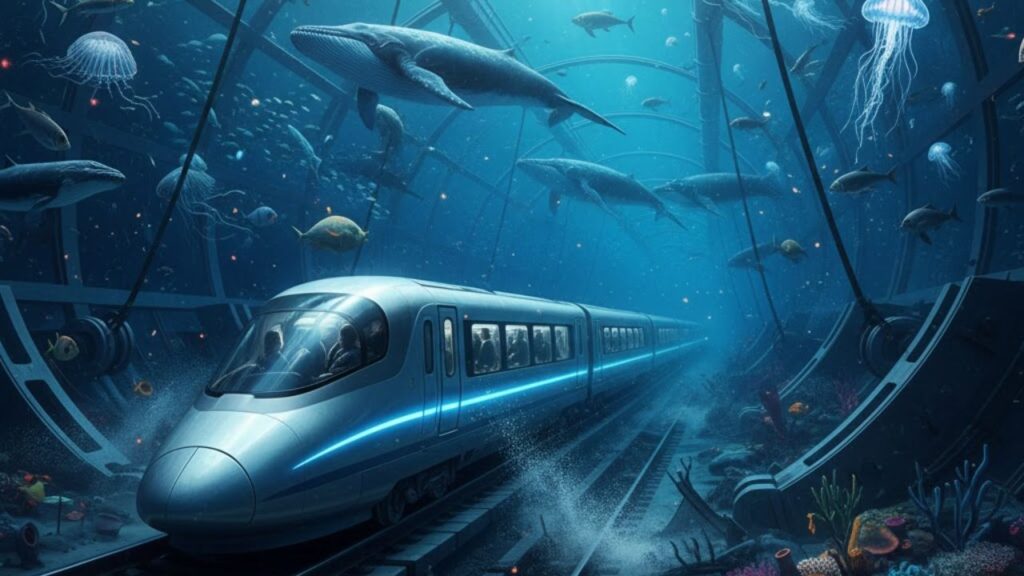
The proposal sounds like science fiction. A sealed, high-speed train running through pressurised tubes laid across the ocean floor, linking continents beneath the waves. Promotional images show sleek capsules gliding through glowing blue water, passengers sipping coffee as sharks drift past outside. The message is polished: no jet lag, lower emissions, and a new chapter in global travel. For politicians hoping to cut flight pollution without slowing growth, it looks irresistible. For investors, it resembles the next great moonshot.
Why Scientists and Coastal Communities Are Alarmed
Behind the glossy visuals, concern is building. Marine biologists, small island states, and Indigenous coastal communities are studying the same plans with unease. A leaked feasibility study for an Atlantic route shows the tunnel crossing known migration corridors for humpback and fin whales. On paper, it’s a neat line. In reality, it slices through a living highway filled with movement and sound.

The Problem of Noise Beneath the Waves
Off Iceland, researchers are already modelling the constant low-frequency vibration these trains could generate. Early simulations suggest a persistent noise “halo” spreading hundreds of kilometres, a mechanical hum that never fully fades. For species that rely on sound to navigate, feed, and communicate, this kind of disturbance could reshape entire ecosystems.

What Construction Could Mean for Life at Sea
Fishermen near potential landfall sites worry about what comes first: dredging, blasting, concrete bases, and endless deliveries of rock and steel. One fisherman summed it up bluntly, saying his son might be the last in the family to fish those waters. On land, we’re used to visible scars from roads and tunnels. Underwater, the damage is hidden, which is exactly what troubles critics most.
Invisible Impacts With Lasting Effects
A deep-sea tunnel isn’t just a silent tube. Its construction triggers seismic shocks, clouds of sediment carried by currents, and a permanent chain of maintenance hubs, cables, and power lines. Each becomes a source of noise, heat, and chemical runoff in environments shaped by long-term stability. A project like this doesn’t just connect continents; it embeds industrial activity into places we barely understand.
The Quiet Phase Before Approval
If the project advances, the first visible signs won’t be trains, but ships. Survey vessels dragging sonar arrays, drilling rigs punching test holes into deep sediment, barges placing sensors and explosives for mapping. Activists in Portugal and Canada are already tracking these movements using binoculars and public ship data, calling it “the creeping phase”—the moment when nothing is officially approved, yet the ocean is steadily reduced to data and profit forecasts.
Why Early Contracts Matter
Campaigners warn that the most critical decisions hide in small steps: environmental assessments, “temporary” platforms, auxiliary ports. That’s where the irreversible damage often begins. Many still imagine the sea as infinite and self-healing, assuming tides will erase the evidence. History suggests otherwise, as coral bleaching, collapsing fish stocks, and stronger coastal storms continue to prove.
 Sorry, the Matrix doesn’t exist: new mathematical proofs suggest the universe cannot be a simulation
Is It Really a Green Alternative?
Supporters frame the underwater train as a cleaner substitute for long-haul flights. On paper, fewer transatlantic planes sound like progress. Critics argue the comparison misses the point. A permanent tunnel would stack on top of existing pressures like deep-sea mining, container shipping, offshore drilling, and plastic pollution. Few people read hundreds of pages of impact assessments closely, and that’s how risky shortcuts slip through.
When Innovation Becomes Exploitation
The harshest critics describe the plan not as bold innovation, but as a final attempt to stretch a growth model already pushing planetary limits. Marine ecologist Dr. Rahul Menon calls it “the colonisation of the deep”, arguing that a broken relationship with land is being exported to oceans already under strain. Leaked investment slides boasting about “unlocking undersea real estate value” only deepen that fear.
The Environmental Pressures at Stake
- Noise: constant low-frequency rumble disrupting whales and fish
- Light: artificial glow from stations and hubs leaking into dark zones
- Chemicals: lubricants, paint particles, and microplastics entering currents
- Heat: warming plumes from power systems altering local ecosystems
- Access ports: new coastal scars inviting further industrial expansion
Speed, Convenience, and the Question We Avoid
Step back, and the underwater train becomes less about engineering and more about our relationship with speed. A ninety-minute Atlantic crossing sounds thrilling, but it assumes we should always be reachable, available, and moving faster than our own systems can process. For global professionals, the promise feels exciting. For coastal residents watching another “strategic hub” rise, it feels like someone else’s dream cutting through their shoreline.
Who Is This Really For?
The communities most affected—Indigenous fishers in the Arctic, small island nations in the Pacific, coastal towns from Ireland to Morocco—are still struggling to gain real influence. Their questions are direct: What happens to fisheries? Who cleans up an accident four kilometres down? Who decides what counts as acceptable damage? While engineers present reassuring charts and politicians speak of balance, one phrase keeps surfacing from opponents: environmental crime.
The Debate That Isn’t Going Away
Critics use that phrase to stress intent and scale. This isn’t a small error, they argue, but a deliberate move to industrialise fragile ecosystems despite decades of warnings. Supporters say safeguards and cleaner methods could reduce harm. Opponents counter that some places—deep trenches and key migration routes—should remain off-limits. Even the climate benefits are contested, with researchers warning that mega-projects often add demand instead of replacing it.
Where Scrutiny Still Has Power
- Deep oceans aren’t empty: they’re filled with life and migration routes, not blank space
- Green labels can mislead: cleaner than planes doesn’t mean harmless
- Public oversight matters: survey work, impact studies, and hearings are real leverage points
