
On the scorching runway of a military air base, a Rafale fighter jet gleamed beneath floodlights, looking ready for a ceremonial handover. Flags were pressed flat, speeches refined, and hotel suites reserved for what was meant to be a triumphant signing. In Paris, aides quietly refreshed briefing notes, already tallying the billions destined for France’s defense sector and the favorable headlines to come. Every signal suggested confidence — that diplomatic word used when celebration has practically begun.
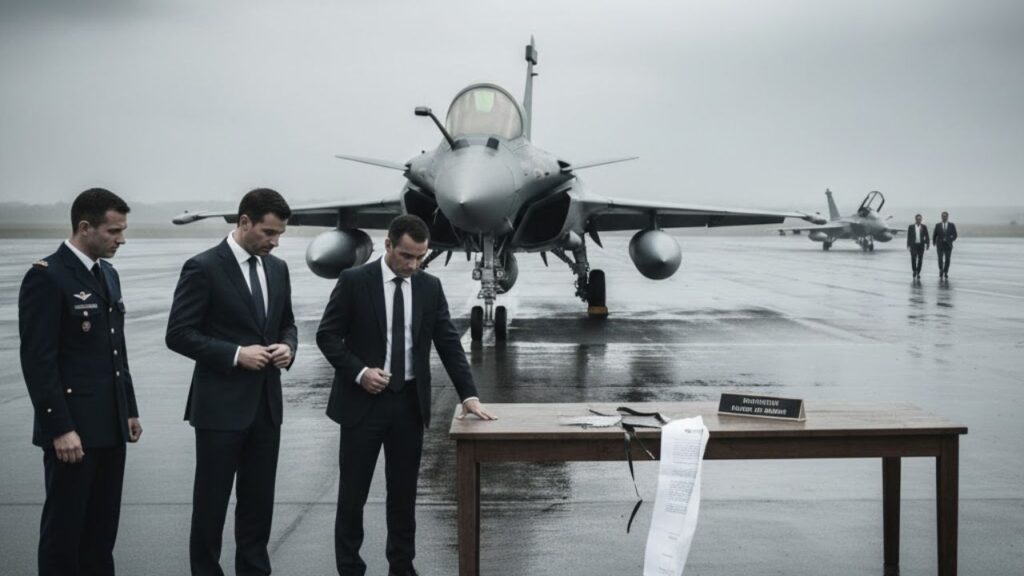
Then, almost without warning, the rhythm changed. Calls were returned more slowly. A meeting was abruptly “rescheduled.” A supposedly minor technical issue suddenly required “additional evaluation.” Within days, the news landed with force: the €3.2 billion Rafale agreement was cancelled, undone by a late reversal that left one jet idle on the tarmac and one negotiating team stunned.
How a near-final agreement quietly collapsed
Those close to the negotiations describe the moment like an inevitable split everyone sensed but refused to admit. French envoys, after months of shuttle diplomacy between Paris and a Gulf capital, entered the final round upbeat, contracts neatly prepared. The deal was described as “99% complete” — a phrase that now carries a bitter edge.

The atmosphere shifted when the buyer’s delegation arrived late to the decisive meeting. Conversations were brisk, humor fell flat, and the contract draft lingered unopened. Subtle cues hinted that political winds were shifting before anyone stated it outright.

Soon after, the pivot became clear. Despite years of assessments, joint drills, and public appearances, the buyer signaled interest in a “different strategic path.” In diplomatic language, this meant a rival supplier had entered decisively. Locally, talk grew of an alternative offer rich in industrial offsets, technology sharing, and more attractive financing.
Back in Paris, officials quietly erased a date that had taken on symbolic weight — the planned signing. A €3.2 billion export victory for the Rafale, an aircraft that had recently scored successes in Egypt, Qatar, India, Greece, Croatia, and Indonesia, vanished almost overnight. For a jet that had finally shed its reputation as difficult to sell, the reversal felt like a step backward.
The unspoken forces behind the decision
On the surface, the cancellation appeared routine: a sovereign buyer exercising its right to reconsider. No scandal, no dramatic fallout. Yet the real explanation lies in the margins — regional realignments, discreet external pressure, and internal political divides within the purchasing country. One faction favored continued cooperation with France; another leaned toward a competing power.
Major arms contracts are rarely decided by performance metrics alone. They hinge on trust, alignment, and the answer to an unspoken question: who answers the phone at 2 a.m. when tensions spike? In that calculation, France and the Rafale slipped just enough to lose the edge. The aircraft itself was not rejected; the diplomatic framework supporting it faltered by a critical margin.
Inside the unwritten rules of multibillion-euro weapons sales
Behind polished promotional videos lies a less glamorous reality. Selling a fighter jet resembles a long-term partnership more than a transaction. French teams invested years cultivating this client — training crews, staging demonstrations, dispatching engineers to resolve endless technical queries. They were offering decades of maintenance, cooperation, and political alignment, not just hardware.
At this level, the smallest gesture can decide the outcome: a head-of-state visit, a discreet phone call, a concession on local production or spare-parts access. When a €3.2 billion agreement collapses at the finish line, it usually means another actor executed these moves with sharper timing.
 Washing a Beard With Regular Hair Shampoo Can Cause Dry Skin and Intense Itching, Experts Warn
Similar scenarios have played out before. A nation courts one supplier for years, showcases its aircraft at air shows, and hints publicly that a deal is imminent. Then a competitor arrives with an offer extending beyond jets — including security guarantees, satellite cooperation, or diplomatic backing on the global stage. By the time the original vendor recognizes the shift, the decision is effectively sealed.
What the Rafale reversal says about power politics
For France, the Rafale is more than a combat aircraft; it is a symbol of strategic autonomy, positioned as an alternative to dependence on Washington or Moscow. This stance attracts partners seeking balance, yet it also demands constant diplomatic calibration.
When the €3.2 billion deal slipped away, analysts in Paris began reassessing their assumptions. Had they leaned too heavily on historic ties? Misread a tilt toward another bloc? Or trusted the Rafale’s recent success streak too much? Global arms markets rarely forgive complacency.
Why fighter jet choices reveal global alignments
Strip away the technical jargon, and one principle emerges: follow the aircraft. Selecting a Rafale, an F-35, or another platform signals where a country intends to align. Watching a massive French contract dissolve overnight is akin to witnessing a subtle change of colors on the geopolitical map.
Beyond aircraft numbers, the real indicators are who gains access to whose air bases, whose technicians embed long-term, and which language future pilots use in the cockpit. These details quietly define alliances.
The immediate consequences of a failed flagship deal
- Reduced negotiating leverage as future buyers sense uncertainty and push harder on price or technology transfer.
- Disruption to domestic industries, with production schedules and hiring plans suddenly frozen for engineers and factory workers.
- A signal to competitors that traditional French influence zones may be more open to challenge.
A €3.2 billion lesson that will endure
The Rafale intended for this contract will eventually serve elsewhere; Dassault’s export momentum remains real. Yet this cancellation leaves a mark on France’s image as a dependable arms partner. Within ministries and boardrooms, the episode will be cited as a reminder that no deal is final until signatures are inked and the first spare part is delivered.
Beyond defense circles, the episode reflects a broader reality: decisions today are increasingly fluid and transactional. Whether in arms, energy, or infrastructure, every agreement carries questions of alignment and trust. As one veteran negotiator observed, “These deals don’t fail in a day — they unravel during the months when everyone pretends everything is fine.”

| Key point | Detail | Value for the reader |
|---|---|---|
| Rafale deal collapse | €3.2 billion contract canceled at the last minute after a political U‑turn | Helps decode how fragile “done deals” really are in geopolitics |
| Power signals | Choice of fighter jet equals choice of strategic camp and long‑term alignment | Offers a simple lens to interpret big diplomatic moves in the news |
| Hidden consequences | Impact on jobs, influence, and future negotiations for France | Shows the real‑world ripple effects behind abstract defense headlines |
