
The first time I studied the plans, they were spread across a metal table inside a loud port office, their corners curling in the salty air. Outside, cranes groaned above container ships while a gray, restless sea rolled in. Inside, two engineers in bright orange jackets calmly traced a dotted line that vanished beneath the ocean and explained that this portion was already under construction. I blinked, waiting for a joke that never came. A railway buried beneath thousands of meters of water, linking continents, sounded less like infrastructure and more like a spacecraft hidden under the seabed.
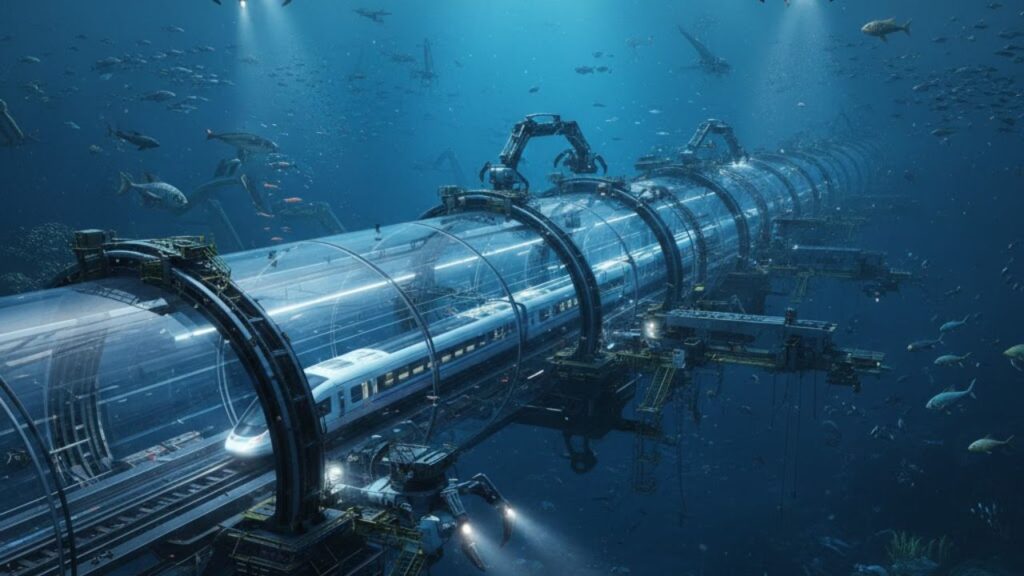
On their screens, a rotating 3D model revealed seabed ridges, drilling heads, and pressure chambers — images that looked like science fiction concept art. Yet this was no fantasy. In that noisy port office, the future didn’t arrive with drama; it simply clicked quietly into place.
An Underwater Rail Line Moves From Idea to Job Site
At a dry dock along a windswept coastline, the future of intercontinental travel looks surprisingly ordinary: a long gray cylinder resting on its side. Workers move along it with welding torches, sparks scattering into shallow puddles. Few would guess this tube will soon be lowered into a seabed trench and locked to the next segment with millimeter-level accuracy. Engineers on site say it plainly: this is no longer a prototype, it’s a functioning supply chain.
Concrete sections arrive by barge, robotic survey vessels scan from above, and deep-sea ROVs crawl along the trench like mechanical creatures. Inside a temporary control room, large screens slowly illuminate the embryonic route between continents, segment by segment, turning an abstract line into something tangible.

- A bay leaf under the pillow: a small nighttime habit once mocked, now linked to better sleep
- From perovskite to fusion: energy breakthroughs expected to leave the lab in 2026
- Starlink mobile coverage: satellite internet reaching phones without new hardware
- Bedroom airflow at night: how open doors may reduce carbon dioxide and deepen sleep
- Discovery of the century: gold bars found more than a kilometer underground
- Kitchen spices in winter: natural ways to deter mice and rats
- The end of the dish rack: space-saving kitchen trends
- Paper shopping lists: seven psychological traits linked to handwritten notes
The Scale, Sensors, and Strategy Behind the Tunnel
The figures behind the project sound almost unreal. The tunnel will extend for dozens of kilometers beneath the sea, in places buried under layers of silt and engineered backfill to protect against anchors and earthquakes. Sensors are embedded everywhere — inside the concrete, along the rails, even within drainage systems — sending constant data to surface control centers.
Engineers call it a “living tunnel”, one that constantly reports, adjusts, and responds. One project manager showed monitoring graphs tracking seabed movement in fractions of a millimeter, while another screen displayed oxygen levels for workers inside maintenance shafts. The aim isn’t just a record-breaking structure, but a deep-sea rail corridor that behaves as calmly and predictably as a metro line, regardless of the ocean outside.
Why Build Beneath the Ocean at All?
Behind the complexity lies a simple logic. Air travel between continents is crowded, costly, and easily disrupted. Shipping is slow and carbon-heavy. Meanwhile, intercontinental data cables already cross the seabed, quietly carrying global communication. This project extends the same idea to physical travel.
Tunnels are safer than bridges, less exposed to storms and geopolitical boundaries. Governments see strategic value in a protected, high-capacity link capable of moving passengers, freight, and even emergency supplies when air routes shut down. Electrified trains on a flat, shielded route also promise significant emissions reductions compared to long-haul flights.
How a Train Line Is Built Under the Sea
The construction method is surprisingly modular. Instead of drilling one endless passage, engineers fabricate enormous tunnel sections in dry docks. Each piece is fully fitted with rails, cables, and safety systems before entering the water. Once ready, floating platforms tow a segment into position, ballast tanks fill, and the structure sinks with GPS-guided precision.

Divers and remotely operated vehicles inspect seals, robots inject grout, and the next section is aligned. Gradually, a continuous tunnel grows along the seabed, much like extending a toy train track across a room. The biggest challenges aren’t equations but small human errors: a misaligned connector, mislabeled cables, or a storm arriving a day early.
The Human Systems Holding It Together
Veterans speak openly about long night shifts, paperwork, and relentless safety drills. Teams rely on checklists, simulations, and a culture where even junior staff can raise concerns. Photos of past mishaps hang on walls, not as blame, but as reminders that the sea doesn’t forgive arrogance.
On one whiteboard, a simple message was underlined twice: “We’re not fighting the ocean, we’re negotiating with it.” Nearby, a short list welcomed newcomers — learn adjacent roles, ask questions daily, stop work if something feels wrong, and remember that a quiet shift means success. In many ways, this modest checklist forms the project’s real backbone.
Rethinking Distance, Borders, and Risk
When the line becomes fully operational, ideas of distance will shift again. Overnight journeys that once meant cramped flights and jet lag could feel like extended train evenings, complete with dining cars, bunks, and quiet reading time. Cities once considered far away may start to feel like neighbors separated only by time zones.
Debates will follow — over cost, environmental impact, and personal comfort with traveling beneath thousands of tons of water. Some will never step inside such a tunnel. Others will use it as casually as today’s subway. What stands out is how many hopes converge on the same structure: faster trade, greener transport, new tourism, and scientific access.
The tunnel is still being welded, sunk, and aligned — messy, human, and unfinished. Yet with every new segment placed on the seabed, the psychological size of the world shrinks a little more. Even if you never ride it, the knowledge that continents can be quietly stitched together beneath the ocean lingers, especially when you look out at the horizon and wonder what is taking shape just out of sight.

Key Takeaways From the Project
- Deep-sea tunnel underway: Prefabricated segments are actively being assembled on the seabed, proving the concept is already real
- A new continental crossing: Electric trains will travel through a pressurized rail tunnel beneath the ocean
- Safety-first design: Dense sensor networks, redundant systems, and modular construction keep risks comparable to standard rail lines
