
The sandstorm comes suddenly, like a beige wall erasing the horizon. One moment, the sky is a sharp blue; the next, it fades into the dull shade of old paper. In a village near the Tengger Desert, routines change instantly. Doors are shut, laundry is rushed inside, and loose buckets are dragged to safety before the wind claims them. An elderly man, cap bleached by years of sun, peers toward a thin green strip in the distance—something he never saw in his youth. “The trees stop it now,” he murmurs softly.
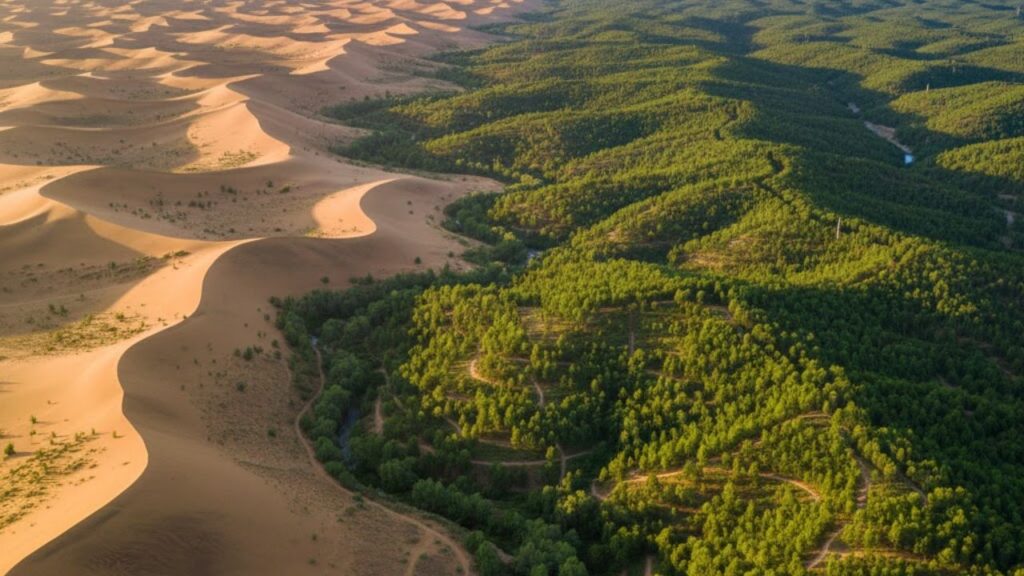
Ten years ago, the desert pressed right up against the village. Today, it lies several kilometers away. Many locals believe one thing made the difference: the forest.
How a Nation Chose to Push Back the Desert
From above, satellite images reveal northern China as a place where the desert’s advance seems paused. Rolling dunes collide with vast, man-made green belts that cut through the sand like deliberate scars. On the ground, these lines are made of poplars, pines, shrubs, and resilient grasses, planted painstakingly by hand since the late 1970s, with major expansion during the 1990s.
The objective is straightforward: prevent the Gobi and other deserts from spreading east toward major cities like Beijing. Once, desertification swallowed farms, roads, and entire communities. The tree belts represent a firm response—an attempt to draw a line and hold it.

The Scale Behind China’s Green Barrier
The figures involved sound almost impossible. As part of the “Great Green Wall,” officially known as the Three-North Shelterbelt Program, China has planted well over a billion trees. Entire provinces have turned planting into a seasonal mission, sending students, soldiers, office staff, and farmers out year after year to place young saplings into dry, unforgiving soil.
In regions such as Inner Mongolia and Ningxia, satellite data now indicate that desert expansion has slowed or even reversed since the early 2000s. Areas once written off as barren now support scattered but persistent greenery. Farmers who used to watch their topsoil blow away are cautiously harvesting again, always mindful of the wind.
Why Trees Change the Landscape
The reasoning is simple but complex in practice. Trees and shrubs anchor loose soil, their roots gripping the sand while branches weaken the force of the wind. Over time, small pockets of moisture form, organic matter builds up, and new plants gain a foothold. These restored ecosystems help reduce dust storms that once darkened Beijing’s skies and disrupted life across northern China.
Yet results are uneven. Not every tree survives. Not every green patch becomes a true forest. Some early efforts failed outright. Still, people return to the dunes year after year, carrying seedlings and patience, trying again on land shaped mostly by wind.
The Quiet, Technical Work Behind Mass Planting
Popular images show neat rows of trees advancing into the desert. Reality looks far less orderly. On-site, plantings are irregular and fragile. Technicians arrive months in advance, testing soil moisture, measuring groundwater depth, and marking layouts with simple wooden stakes. Trenches are dug just deep enough to protect roots and capture rare rainfall.
Rather than filling every space with trees, workers design layered systems: shrubs in front to break the wind, taller trees behind, and grasses scattered between. The goal is not a solid wall, but a living net that slows the desert’s movement.

Learning From Early Mistakes
In the beginning, the desert was treated like empty farmland that only needed trees. Fast-growing, water-hungry species were planted in areas with minimal rainfall. Many of these plantations failed, leaving behind sun-bleached stands locals came to call ghost forests.
Today’s strategy is more cautious. Forestry teams work with herders who understand where snow lasts longest and which plants endure severe drought. They plant fewer trees, favor native or drought-resistant species, and accept low survival rates at first. Progress now comes through trial, error, and adjustment.
More Than Just Trees
Experience has shown that trees alone are not enough. Grassland restoration, managed grazing, and selective fencing play equally important roles. Near the Kubuqi Desert, a local technician explained the shift simply: “We stopped fighting the desert and started learning how to live beside it.”
Over time, a few guiding principles have emerged:
- Plant fewer trees, but match them carefully to the local climate.
- Mix species—trees, shrubs, and grasses work better together.
- Protect young plants from grazing during their most vulnerable years.
- Rely on local knowledge from farmers and herders.
- Plan in decades, not seasons, because restoration is slow by nature.
What the Great Green Wall Ultimately Suggests
Standing in a forest that once was sand creates a strange feeling. The soil remains dusty, the trees are young, yet the air feels different. Birdsong replaces constant wind. Tractors rest in the shade of poplars, and children ride bicycles where earlier generations walked with heads bowed against blowing dust.
The boundary between barren land and recovering land is thinner than maps suggest.
China’s billion-tree effort does not solve the climate crisis or undo decades of environmental strain. Critics point to monocultures, water stress, and communities that were overlooked early on—and those concerns remain valid. Still, the sheer scale of the project raises an important question: what becomes possible when a country commits to changing its land not just on paper, but with sustained physical effort?
For those far from the Gobi, the lesson may not be about copying this model or planting trees everywhere. It may be about recognizing that degraded land is not finished land, and that long-term policy paired with everyday action can slowly redirect the future, one small adjustment at a time.

Key Takeaways
- Desert expansion can slow: China’s green belts have reduced desert spread in several regions, showing that large-scale damage is not always permanent.
- Choosing the right species matters: Shifting from single-species planting to mixed, drought-tolerant vegetation improves survival and stability.
- People on the ground matter most: Local farmers and herders now guide decisions, proving that policy works best when paired with lived experience.
