
The fish exploded through the surface like a slow-motion collision. One moment, the Atlantic off Cape Cod lay flat and grey. The next, a vast blue shadow rolled beneath the boat, flashed metallic silver, and froze every deckhand mid-sentence. Even the ocean seemed to hesitate as the tuna’s dorsal fin sliced the water like a honed blade.
No one spoke at first. You don’t usually lower your voice at sea, yet breaking that moment felt almost wrong. How often do you watch hundreds of kilos of muscle and ocean history glide past your boots?
A fight that rewrote the data sheets
The tuna did not surrender easily. When it struck the baited research line, the rod snapped downward so violently a biologist nearly lost his balance on the slick deck. The fish tore away in a silver arc, line screaming, the reel burning to the touch. For forty drawn-out minutes, the crew worked in focused silence, trading the rod, adjusting drag, tracking the fish as it sounded and resurfaced like a submarine.

When the bluefin finally came alongside, its scale was undeniable. Shoulders thick as a racehorse’s. Eyes the size of ping-pong balls. A body nearly as long as some of the crew were tall. More than one person thought the same thing: this fish could change the numbers.

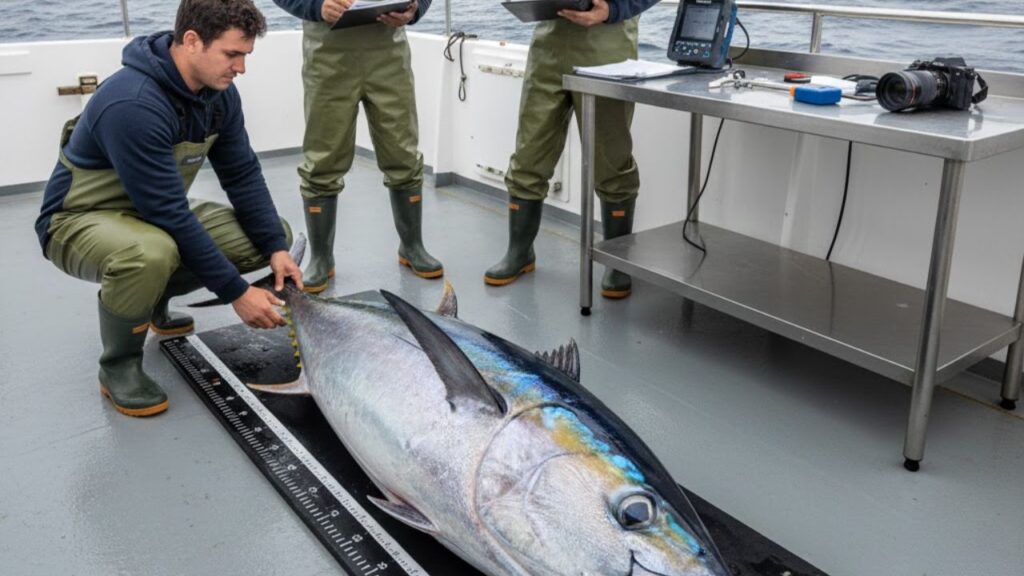
They did not haul it onto the blood-slick deck like a prize. This was not that kind of vessel. Instead, the team eased a soft cradle into the water, guiding the tuna gently alongside and keeping fresh seawater flowing over its gills. A scientist in chest waders leaned out with a measuring board that looked more like a surfboard marked in centimeters.
Everything on deck revolved around a single purpose: measure, tag, document, release. A waterproof scale ran through a sling. Tape stretched from snout to tail fork. Girth was taken at the widest point. Each number was spoken aloud, checked twice, and written into a salt-stained notebook with the care of a courtroom record. This was not a sea story for a bar. It was data destined for a peer-reviewed database.
That precision exists for a reason. Giant bluefin tuna are not merely large fish; they are climate signals, economic drivers, and endangered icons rolled into one powerful body. If their story is going to guide quotas, management plans, and conservation law, the data cannot wobble. Protocols must be followed so other scientists can test, challenge, and trust the results.
Length and weight are not bragging points. They help estimate age, health, migration routes, and how quickly populations are recovering from decades of overfishing. Get them wrong, and the models built on those figures tilt the wrong way. A single careless measurement can ripple through policy for years.
- According to psychology, people raised by strict parents often develop these habits later in life
- Neither seeds nor cuttings are needed as this simple trick reliably multiplies rosemary every single time
- Neither vinegar nor soap: the simple trick to remove limescale from an electric kettle
- A state pension cut has now been officially approved, reducing monthly payments by £140 from February and affecting thousands of retirees
- People who lend money to friends or family often don’t realise they may be quietly damaging the relationship for good
- A discovery called the find of the century reveals gold bars buried more than a kilometre underground, all tied to a single nation
- Ten phrases deeply unhappy people often use in everyday conversations
- According to psychology, overly nice people have often lived through the same experience
How scientists measure a giant that doesn’t know its name
On a rolling deck, the process felt almost ceremonial. First, the fight was timed to avoid exhausting the fish into collapse. Once alongside, the captain nudged the boat into a slow forward gear, forcing clean water through the tuna’s open mouth and across its gills. A researcher balanced on the gunwale, gripping a floating measuring board lined with waterproof metric marks.
The alignment had to be exact. Snout pressed to the zero stop. Body straight. Tail fork held steady. A bright yellow tag carrying a unique ID slid beneath the skin near the dorsal fin. Someone called out the length—straight fork length, the standard for bluefin research. Another confirmed it. A third recorded it, alongside GPS coordinates, sea-surface temperature, and the precise time. Only then did they lift the sling briefly to capture the weight, arms trembling under the load.

On land, most of us rush measurements. We guess. We round. At sea with a giant tuna, there is no rounding. The scientists work with the seriousness of a surgeon, but with wind, waves, and a living, thrashing subject that did not ask for the appointment. They know fatigue is risky for both crew safety and fish survival.
Tasks are deliberately separated. One person measures. Another times. Another records. No heroic multitasking. Errors creep in when someone tries to do everything. Laminated checklists, taped near the rail, guide each step—every action bolded, every box waiting for a wet pencil mark. That unassuming sheet of plastic may be the most powerful conservation tool on board.
The lead biologist, sunburnt and backed by three decades of data, said something that lingered. Bracing herself against the rail as the tuna quivered beneath her hands, she explained:
“Fishermen ask how big it was. Politicians ask how many are left. To answer either honestly, we have to measure this fish the same way people will still be measuring them twenty years from now.”
She nodded toward the weather-stained folder holding their protocols, marked with salt and coffee.
Field rules that turn adrenaline into science
- Use identical tape types with the same start point at the snout and end point at the tail fork
- Record length before weight; length matters most for long-term comparison
- Repeat measurements if uncertain and never correct entries later
- Log tag ID, time, and GPS with the same care as the numbers themselves
- Release quickly once data are confirmed; survival outweighs extra photos
Those simple lines transform a charged moment into usable, trustworthy science.
The quiet influence of one carefully measured giant
When the sling finally loosened, the tuna slipped free and vanished into deep green water. There was no dramatic splash, just a shadow fading away. Everyone on deck exhaled together. The weight placed it firmly in the giant category, the length among the largest recorded in years, all confirmed through established protocols. Still, the mood remained restrained.
They understood that on paper, this fish would become a single row among thousands. Weight. Length. Date. Latitude. Longitude. Tag ID. A plain table that would bore most readers—unless you realise those rows quietly guide multi-million-dollar fisheries and help answer whether future generations will ever see a wild bluefin.

Why one accurate measurement matters
- Standardised methods: snout-to-fork length, calibrated scales, repeated readings under peer-reviewed rules — builds confidence that “giant” claims are real, not hype
- Data beyond the dock: every measured tuna feeds global scientific databases — shows how one fish can influence quotas, pricing, and ocean health
- Ethical handling: cradle support, constant gill flow, rapid release — proves conservation and research can exist alongside awe and respect
