The first thing people registered was the silence. Birds that had been calling from every branch suddenly fell quiet. On the football field behind the high school, hundreds of heads lifted in unison, cardboard eclipse glasses pressed to uneasy faces. The air cooled, one degree, then another. Somewhere nearby, a car alarm shrieked — and no one bothered to turn around.
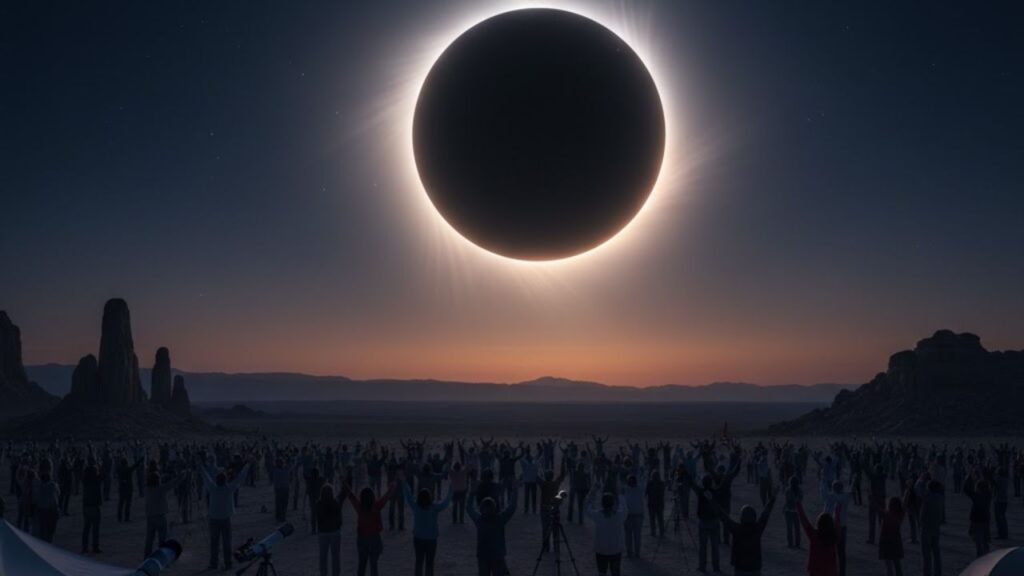
The Sun, usually so predictable, began to fade as if someone were slowly dimming a switch. A teenager beside me murmured, “This feels wrong,” yet he couldn’t look away. A dog whimpered softly and slid beneath a folding chair.
Then it happened. Day faltered, trembled, and quietly gave way to night.

Soon, we will witness that again. Only this time, the darkness will last longer. Much longer.

The Century’s Longest Solar Eclipse Finally Has a Date
Astronomers have officially marked a day when the sky will perform its most dramatic act of the century. A record-length total solar eclipse will cast parts of the Earth into midday darkness, lingering long enough for people to pause, breathe, and fully absorb the moment.
This will not be a fleeting blink. It will be several unbroken minutes where the Sun vanishes, stars appear early, and streetlights glow during lunch hour. It will feel less like a passing event and more like stepping into a surreal daytime dream.
Most total eclipses offer just two or three minutes of full darkness in one location. The well-known 2017 eclipse across the United States lasted around two minutes. In 2024, some areas experienced nearly four. People cried, cheered, or stood frozen in silence.
Now imagine standing beneath the Moon’s shadow not for two minutes or three, but for what scientists are calling the longest totality of the 21st century. A perfect alignment of Sun, Moon, and Earth will create a shadow that glides across the planet with astonishing precision — an alignment that will not repeat for generations.
Why This Eclipse Will Linger
The duration of a total solar eclipse depends on a delicate cosmic balance. The Moon must be near its closest point to Earth so it appears slightly larger. The Earth must be positioned so the Sun looks marginally smaller. And the Moon’s shadow must trace a long path across the planet’s surface.
When those moving parts align just right, the darkness stretches. Astronomers have known for decades that such a moment would arrive this century. Now the calculations are finalized, the models agree, and observatories have synchronized their clocks. The longest shadow of our lifetimes has a fixed appointment.
Where and When to Witness the Extended Darkness
The date is now set. According to long-term eclipse catalogs, the longest total solar eclipse of the century will occur on August 2, 2027. Along its central path, totality will last up to 6 minutes and 23 seconds — an eternity by eclipse standards.
The Moon’s shadow will sweep across North Africa and the Middle East, turning select regions into front-row seats while much of the world watches from afar. Cities such as Luxor, Egypt are already being discussed in astronomy circles as prime viewing locations.
Picture the scene. The Sun high overhead. Heat shimmering off streets. Markets buzzing. Then the light begins to change. Shadows sharpen unnaturally. Colors drain. People lift hastily bought eclipse glasses.

As totality arrives, traffic stalls and rooftops fill. The Sun’s ghostly white corona unfurls around the Moon’s black disc. Venus glows in the darkened sky. For six unreal minutes, an entire city seems to hold its breath. Then, just as the stillness feels familiar, a thin blade of sunlight cuts back through.
The Science Behind the Spectacle
The extraordinary length of the 2027 eclipse comes down to timing and position. The Moon will be relatively close to Earth, appearing larger than usual. At the same time, Earth will be near aphelion, slightly farther from the Sun, making the Sun appear smaller.
On top of that, the eclipse path runs near the equator, where Earth’s rotation subtly stretches the duration for observers below. In select locations, totality will exceed six minutes — a rarity that will not casually repeat within a human lifetime.
How to Experience It Without Missing the Moment
Preparation begins with your eyes. Certified solar viewing glasses meeting ISO 12312-2 standards are essential during every phase except totality. Regular sunglasses offer no protection.
Plan as you would for a once-in-a-lifetime event. Book accommodations early. Study eclipse path maps from trusted observatories. Build flexibility around weather, and identify a backup viewing location in case clouds roll in at the last minute.
The temptation to document everything will be strong. Photos, videos, time-lapses — it’s easy to lose the moment behind a screen. Yet nearly everyone who has seen a total eclipse says the same thing: the most powerful memory is the one you experience directly.
If you bring equipment, test it well in advance. Set your phone to airplane mode. Decide ahead of time how much of totality you’ll spend recording — and how much you’ll spend simply looking up.
During those slow, surreal minutes, the smallest details stand out. The sudden chill. The animals reacting. The rise and fall of human voices. Asking yourself a few simple questions beforehand helps clear space for awe:
- Where exactly will you stand, and how early will you arrive?
- Who do you want beside you when the light disappears?
- What can you leave untouched so you can truly watch?
The more you plan ahead, the more room you leave for wonder.
What This Long Eclipse Reflects About Us
Once the date is set and plans take shape, something shifts. The eclipse becomes more than an astronomical event. It turns into a shared point in time — a quiet question about where we’ll be, who we’ll be with, and how life might look when the sky goes dark.
Ancient cultures wove myths around eclipses, seeing meaning in the sudden loss of light. While we no longer read omens the same way, the feeling is familiar. When the longest eclipse of the century passes overhead, it will silently remind us that we all live beneath the same fragile glow — waiting, together, for the Sun to return.

| Key point | Detail | Value for the reader |
|---|---|---|
| Record-long eclipse | August 2, 2027, totality up to ~6 min 23 s | Know why this date stands out from all other eclipses |
| Best viewing zones | Path crossing North Africa and the Middle East, including parts of Egypt | Decide if traveling is worth it and where to aim |
| Experience over gadgets | Prioritize preparation, safety glasses and presence in the moment | Turn a rare event into a memory that actually lasts |