
You’re doom-scrolling after midnight, eyes heavy, when a familiar thought slips in: what if none of this is real? The soft buzz of the fridge, the glow of your phone, the tiny delay as your thumb swipes. Somewhere between a joke about “escaping the simulation” and a quote credited to Elon Musk, the idea lands again — what if we’re just NPCs in someone else’s game?
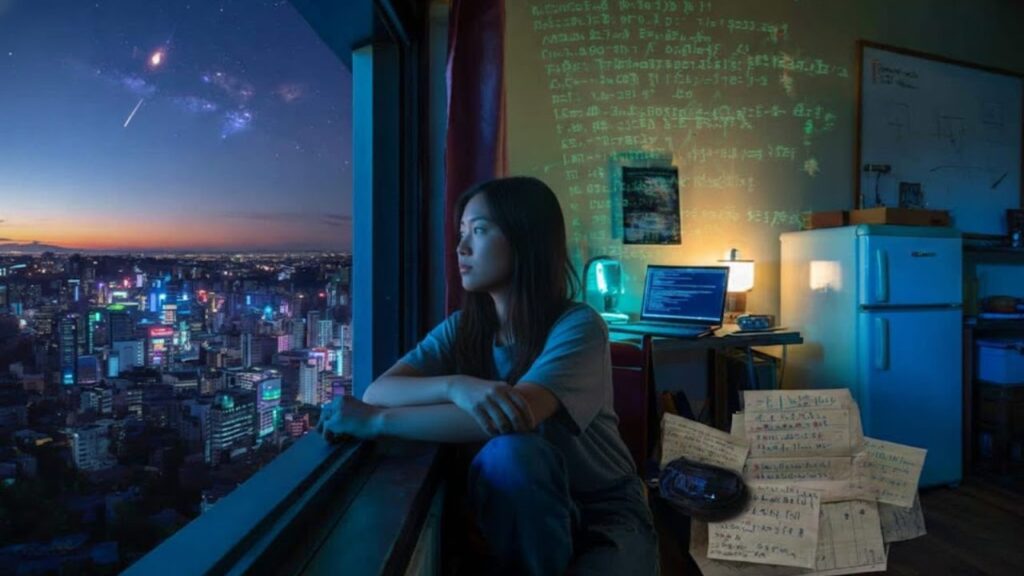
It’s not just internet culture that’s toyed with this. Scientists have explored it too. But recently, mathematicians and physicists have begun pushing back, quietly and methodically. Using equations instead of philosophy, they’re chipping away at the Matrix dream — and what they’re uncovering may be even more unsettling.
Why the Simulation Story Is Losing Its Shine
The modern obsession with simulations exploded when tech leaders voiced what philosophy students had debated for years: maybe reality itself is a program. It was an alluring story. Instead of an indifferent universe, we’d be part of a higher-level project, like characters in a vast cosmic game run by post-human coders.

The idea felt natural in the digital age. We leapt from dial-up internet to hyper-realistic game worlds that trigger real fear at virtual heights. Scaling that up, it seemed plausible to imagine the universe as better graphics, bigger servers, and smarter code.

But another group has been speaking up — people who live inside equations. They’re not dismissing the idea casually. Several research teams argue that a universe like ours may not be fully simulatable at all, regardless of how powerful the computer is supposed to be.
The Math Problem Hidden Inside the Matrix
One major challenge comes from studies of “lattice simulations.” Physicists use these grids to model small pieces of reality, such as quarks inside atoms. Some researchers asked: if our entire universe were built on a similar grid, could we detect its pixels?
They examined ultra-high-energy cosmic rays — particles hitting Earth with staggering force. In a grid-based reality, these rays should reveal directional glitches, like zooming too far into a digital image. No such pattern appeared. The result doesn’t kill the simulation idea outright, but it seriously undermines one of its most popular versions.
When Computation Hits a Wall
Other researchers went further, focusing on raw computational limits. Simulating every particle and interaction in our universe would cause the information requirements to explode. Using quantum information theory, scientists found that any machine capable of perfectly simulating our universe would need to be as large and complex as the universe itself.
At that point, it stops being a shortcut and starts being a duplicate. That’s not a simulation — it’s just another universe.
Even with perfect compression, physics imposes hard caps, like the Bekenstein bound, which limits how much information can exist in a given space. Any “computer outside reality” would still obey those laws, meaning it couldn’t store more data than the universe it’s meant to recreate.
What These New Arguments Really Mean
At the core of recent anti-simulation work is a simple move: follow the information and watch what happens. Complexity theory studies how difficult tasks are for any computer. Once “simulate a universe” is treated as a computational task, strict limits appear.
Some arguments compare our universe to known hard problems in computer science, like simulating arbitrary quantum systems. These problems scale brutally. Doubling the system doesn’t double the cost — it makes it explode. Very quickly, the required resources exceed anything even a hypothetical super-computer could provide.

Attempts to “downscale” reality fail too. Quantum experiments show that tiny fluctuations, rare events, and entanglement all matter. You can’t skip frames or lower resolution without changing outcomes. If our world were a simulation, it would need full quantum fidelity — and the math says that’s too much for any external machine constrained by physics.
Rethinking the Famous Probability Argument
Some mathematicians also challenge the logic behind the popular claim that we’re probably in a simulation. That argument assumes advanced civilizations run endless, richly detailed simulated worlds. New analyses point out that this relies on unrealistic assumptions about infinite resources.
Once real computational costs are included, the odds flip. Fully detailed simulations become vanishingly rare. As one researcher joked at a conference, “Eventually you stop doing simulations and start doing theology with extra steps.” The universe increasingly looks less like code and more like itself.
Living Without the Simulation Comfort
There’s a practical side to abandoning the Matrix idea. For many, the simulation story offered comfort. If life is a game, maybe there’s a watcher, a scoreboard, or a reset button.
A grounding alternative is to turn the question inward. Instead of asking if reality is fake, ask where you’re acting on autopilot. If the universe is fully real, then so are the conversations you’re avoiding and the risks you keep postponing.
Obsessing over simulations can also become a form of existential procrastination. Why commit if you might just be code? But that quiet doubt can sap urgency or feed anxiety. The math-heavy rebuttals gently suggest something sobering: this is the only level there is.
Why Reality Still Feels Uncanny
These arguments don’t solve every mystery. They don’t explain consciousness or why physics is so elegantly mathematical. What they do remove is one layer of wishful thinking.
Without imaginary programmers, we’re left with a universe that behaves in stable, intelligible ways — patterns we can test, predict, and sometimes understand. For some, that’s disappointing. For others, it’s freeing. Reality doesn’t need a hidden server room to be strange.
If there’s no higher engineer patching our bugs, then the glitches we see — social, ecological, psychological — are ours to fix. Not as tasks in someone else’s experiment, but as the open-ended work of beings who are, as far as we can tell, completely real.

Key Takeaways at a Glance
- Mathematical limits on simulations: Complexity theory and information bounds suggest a perfect universe-scale simulation would require resources comparable to the universe itself, grounding the debate beyond science fiction.
- Physical tests for “pixelation”: Searches for grid-like signatures in high-energy cosmic rays have found nothing, showing how the Matrix idea can be tested with real data.
- Psychological impact: Overreliance on simulation stories can fuel apathy or anxiety, while letting them go can refocus attention on lived, tangible reality.
