
The sea had already turned pitch black when the French divers slipped quietly under the surface off North Sulawesi. On deck, the final traces of sunset were fading, while below, their lamps carved narrow beams through the warm Indonesian water. Their guide had warned them with a half-smile, half-serious tone: “Down here, you might meet a ghost from another age.”
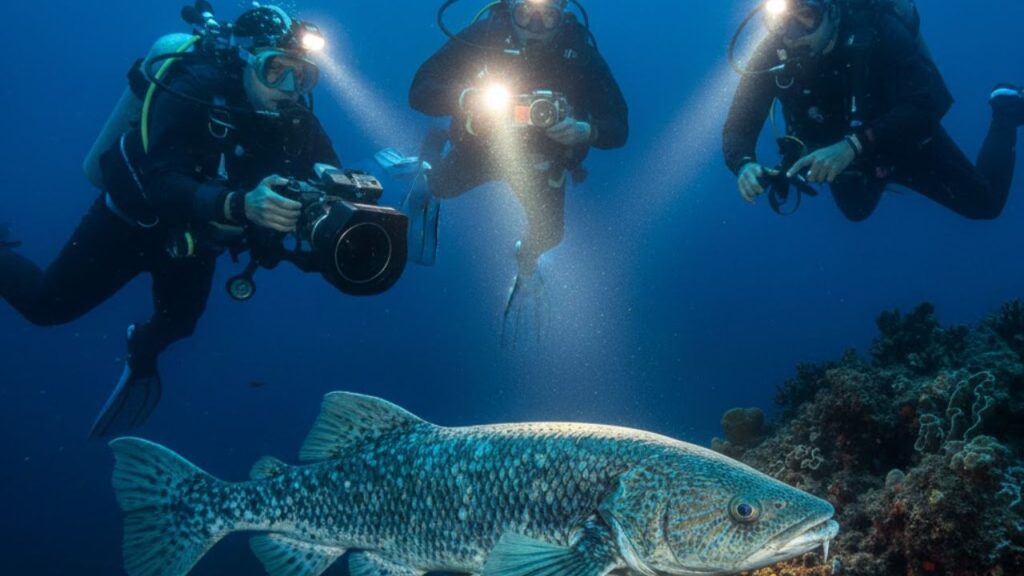
At around twenty meters, the reef wall fell away into a silent blue emptiness. Only the clicking of shrimp, distant crackles, and the hiss of bubbles filled the darkness. Then, at the edge of the light, something shifted. A thick, lobe-finned shape, slate blue and dotted with white, hovered motionless in the current, like a thought that refused to fade.
When French Divers Came Face to Face With a 400-Million-Year Survivor
The group had expected the usual tropical highlights: reef sharks, turtles, colorful nudibranchs. No one truly believed they would encounter the near-mythical creature scientists once thought vanished alongside the dinosaurs. Yet there it was, tucked into a rocky hollow at thirty-five meters: a coelacanth, heavy and calm, resting like a submerged boulder.

Their first reaction wasn’t scientific. It was deeply human. A sharp inhale through the regulator, a shaky hand reaching for the camera, and a quiet inner voice whispering: remember this, you will tell this story forever.

The flash fired. For the first time, French recreational divers had photographed this iconic species in Indonesian waters.
A Creature That Forces Science to Rewrite History
The coelacanth feels almost unreal. First described in 1938 from a specimen off South Africa and later found near the Comoros and Indonesia, it carries eight thick, limb-like fins, a three-lobed tail, and eyes that glow under artificial light. It appears caught between a fish and a creature that nearly stepped onto land.
Biologists call it a “living fossil” because its lineage stretches back over 400 million years, predating birds, flowers, and mammals. Until the twentieth century, it was believed to have disappeared around sixty-five million years ago. Then one surfaced in fishing nets, forcing science to rewrite an entire chapter overnight.
This story has long fascinated divers, especially the French, whose history is closely tied to underwater exploration.
Local Legends That Turned Out to Be True
The French team was on a routine night dive near Manado, where steep underwater cliffs plunge rapidly into deep water. For years, locals had shared rumors of a large blue fish living far below. Most dismissed it as dive-center folklore. Until that night.
Guided by an instructor skilled at spotting pygmy seahorses, they followed the wall, briefly switching off their torches to let their eyes adjust. Slowly, a massive outline emerged, barely moving, its fins rotating like awkward propellers. The emotion wasn’t fear, but a profound, silent shock.
No one truly prepares to meet an animal whose ancestors witnessed Earth’s first forests.
How to Encounter a Living Fossil Without Disturbing It
Seeing a coelacanth is less about luck and more about how you dive. These fish rest in deep caves during the day and rise slightly along steep walls at night. The divers adjusted their behavior: slower descents, minimal noise, longer pauses near drop-offs, and eyes trained on darkness rather than bright coral.
The guide set clear rules. No chasing. No sudden beams in the eyes. Wide lights instead of sharp spots. When they finally spotted the fish, they stayed about five meters away, carefully controlling buoyancy to avoid drifting closer.
Photos were taken with low flash power, short bursts, and long pauses. The goal was simple: witness, not invade.
Calm Decisions That Made the Moment Possible
Many divers dream of checking off rare species like items on a list. That mindset can lead to risky behavior, especially during deep night dives. The French group had discussed this beforehand and agreed on a clear plan.
When the coelacanth appeared, the plan held. No frantic fin kicks. No clouds of sediment. No tank banging. Just hand signals, wide eyes, and a long shared silence. They surfaced later with much of the planned route unfinished, and no one complained.
 Sorry, the Matrix doesn’t exist: new mathematical proofs suggest the universe cannot be a simulation
Why These Photos Matter Beyond the Dive
When the images circulated among Indonesian and French marine scientists, they sparked immediate interest. Coelacanths were already known in the region, but photographs from recreational divers offer rare glimpses of natural behavior. The fish appeared relaxed, resting sideways against the rock, unbothered by human presence.
One marine biologist summarized it perfectly:
“Every coelacanth encounter opens a window into deep time. We don’t just see an animal, we see ecosystems that survived every planetary crisis.”
What This Story Teaches Curious Readers
- Respectful observation matters more than the perfect image.
- Rare encounters often happen when you slow down.
- Local guides protect knowledge no map can show.
- Photos can help science when shared thoughtfully.
- Some moments are more powerful than social media posts.
A Quiet Shift in How We See the Ocean
You don’t need to dive at night to feel the weight of this story. Somewhere between the boat and that dark reef wall, a group of French tourists became witnesses. They returned with grainy images, shaky videos, and a changed perspective.
One diver later admitted that, afterward, clownfish and turtles felt like sketches compared to an original painting. Not because they’re less beautiful, but because the coelacanth carried a quiet authority, as if holding memories older than humanity itself.
Realizing such a creature still survives in waters shaped by fishing, ports, and plastic waste complicates our idea of fragility. The ocean moves at an ancient pace, while modern life races forward.
The coelacanth doesn’t rush. It doesn’t roam vast distances. It simply endures, generation after generation, within the narrow bands of deep reef it knows.
That slowness clashes with the speed of coastal development, warming seas, and pollution. On the same trip, the divers saw both thriving coral gardens and bleached, lifeless zones just bays apart.
No lecture was needed. The message was already there, in the animal’s gaze.
A Shared Responsibility Written Beneath the Surface
For Indonesia, the coelacanth is a scientific treasure and a quiet symbol of responsibility. For France, whose divers inherit the legacy of Cousteau and early exploration, photographing this fish forges a new link between two maritime cultures.
The story now circulates across forums and group chats among underwater photographers planning future trips. Some will try to repeat the experience. Many won’t. And that’s perfectly fine.
The true value of this moment isn’t a rare entry in a logbook. It’s the realization that beneath dive brochures and tourist routes, the planet still hides pockets of deep time that persist whether we notice them or not.
Sometimes, the most modern act is simply pausing long enough to feel how old the world really is.

Key Takeaways From the Encounter
- Living fossil: A 400-million-year lineage once thought extinct, now photographed by French divers in Indonesia.
- Ethical diving: Slow movement, gentle light, distance, and coordination protect sensitive species.
- Shared stewardship: A reminder that divers, scientists, and local communities all shape the future of deep-reef ecosystems.
