
At the salon sink, under that ridiculous paper cape, a woman in her fifties sighs as wet strands cling to her cheeks. “I don’t understand,” she tells the stylist. “Every time I cut it, my hair looks thinner. I thought shorter was supposed to add volume.” The stylist smiles politely, but her eyes say something else: we need to talk about your haircut, not your hair.
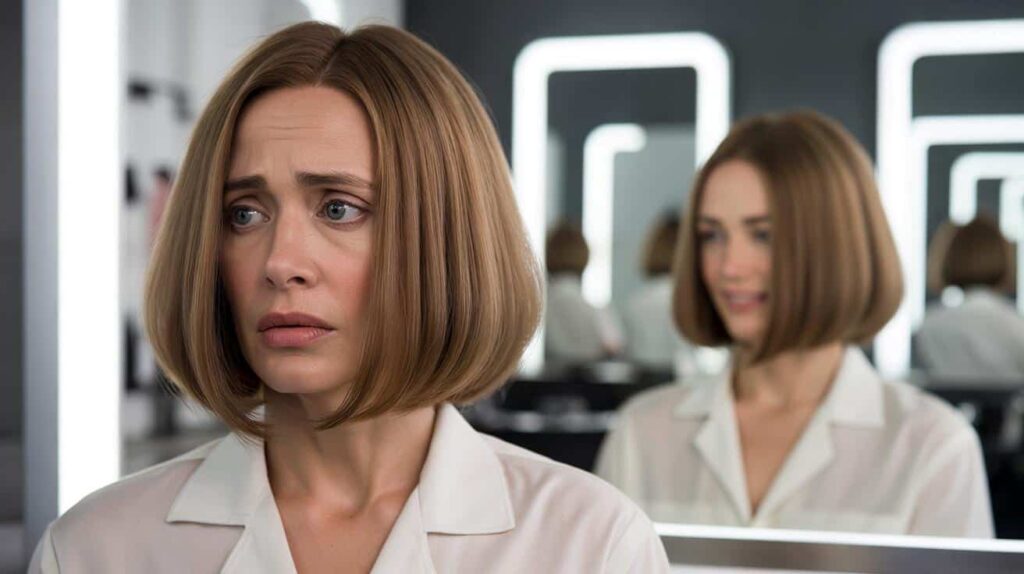
Two chairs down, a younger client leaves with a textured bob that seems to double the density of every strand. The contrast is brutal. Same length more or less. Completely different result. The difference isn’t genetics or magic products. It’s one specific cut choice that quietly steals fullness year after year.
Most of us don’t even realize we’re asking for the one haircut that makes everything look flatter and older.

The sneaky haircut mistake that makes hair look thinner with age
Ask any seasoned stylist what ages hair the fastest and you’ll hear the same answer, said in slightly different ways. The big mistake isn’t “short hair” or “long hair.” It’s clinging to one blunt, one-length cut that hangs straight down with no internal shape. That heavy, ruler-straight perimeter might feel safe, but on hair that’s getting finer, it becomes a curtain that collapses.
When every strand sits at the exact same level, gravity wins. The weight pulls the hair flat to the scalp, especially around the crown and temples. Under bright bathroom lights, that flatness reads as thinning, even if you haven’t actually lost that much density. The eye sees less movement, less air, less lift. It translates the look as: less hair.
Stylists tell the same story over and over. A client turns 40, 45, 50, and says, “Just cut it all one length, like a bob. No layers, no fuss. I want it to feel thicker.” A few weeks later, that client is back complaining that her hair seems limp, separated into skinny strings, and impossible to style. The “safe” cut did the exact opposite of what she hoped.
One London stylist described a woman who insisted on a jaw-length, ultra blunt bob “for volume.” Once dried, every individual strand was suddenly visible, like pencils stacked together. The hair wasn’t thinning dramatically. The cut was simply offering zero support. No graduation at the back. No hidden layers to hold shape. Just a razor-straight line exaggerating every gap.
Here’s what’s really going on. Hair naturally loses diameter with age; each strand becomes a little finer. When hair is cut all one length, those finer ends sit together and reflect light as a flat sheet. Any space between strands shows up immediately. Shorter, internal layers, on the other hand, help hair sit on top of itself. That stacking creates shadows, texture, lift.
A blunt, single-length cut can work beautifully on very thick, dense hair. On average or aging hair, it often turns into a visual highlighter for every area where density has changed. The cut isn’t neutral. It’s a magnifying glass. You didn’t imagine it: that “simple, straight bob” really can make hair look thinner overnight.
What stylists wish everyone with aging hair would try instead
Stylists don’t secretly want to give everyone choppy, high-maintenance layers. What they want is some kind of built-in architecture that supports the hair where it needs it most. The alternative to that one-length, thinning look is usually a softly layered shape with *invisible structure* rather than obvious steps.

That might mean a subtle graduation at the nape so the hair doesn’t cling to the neck. It might be “internal layering,” where tiny, shorter pieces are cut hidden inside the haircut to push the top layer up. It could even be a slightly rounded outline at the front, so the eye is drawn to movement around the face instead of flatness at the crown.
Plenty of women walk in saying, “No layers, they make my hair look thin,” because of some traumatic shag cut from the early 2000s. Their fear is valid. But modern layering for fine or aging hair is almost invisible. Good stylists will point to those micro pieces at the crown or behind the ear and say, “These are here to hold everything up, not to show.”
We’ve all been there, that moment when a hair disaster from ten years ago still dictates what we ask for in the chair. The result: we default to the one-length “safety” cut that quietly steals lift. The clients who see real change are usually the ones willing to add just a hint of shape, even if that’s only a gentle face frame or tiny crown layers.
“Think of hair like fabric,” explains New York stylist Carla M. “If a dress is cut as one stiff rectangle, it hangs straight down and shows every line underneath. Add darts and seams, and suddenly the fabric skims the body, creates shape, and looks richer. That’s exactly what subtle layers do for aging hair.”
- Avoid: ultra blunt, all-one-length bobs on fine or thinning hair
- Choose: soft internal layers that you can’t clearly “see” but can feel in the lift
- Ask for: a face-framing shape, not long, heavy front pieces that drag everything down
- Skip: extreme thinning scissors on already fine hair; you end up with wispy ends
- Embrace: rounded, slightly shorter crowns that create a natural “bump” instead of forced teasing
How to talk to your stylist (and your mirror) about thinning hair
There’s a quiet turning point where you stop saying, “My hair is being weird,” and start whispering, “Is it…thinning?” That’s usually when we panic-cut: “Chop it blunt, take off the dead stuff, anything to make it feel thicker.” The more honest move is gentler. Start by bringing photos of hair that looks full, not necessarily young, and point out what you like: the lift at the crown, the softness around the jaw, the absence of stringy ends.
Then name the fear out loud: “I’m worried about my hair looking thinner with this cut.” Good stylists light up when you say that. It gives them permission to suggest small changes: a bit less weight at the front, slightly shorter layers on top, less harsh straightening. Let’s be honest: nobody really does this every single day. So ask for a cut that falls into place with your actual, rushed-morning habits, not your fantasy styling routine.
At home, the mirror conversation matters too. If your hair is shoulder-length, one-length, and you keep noticing those skinny little “tails” at the sides, that’s your sign. You’re not crazy. The shape is dragging everything down. Try observing your hair on day two, slightly lived-in. Does the top collapse while the bottom forms a dense horizontal line at your shoulders? That’s the exact visual effect that reads as thinner: all the weight at the ends, nothing happening at the roots.
A small tweak goes far. Taking the length up by just a couple of centimeters and adding discreet internal layers can redistribute that weight. Suddenly the eye sees volume at cheekbone and jaw level, not just a heavy block at the collarbone. The hair hasn’t magically thickened. The architecture changed, and the story your hair tells in the mirror changes with it.

| Key point | Detail | Value for the reader |
|---|---|---|
| The worst “thinning” mistake | Ultra blunt, one-length cuts on aging or fine hair collapse and highlight gaps | Helps you avoid a popular but misleading “safe” cut that backfires |
| What to ask for instead | Soft, internal layers, gentle graduation, and face-framing pieces with movement | Gives exact language to use with your stylist for fuller-looking hair |
| How to read your own hair | Watch for flat roots, heavy ends, and skinny side pieces as warning signals | Lets you spot when your current cut is aging you and plan your next change |
FAQ:
- Does cutting my hair shorter always make it look thicker?Not always. A short, blunt cut with no layering can actually make fine or aging hair look thinner because it sits flat and exposes every gap in density.
- Are layers bad for thinning hair?Harsh, chunky layers can be, but soft, internal layers that you barely see are often the key to lift and dimension in finer hair.
- Can I keep my hair long if it’s getting thinner?You can, as long as the ends aren’t all one length and dragging down the shape. Light layering and a slightly shorter front can keep long hair from looking stringy.
- What should I tell my stylist if I’m nervous about change?Say you want “minimal, invisible layers for volume, nothing choppy” and agree on how much length you’re comfortable losing before the scissors come out.
- Do products fix a bad cut on thinning hair?They help, but they can’t replace structure. A good cut with subtle shape will always beat styling foam piled onto a flat, one-length haircut.
