Germany has marked a historic moment in modern science as researchers achieved a world first in quantum physics by recreating a Josephson junction using only a laser. This breakthrough blends precision optics with quantum engineering, opening fresh pathways for studying superconducting behavior without traditional materials. By replacing physical junctions with controlled laser light, the German team demonstrated a cleaner, more adaptable method that could influence future quantum technologies. The achievement places Germany firmly at the center of next-generation quantum research while sparking global interest in laser-based quantum systems.
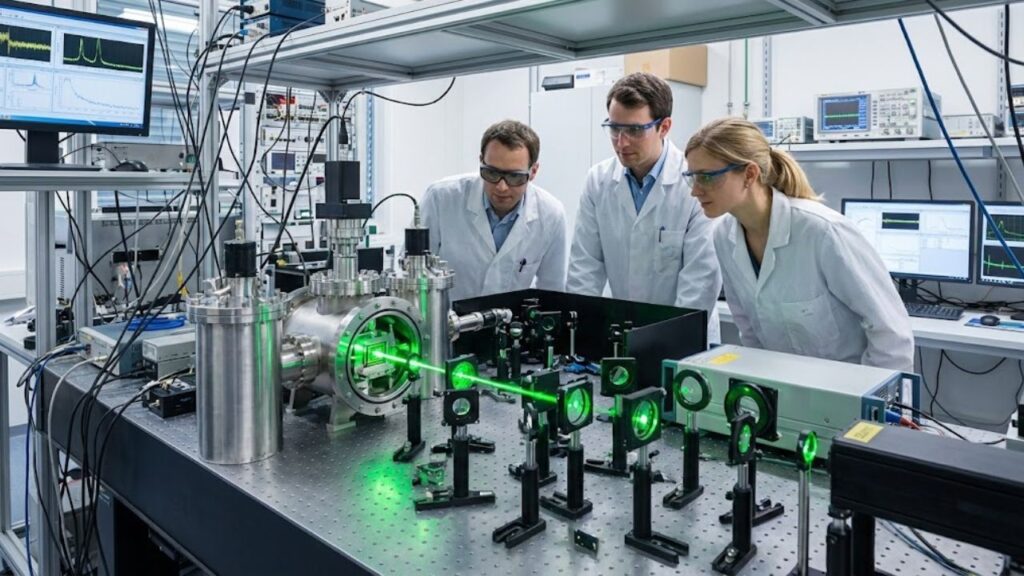
Laser-based Josephson junction breakthrough in quantum physics
The recreated Josephson junction relies on laser light to mimic the behavior usually seen in superconducting materials separated by an insulating barrier. Instead of using solid components, scientists controlled atomic states with extreme precision, allowing particles to tunnel in a predictable way. This method offers unprecedented control over quantum states and reduces material-related noise. Researchers highlighted how laser precision enables cleaner measurements and more flexible setups. The experiment also delivered quantum phase control that is difficult to achieve with conventional junctions, making it a promising platform for testing theories and refining experimental techniques in quantum physics.
How German scientists recreated a Josephson junction with light
The German research team designed an optical system where ultracold atoms respond to carefully tuned laser beams, effectively simulating the junction environment. By adjusting light intensity and phase, they reproduced current-like oscillations central to Josephson physics. This approach offers material-free design, removing defects that often plague solid-state devices. The setup also allows rapid parameter tuning, meaning scientists can explore different regimes in real time. Perhaps most importantly, it provides clean experimental signals, helping researchers observe subtle quantum effects that were previously masked by imperfections.

Why this world first matters for future quantum technology
Recreating a Josephson junction with a laser is more than a laboratory curiosity—it signals new possibilities for quantum devices. Laser-based systems can be scaled or modified without rebuilding hardware, supporting flexible quantum platforms. This could accelerate work on sensors, simulators, and computing elements that depend on coherent quantum behavior. The experiment also strengthens theoretical validation, as models can be tested under near-ideal conditions. With improved experimental reliability, researchers worldwide may adopt similar techniques to explore phenomena that were once considered too delicate to study.

What this achievement signals for quantum research
This German-led breakthrough reflects a broader shift toward using light as a primary tool in quantum engineering. By demonstrating a fully functional, laser-driven Josephson junction, the team showed that complex quantum components can exist without physical structures. This supports next-generation experimentation and encourages international collaboration around optical quantum systems. It also hints at long-term scalability, since lasers can be finely controlled and replicated with relative ease. As interest grows, this achievement may become a reference point for future quantum standards in both academic and applied research.
| Aspect | Traditional Josephson Junction | Laser-Based Junction |
|---|---|---|
| Core Medium | Solid superconductors | Ultracold atoms |
| Control Method | Material fabrication | Laser tuning |
| Noise Levels | Higher material noise | Lower optical noise |
| Experimental Flexibility | Limited | Highly adjustable |
Frequently Asked Questions (FAQs)
1. What is a Josephson junction?
It is a quantum device where particles tunnel between two regions, producing unique superconducting effects.

2. Why use a laser instead of materials?
Lasers allow cleaner control and remove defects caused by physical components.
3. Who achieved this world first?
A German research team successfully recreated the junction using optical methods.
4. How does this impact future technology?
It could lead to more flexible and precise quantum devices for research and applications.