Across quiet European farmland, something is quietly ripping up fields, season after season, with unnerving regularity.
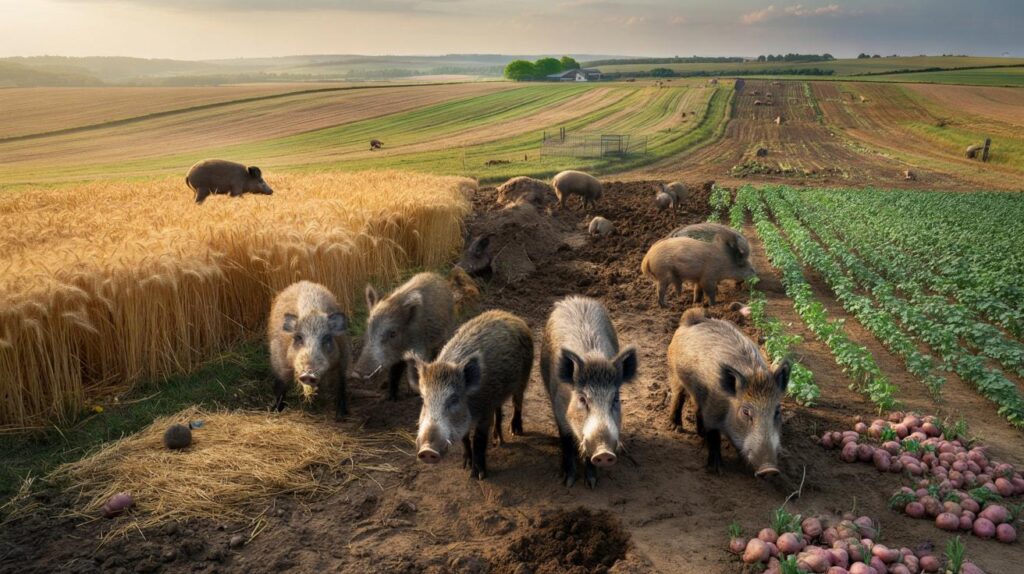
A long-running scientific study has now pulled back the curtain on how wild boar operate in agricultural landscapes. Far from acting at random, these powerful, highly adaptable animals follow a clear seasonal script that hits farmers hardest in the warmest months of the year.
Boar raids follow the farming calendar, not chance
The new research, carried out over more than 20 years on around 5,000 hectares of farmland, analysed 9,871 recorded cases of crop damage caused by wild boar. The landscape barely changed over that time: same types of crops, similar field sizes, and a stable planting and harvesting schedule.

When the countryside stays predictable, wild boar behaviour becomes predictable too – and that makes their raids painfully regular.

Scientists found that boar track the agricultural calendar almost like seasoned farm workers. They move from one type of crop to another as the year progresses, always homing in on whatever offers the richest food for the least effort.
Why summer and autumn are the danger zones
While boar cause damage throughout the year, the research shows a clear peak between summer and late autumn. The timing is not random; it mirrors what is happening in the fields.
Spring: fewer attacks, but often brutal
In spring, boar numbers are relatively low. Many animals are still recovering from winter, and young of the year have not yet fully entered the feeding frenzy.
- They focus on grasslands, pastures and meadows.
- Incidents are less frequent.
- When they do strike, they can devastate large areas in a single night.
With fewer animals competing, groups can concentrate on a patch of land and plough it up with their snouts, searching for roots, bulbs and invertebrates. Farmers may see fewer reports in spring, but the individual losses can be shocking.
Summer: cereals become the main target
Once summer arrives, everything changes. Grain crops ripen, offering a calorie-rich buffet protected only by thin stalks and fences that often fail at night.
Wheat, barley and other cereals become the centre of attention just as the wild boar population swells with new litters.
More animals on the landscape mean:
- More incursions into fields.
- A larger number of affected plots.
- Individual events that can be slightly less intense, but far more frequent.
At this stage, boar may visit several fields in a single week. A single sounder – a family group – can trample and eat through enough grain to wipe out a small farmer’s profit for the season.
Autumn: legumes and roots take the hit
As the year moves into autumn, cereals lose their appeal. Harvesters pass through, leftovers are picked clean, and boar shift their attention yet again.
At the beginning of autumn, legumes such as beans and peas attract hungry animals. Later in the season, root crops take centre stage: think potatoes, beet and other underground stores packed with starch and sugar.
The highest number of damage incidents occurs in early and mid‑autumn, when wild boar numbers and food demands peak together.
Roots are particularly vulnerable because boar are natural diggers. A field that looks fine at sunset can be pitted with craters by dawn, plants uprooted and rows erased as if a plough had passed through at random angles.
Why the pattern repeats every single year
The striking part of the study is not just that this pattern exists, but that it repeats almost identically year after year. The explanation lies in the stability of the agricultural landscape.
Field sizes remain small. Crop types barely change. Farmers stick to familiar rotations and sowing dates. For an intelligent, opportunistic animal like the wild boar, this is an open invitation.
Boar hit the crops that give them the most calories for the least effort, and they do it on roughly the same dates every season.

In spring, when competition between individuals is lower, they can spend more time on a single patch, leading to high-impact raids. As the year continues and litters are born, the landscape fills with more mouths. The pressure spreads. Instead of a few intense attacks, farmers experience a broad wave of smaller but more widespread incidents.
Because the food offer barely changes, the boar have no reason to alter their tactics. The agricultural routine writes the script, and the animals simply follow it.
From reaction to anticipation: what this means for farmers
For decades, many farmers treated wild boar damage as bad luck: a terrible year here, a quiet year there. By charting these raids over two decades, scientists show that the problem is not random at all. That changes how it can be managed.
If the calendar of attacks is predictable, prevention can be targeted, cheaper and more effective.
Timing defences, not just building them
Instead of investing the same amount of protection all year round, the study points towards a smarter approach:
- Reinforce defences around cereal fields in early and mid‑summer.
- Shift effort to legumes in early autumn.
- Protect root crops especially in late autumn, when pressure is highest.
That can mean temporary electric fencing, night patrols during critical weeks, or using deterrent systems such as noise, light or scent barriers. None of these tools is perfect alone, but timing them correctly can greatly cut losses.
Health risks: when crowded boar meet domestic pigs
The study also raises alarm bells beyond economics. Dense groups of boar moving through farmland increase the risk of animal disease spreading, especially in regions with pig farms nearby.
High boar densities in late summer and autumn can act as a bridge for viruses between wild populations and domestic herds.
One of the biggest fears is African swine fever, a viral disease that does not affect humans but can devastate pig herds and trigger trade bans. Boar can carry the virus, shed it in the environment, and approach fences around outdoor pig units.
Health authorities already recommend measures such as:
- Reducing unnecessary contact between boar and domestic pigs.
- Keeping feed and carcass disposal areas secure.
- Organising targeted population control where numbers are high.
Again, the seasonal pattern matters. Knowing when and where boar concentrate allows vets and farmers to tighten biosecurity at the right moment, not months too early or too late.
What “density” and “damage incidence” really mean
Two expressions often used in these studies can feel abstract. In practice, they are very concrete for those on the ground.
“Density” refers to how many boar occupy a given area, usually measured as animals per square kilometre. In reality, this translates into how often you see tracks, droppings or the animals themselves. Higher density almost always means more visits to fields.
“Damage incidence” means the number of separate events recorded, not just their severity. A region might see dozens of small incursions or a handful of dramatic ones. Both patterns hurt, but they require different types of response: broad surveillance for scattered incidents, intense protection where heavy raids repeat.
Imagining the next harvest: a realistic scenario
Picture a mixed farming district with cereals, beans and potato fields. In May, a couple of meadows show torn turf, and one farmer shrugs it off as “just boar being boar”. In July, grain stands tall and golden. Camera traps begin to capture family groups slipping through hedges at night.
By late August, damaged cereal ears and flattened patches prompt insurance claims. A month later, boar are raiding bean fields, then digging into potatoes. Without planning, each farmer faces the problem alone. With the seasonal pattern in mind, they could have pooled resources, rotated patrols and installed temporary fences only during the one or two months when their crops were most attractive.
This is the quiet revolution that the long-term data supports: not more panic, but better timing, grounded in a clear understanding of how wild boar match their feeding routes to the agricultural year.