
On a frozen January night in a quiet European suburb, a father wrapped his scarf a little tighter and told his daughter, “This cold means winter is finally back.”
The streetlights glowed in the fog, breath hanging in the air like small ghosts. The kind of scene that feels steady, familiar, almost comforting.
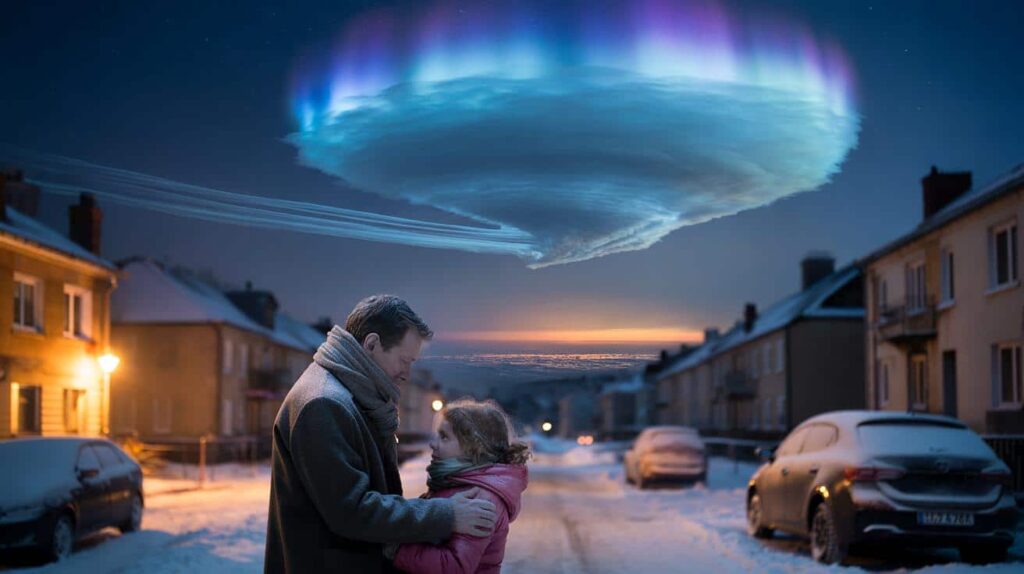
What he didn’t know is that thousands of kilometers away, high above the North Pole, the atmosphere was starting to twist out of shape.
Weather balloons, satellites, and silent algorithms were picking up a pattern that seasoned meteorologists instantly recognized — and this time, the numbers looked wrong.
Far above that peaceful street, the Arctic’s icy order was wobbling.
And some scientists think early February could bring a collapse unlike anything they’ve ever tried to forecast.

The Arctic engine is stuttering — and it’s messing with our sense of “normal”
You can picture the polar vortex as a giant spinning top of freezing air, locked over the Arctic like a lid on a pot.
Most winters, it wobbles a bit, then holds. The jet stream — that fast river of air guiding storms — loops around it, following patterns forecasters know almost by heart.

This year, that top is tilting in a strange, jagged way.
Meteorologists watching the stratosphere say the vortex is stretching, tearing, and may completely split in early February.
That’s not just science-speak.
When the Arctic’s “lid” comes undone, cold air does not politely stay put.
It spills.
Back in 2021, a similar disruption sent Arctic air plunging into Texas.
Pipes burst, power grids failed, families melted snow in pots to flush toilets.
Now, several major models — the same ones airlines, energy traders, and governments rely on — are flashing new red flags.
They suggest that in early February, the polar vortex could weaken so suddenly that the usual forecast rules stop working for a while.
One European meteorologist described the latest ensemble runs to me as “like watching a train switch tracks in slow motion, and not knowing where the new rail line even goes.”
The numbers disagree, the timelines shift, and the spread of possible scenarios widens day by day.
For people on the ground, that simply means this: the weather might stop behaving like the weather you know.
Under normal conditions, scientists lean on patterns.
They stare at decades of data: when the Arctic warms up here, cold tends to drop there, storms usually form over this corridor, and so on.
During an Arctic collapse, those patterns warp.
Cold can lunge deep into parts of North America or Europe while the Arctic itself turns bizarrely mild.
This time, the twist is sharper because the background climate is warmer.
Sea ice is thinner, ocean heat is higher, and feedback loops are speeding things up.
*The old equations were never designed for an Arctic that’s changing this fast.*
That’s why some long-range forecasts for February suddenly flipped from “mild and rainy” to “potential severe cold and snow” in a single update.
The map, for a brief stretch, is no longer reliable.
How to live with a sky that keeps changing its mind
So what do you do when the experts start saying, “Our models are struggling with this”?
You don’t panic. You shrink your time horizon.

Instead of planning weeks ahead based on one dramatic headline, you start working in short, flexible windows.
Look at 3–5 day forecasts from trusted national weather services, not just screenshots on social media.
If you live in a region that’s been flagged for potential extreme cold after the first week of February, think like a camper.
Extra blankets, a backup way to stay warm, batteries for lights, a charged power bank.
None of this needs to be perfect — it just needs to exist before the temperature dives.
We’ve all been there, that moment when you laugh off a warning because last time “nothing really happened.”
That’s the trap with rare events: the ones that miss us make us complacent, right up until one doesn’t.
The meteorologists I spoke with are careful with their tone.
They’re not shouting “apocalypse”; they’re saying “this setup is unusual and our confidence is lower than we’d like.”
Let’s be honest: nobody really does this every single day.
Most of us don’t revisit emergency kits after a quiet winter, we just trust the heating and carry on.
But during an Arctic collapse, small decisions matter.
Checking on older neighbors, parking the car out of ice-fall zones, thawing that bag of rock salt buried in the shed — these aren’t dramatic survival moves.
They’re simple, quiet adjustments to a sky that might surprise you.
“People think of forecasts as promises,” says Dr. Lina Markovic, a climatologist who has tracked polar vortex events for 15 years.
“When the Arctic breaks its usual structure, what we’re really offering is a moving probability. It’s uncomfortable, but that’s the honest answer.”
- Watch the trend, not a single map
Don’t hang everything on one scary chart shared on X or TikTok.
Check how the official outlook changes over several days. A consistent shift toward colder, stormier conditions is more telling than one viral image. - Keep your “winter basics” within reach
Gloves at the door, an extra layer ready near the bed, a full tank of fuel if you drive.
When polar air dives south, small delays — like realizing you’re out of de-icer at 7 a.m. — quickly turn into big frustrations. - Use local knowledge alongside global warnings
Older relatives, long-time farmers, city workers who deal with streets and pipes year after year — they know how your area behaves in a freeze.
Their practical advice can anchor you when the big-picture science sounds abstract. - Know your weak spots at home
Drafty windows, that one pipe that’s close to an exterior wall, the balcony that turns into a skating rink.
Addressing just one or two of these can cut the risk of expensive damage if February turns wild. - Give yourself permission to adjust plans
Rescheduling a road trip, working from home on a potential ice day, or moving an outdoor event isn’t overreacting.
It’s simply aligning your life with a world where the Arctic doesn’t always play by the old rules.
A broken Arctic, a shaky future, and the stories we’ll tell about this winter
Maybe, a few weeks from now, you’ll look back at these warnings and shrug: the cold snapped, but not as hard as feared.
Or maybe you’ll remember a night when your street turned silent under sudden snow and the sky felt strangely close.
Meteorologists are not oracles; they’re translators of a system that is getting noisier, hotter, more restless.
When they say an “unprecedented Arctic collapse” might break the patterns they rely on, they’re also admitting something deeply human: they’re losing some of the old certainties that guided their craft.
For the rest of us, this winter could be a quiet rehearsal.
A glimpse of what it means to live in a climate that still follows laws of physics, but not the habits we grew up with.
You might start checking the sky a little differently.
Listening more carefully when a forecaster says, “This is not like previous years.”
And maybe, under some February wind that doesn’t feel quite right, you’ll sense that the Arctic — distant, white, and abstract on a map — has stepped a little closer to your front door.

| Key point | Detail | Value for the reader |
|---|---|---|
| Unprecedented Arctic collapse | Polar vortex may weaken or split in early February, disrupting usual weather patterns and long-range forecasts. | Helps readers understand why forecasts feel uncertain and why headlines about “crazy weather” are escalating. |
| Limits of traditional models | Warming Arctic, thinner sea ice, and faster feedbacks make old statistical relationships less reliable during such events. | Builds realistic expectations about what meteorologists can and cannot promise, reducing confusion and mistrust. |
| Practical response | Short planning windows, basic home readiness, and local knowledge become more valuable than rigid long-term plans. | Gives readers concrete, non-dramatic steps to feel safer and more in control during volatile winter spells. |
FAQ:
- What exactly is an “Arctic collapse”?An Arctic collapse usually refers to a major disruption of the polar vortex, the ring of cold air high above the Arctic. When it weakens or splits, frigid air can spill south while the Arctic itself warms, reshuffling typical weather patterns for weeks.
- Does this mean my area will definitely see extreme cold?No. It raises the odds of unusual cold or snow in certain regions, but the exact targets depend on how the jet stream bends afterward. Forecasts can improve just a few days before the main impacts, so local updates matter more than global headlines.
- Is climate change causing these disruptions?Scientists are still debating the details. Many studies link a rapidly warming Arctic and shrinking sea ice to a wobblier jet stream and more frequent polar vortex disturbances, but the strength of that connection is actively researched and not fully settled.
- Why do forecasts keep changing this winter?During a polar vortex disruption, the atmosphere behaves in less predictable ways and long-range models disagree more than usual. As new data comes in, the predicted path of cold air and storms can shift significantly, so updates may look “flip-floppy.”
- What’s the most reasonable thing I can do right now?Follow your national weather service, prepare basic winter supplies, and stay flexible with travel or outdoor plans in early to mid-February. You don’t need to obsess over every model run — just stay calmly informed and ready to adapt.
