
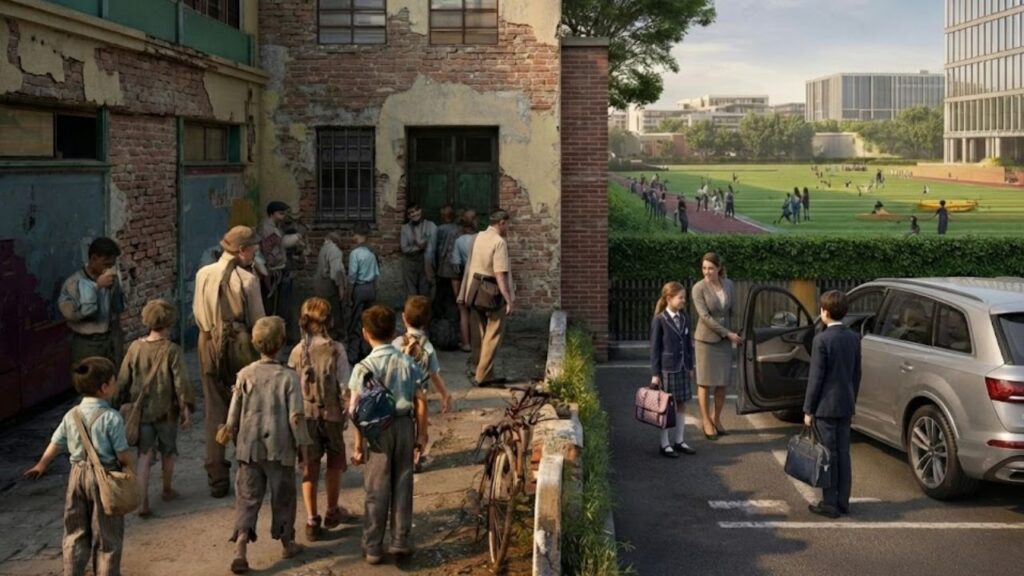
On one sidewalk, children in slightly worn uniforms squeeze past each other, backpacks mended and shared earphones buzzing softly. Across town, beyond high brick walls and perfectly trimmed hedges, other students step out of polished cars in blazers that cost more than some families’ monthly rent. Their schools boast smart boards, language labs, theatres, and rowing clubs. In contrast, many public classrooms make do with a few broken laptops and teachers who have seen no real pay rise for years.
When Education Stops Lifting and Starts Sorting
Walk through any major city on a weekday morning and the class divide is clear at the school gates. Public schools fill with noise and movement—siblings clinging to hands, parents in work uniforms rushing to shifts. Private school entrances feel calmer and more controlled, with fewer children, more cars, and branded sports bags replacing bus passes.
This contrast does not fade after the first bell. Over time, it shapes who leads, decides, and holds power decades later.

The Same Pattern Across Countries
In the United Kingdom, roughly 7% of children attend private schools, yet these institutions produce around half of the country’s top judges, along with a large share of MPs, senior journalists, and CEOs. Similar patterns appear in the United States, Australia, and parts of Africa and Asia. A small, wealthy group repeatedly rises to the top of systems that claim to reward merit.

This is not because their abilities are greater. It is because they began from a different starting line.
How Money Quietly Buys Opportunity
When schools charge thousands—or tens of thousands—each year, everything changes. Classes are smaller. Libraries are stocked. Music rooms hold instruments instead of dust. Teachers are better paid, supported, and more likely to stay. Meanwhile, state schools struggle with overcrowded rooms and frozen budgets.
The outcome is simple: wealth converts into opportunity. It buys attention, alumni networks, and the confidence that comes from always seeing people like you in positions of authority. Call it “choice” if you want, but at scale it becomes a machine that sorts privilege.
From Public Good to Private Inheritance
When education works this way, it stops being a shared foundation. It becomes something passed down, not earned. The walls around schools turn into social borders, deciding futures long before talent has a chance to speak.
What Would Happen If Private Schools Were Phased Out?
The idea of banning private schools often sounds extreme, yet change could begin with a practical step. Governments could require that any schooling leading to recognised qualifications be free at the point of use and publicly funded. Schools preparing students for official exams would operate under the same rules and budgets.
Over time, private institutions would be absorbed into a single, strong public system. The physical and social walls would gradually fall.
The Finnish Example
Finland offers a real-world case. In the 1970s, the country phased out most private schools, merged them into a common public network, and removed fees. Today, Finnish education is known for its low inequality and narrow achievement gaps. Teachers are highly trained, respected, and fairly paid.
No system is flawless, but Finland shows that investing in one shared system can work.
Why the Common Arguments Fall Short
A frequent claim is that private schools reduce pressure on public education. That logic ignores the reality that these schools also pull in top teachers, large sums of money, and political protection. The result is a split system—one for the children of decision-makers and one for everyone else.
When leaders’ children are insulated, urgency to improve public schools fades.

Shared Stakes Create Real Pressure
If all families relied on the same schools, improvement would stop being charity and become self-interest. When parents with influence share the same classrooms as everyone else, pressure for quality rises quickly.
Parents, Fear, and Honest Conversations
Many parents feel torn. They want fairness, but they also want safety, attention, and opportunity for their child. Acknowledging that private schooling is not just a personal choice but a collective social decision is a crucial first step.
Open discussions—online and at school gates—about funding, class sizes, and local schools help bring hidden issues into view.
Looking Beyond the Shine
Glossy brochures rarely show exclusion rates, narrow social circles, or who gets left out. Asking direct questions matters: who is admitted, who is pushed out, and who maintains the building?
Supporting mixed classrooms, fair funding, and strong public teaching conditions does more for children than any logo stitched onto a blazer.
A Future Where Names Don’t Decide Classrooms
Imagine a society where politicians’ children share cafeterias with the children of cleaners. Where future surgeons, drivers, and engineers once sat in the same Maths lesson. Where no family can simply buy smaller classes while others fundraise for basics.
That world requires choices that limit a few privileges and expand opportunity for many.
The Question We Avoid
Banning private schools sounds radical only because opting out of the common good has been normalised. We reject private fire services or streetlights for the wealthy alone. Education is no less essential.
The real question is not whether change is affordable, but how long we accept a system that quietly tells millions of children they were born on the wrong side of the gate.
Why This Debate Matters
You may never see private schools disappear completely. Change is slow. Still, every conversation that frames education as a shared right, every vote for fair funding, and every parent who resists buying advantage stretches what feels possible.
This debate is not just about buildings or fees. It is about whether access to opportunity should depend on a family’s ability to pay.
 This 7,000-year-old stone wall found off the coast of France may be the work of hunter-gatherers
Key Takeaways
- Private schools deepen inequality: They concentrate resources and networks among a wealthy minority, revealing education as a structural issue.
- Integration can work: Countries like Finland show that absorbing private schools into public systems is a political choice, not a fantasy.
- Parents have power: Conversations, voting, and backing public funding can reshape what becomes acceptable.
