
The helicopter circled once over the desert, as if hesitating. Then it dipped its nose toward a patch of sand lined with black SUVs and white thawbs flapping in the heat. On the ground, men in sunglasses stared at a cluster of glossy renderings: a vertical shard of glass, one kilometer high, stabbing the horizon where there was nothing but rock, mirage, and sky. Someone clapped. Someone else raised a phone to catch the angle that would go viral on LinkedIn. A PR woman rehearsed words like “iconic”, “game‑changing”, “limitless potential”.
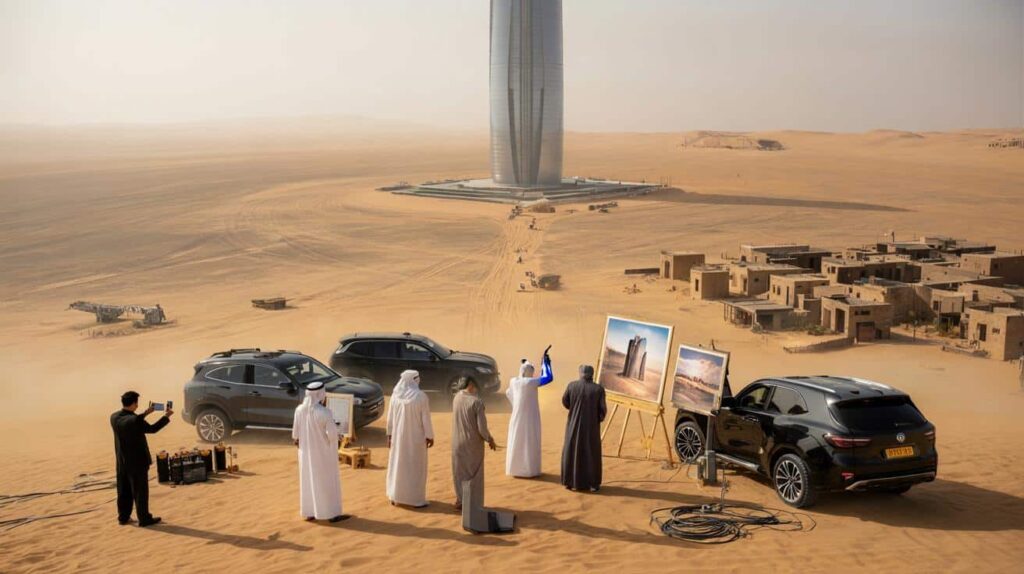
No one seemed to notice the wind pushing dust into the folds of their designer shoes.
This is what progress looks like when common sense has quietly left the room.

A desert monument or a very expensive mirage?
From far away, a 1km tower in the desert sounds almost poetic. A silver needle rising from the dunes, promising jobs, prestige, and a place on every postcard for the next 50 years. The kind of project that gets architects excited and ministers smiling in front of cameras.

Up close, though, the romance fades fast. You picture the pumps that will force water hundreds of meters in the air, the air conditioners fighting 50°C heat, the fleets of trucks hauling materials across scorched ground. You start to hear the hum of generators, not the music of progress.
You also start to smell money burning.
We’ve all been there, that moment when you realize the thing that looks impressive on Instagram makes no sense once you see the bill. A 1km desert tower is that feeling, scaled up to national-budget size. Take the planned Jeddah Tower in Saudi Arabia, which aims to cross the one‑kilometer mark: early cost estimates ran into the tens of billions, before delays, redesigns, and political turbulence.
This isn’t a small skyscraper going a few floors higher. The last meters of height are exponentially more expensive to build, maintain, and cool. Engineers talk about wind loads, foundation depth, elevator logistics, fire safety at 900 meters. Politicians talk about “vision”. The first group is doing math. The second is doing branding.
Guess which calculation usually wins.
There’s a plain truth here: **a kilometer-high tower is not designed for humans first, it’s designed for headlines**. Real cities grow where people already live, work, and move. Real infrastructure follows needs and patterns. A desert tower flips that logic: we build the symbol first, then pray the life will show up later. It’s urbanism as cosplay.
When the goal is to appear in drone shots rather than school textbooks, decisions bend quietly toward spectacle. Energy efficiency is less sexy than “world’s tallest”. Practical transport links lose the PR battle to sky lobbies and glass viewing decks. *The result is an object, not a place – a selfie background more than a city seed.*
And objects age badly when the story around them starts to crack.
What real progress would look like in the same desert
Imagine taking that same budget and that same stubborn ambition, but pointing it sideways instead of straight up. The desert is not empty; it’s brutally honest. It rewards shade, modesty, and clever use of scarce resources. Real progress here sounds boring in press releases, yet it changes far more lives.
You could build shaded, low‑rise districts designed around prevailing winds, not glass trophies. Networks of solar farms feeding micro‑grids, so the air conditioning doesn’t rely on future oil prices. Desalination plants powered by the same sun that bakes construction workers at noon. Walkable streets, not just helicopter pads.
No glossy render will capture the quiet relief of a bus stop that isn’t 48 degrees in the shade.
Look at places that learned the hard way. Dubai’s skyline is spectacular, yet the city has quietly started pushing more modest, climate-adapted policies: district cooling, shaded walkways, smarter building codes. Not because it suddenly fell out of love with height, but because the electricity bills and heat waves began to bite.
In Tunisia and southern Spain, architects are revisiting ancient desert techniques: thick walls, inner courtyards, narrow streets that trap shade. These designs rarely go viral, yet they can cut cooling needs by 50–70%. Now imagine combining that wisdom with modern solar tech, high‑speed fiber, and decent public transport.
You get **a city that works on the worst day of the year, not just in the marketing video**.
The logic isn’t complicated. A 1km tower concentrates risk and resources in one fragile, vertical bet. A network of smaller, well‑designed buildings spreads that risk horizontally, into neighborhoods that can adapt and grow. When water becomes scarcer or temperatures climb, it’s easier to upgrade a block than retrofit a monument.
Let’s be honest: nobody really lives a relaxed daily life at 700 meters above the ground. Elevators become commute bottlenecks. Evacuation plans read like science fiction. Windows have to stay sealed most of the time. The higher you go, the more the city becomes a machine you visit, not a place you inhabit.
Progress isn’t climbing as high as possible. It’s organizing life so people don’t collapse from heat on the way to buy bread.
How to tell vision from vanity when a mega‑project makes headlines
When the next “world’s tallest in the desert” project pops up in your feed, there’s a simple test you can run in your head. Ask one blunt question: what happens here on a Tuesday morning, five years after the inauguration? If your brain goes blank, you’re probably looking at vanity, not vision.
A real city project can describe daily life in boring detail: school runs, bus schedules, water use, rent levels, small shops somehow surviving next to bigger brands. It can show where workers sleep, not just where VIPs land their helicopters. It can explain how the place stays liveable when tourism dips or oil prices crash.
If everything depends on constant hype, the foundation isn’t concrete, it’s pure expectation.
The trap for many of us is emotional. Tall things impress us; they always have. They signal power, competence, control over nature. When a leader promises the biggest tower on Earth, it can feel like a shortcut to pride: finally, our name on the global map. Questioning that promise can look unpatriotic, or simply pessimistic.
That’s why criticism often arrives late, when cracks appear and budgets explode. By then, it’s framed as “unexpected challenges”, not as the predictable result of asking the wrong question at the start. **Was the goal to solve real problems, or to outshine the neighbors?** Both answers may be present, but one usually dominates.
Once you see that, it’s hard to unsee.
“Skyscrapers are not inherently foolish,” an urban planner in Riyadh told me, squinting into the sun. “What’s foolish is pretending they are a development strategy on their own. A tall tower is like a crown. You don’t start a country by building crowns.”
- Who pays the long-term energy and maintenance costs once the cameras leave?
- How does the project handle 50°C heat, water shortages, and grid failures?
- Where will nurses, teachers, cleaners actually live, and how will they get to work?
- What’s the backup plan if tourism or investment dries up for a decade?
- Does the design reuse local knowledge, or pretend the desert is a blank canvas?
A farewell letter to common sense, or a chance to write a different story?
A 1km tower in the desert feels like the last loud stanza of a song we already know by heart. Build higher, shine brighter, ignore the thermostat climbing in the background. Call it “vision 2050” even though the air conditioners struggle in 2026. There’s a strange tenderness in that denial, like watching someone insist on wearing a winter coat in July because it once looked good on them.
Yet the desert doesn’t do nostalgia. It strips away illusions with wind and heat and time. Glass clouds over. Steel weathers. Investors move on to the next big thing. What remains are the quiet basics: water, shade, transport, work that pays the rent. The real test of any “iconic project” is whether it strengthens those basics or drains them.
Maybe the real progress story isn’t a single photo of a record‑breaking spire, but a long, unglamorous series of choices that mean a kid can walk to school at 8 a.m. without feeling like they’re stepping into an oven.

| Key point | Detail | Value for the reader |
|---|---|---|
| Question the height obsession | A kilometer-high tower is built for headlines, not daily life | Helps you see through hype around “world’s tallest” projects |
| Look for Tuesday-morning realism | Real progress describes ordinary routines, not just opening ceremonies | Gives you a simple filter to spot vanity projects |
| Sideways beats upwards | Investing in shade, water, transport and local design pays off longer than mega‑towers | Reframes what genuine urban progress can look like in harsh climates |
FAQ:
- Question 1Is there any practical reason to build a 1km tower in the desert?
- Question 2Are all skyscrapers irrational or wasteful by default?
- Question 3What would a smarter alternative project look like with the same budget?
- Question 4Doesn’t a record‑breaking tower attract investment and tourism?
- Question 5As a citizen or reader, what can I realistically do about such mega‑projects?
