Just after sunrise at Atlanta’s Hartsfield-Jackson Airport, the departure board began turning red. One cancellation appeared, then several more, until entire columns flashed “DELAYED” in bold letters. At Gate B18, a mother distracted her children with airport muffins, while a business traveler across the aisle scrolled through emails with quiet resignation. Answers were scarce — only fragments like “system issues,” “crew time limits,” and “network-wide ripple effects.”
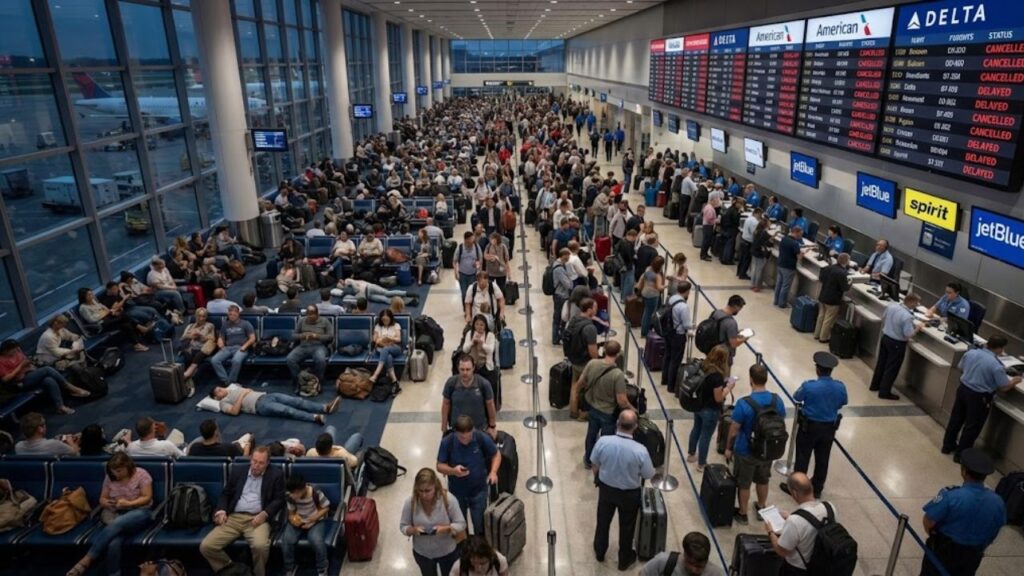
By midday, the scale became clear. Thousands of passengers were stranded, hundreds of flights had vanished, and nearly 5,000 departures sat in limbo.
You could almost feel the country’s air traffic grinding to a halt — from Atlanta to Los Angeles — as if summer travel had been abruptly unplugged.

How a Small Disruption Turned Into a National Crisis
At first, it looked like an unlucky morning affecting only a handful of routes. Then Delta began halting departures from Atlanta. American slowed operations. JetBlue and Spirit pushed boarding times back. One by one, the dominoes fell.

Across the US, around 470 flights were canceled outright, while close to 5,000 were delayed. The numbers felt abstract until you were the one hunting for a power outlet or a spare chair.
What began as a mix of technical failures and staffing strain inside a few airline systems quickly spilled into terminals in New York, Chicago, Dallas, and Los Angeles. Routine layovers turned into overnight ordeals on worn airport carpets.
At Los Angeles International Airport, usually running smoothly by lunchtime, Terminal 5 resembled an emergency shelter. A Delta flight to Atlanta was delayed repeatedly before being canceled when the crew “timed out” under federal rules. Nearby, a young couple quietly cried after realizing they would miss a long-planned wedding.
A JetBlue flight to Boston cycled through delay after delay as gate agents repeated the same apologies. By late afternoon, passengers were trading phone chargers and rumors like currency.
The Real Reasons Behind the Breakdown
The causes weren’t dramatic, just complicated. A combination of technology outages, tight staffing after years of cost-cutting, summer thunderstorms in key corridors, and aircraft stuck in the wrong cities at the wrong times pushed the system past its limits.
When a major hub like Atlanta falters, the entire network feels it. Once crews exceed legal work hours and aircraft miss assigned slots, recovery becomes painfully slow. Airlines can’t summon spare pilots instantly, and thousands of passengers end up paying the price for decisions made months earlier in distant boardrooms.
How Passengers Actually Get Through a Meltdown Day
When the board turns red, the travelers who cope best are usually the ones who act first. The moment your flight status changes, you work multiple channels at once: the airline app, the customer service phone line, and the gate agent. While others wait in line, you’re already searching for alternate routes, nearby airports, or even a train to finish the journey.
- What is a baby squirrel called?
- Banana peels in the garden only work if placed in this exact spot
- Day turns to night as astronomers confirm the longest solar eclipse of the century
- Why storing rosemary and coarse salt together divides cooks
- Why wearing jeans in extreme cold is strongly discouraged
- Restoration experts say this homemade solution revives old wooden furniture
- Astronomers announce the official date of the century’s longest solar eclipse
- 8 phrases deeply selfish people often say without realizing it
One critical step is documentation. Photograph every screen, message, and notice — delay alerts, cancellation codes, rebooking offers. Those screenshots become leverage when negotiating hotel vouchers or a seat on a partner airline once the first wave of chaos subsides.
 Goodbye Hair Dye for Grey Hair: The Conditioner Add-In That Gradually Restores Natural Colour
The biggest mistake during a disruption is passive waiting. Travelers stare at the board for hours, hoping the airline will fix everything, only to discover that all viable alternatives are gone by the time they act.
Most people don’t study ticket fine print or compensation rules in advance. That’s why a small meal voucher for a long delay can feel like an insult when emotions are already frayed.
As one exhausted Delta regular in Atlanta put it while juggling two phones and a fading laptop: “On days like this, you’re basically your own travel agent. The airline helps, but the fastest answers usually come from yourself.”
- Know backup airports: A nearby city plus a rideshare can beat hours of waiting.
- Use direct numbers: Elite or credit card support lines often reach agents faster.
- Ask about partner airlines: Politely request interline rebooking when options run out.
- Document everything: Screens, receipts, and agent names matter later.
- Prioritize rest: A hotel and a shower often help more than arguing longer.
What Mass Cancellations Reveal About US Air Travel
Days like this expose the fragile wiring of modern US air travel. On paper, the system looks optimized — hubs, rotations, and schedules trimmed to the minute. In reality, a single glitch or storm cell can strand travelers thousands of miles away.
Headlines focus on the numbers — about 470 canceled flights and nearly 5,000 delays across major hubs — but the deeper issue is how thin the margins have become. When everything works, the system feels efficient. When it doesn’t, there is very little buffer.
For travelers, the impact goes beyond inconvenience. Weddings, funerals, interviews, and once-in-a-lifetime trips are now planned with a lingering question: “What if the system breaks again?” That emotional cost never appears on a departure board, but it hangs over every terminal.
Some passengers adapt by booking earlier flights, avoiding tight connections, or choosing airlines known for stronger recovery. Others quietly fly less, opting for road trips or trains when possible. These shifts rarely show up in disruption statistics, yet they reflect a subtle loss of confidence.
There is no simple takeaway. Airlines face pressure to cut costs, regulators balance safety and politics, and travelers refresh apps hoping today isn’t their turn. In the space between “boarding soon” and “canceled,” airports become temporary villages where strangers share snacks, watch bags, and trade stories of missed moments and last-minute saves.
Each nationwide disruption chips away at trust — or, depending on how honestly and humanely it’s handled, helps rebuild it.

Key Takeaways for Travelers
- Scale of disruption: Around 470 cancellations and nearly 5,000 delays show how quickly travel plans can be affected.
- Immediate strategy: Use multiple channels, document everything, and request reroutes or partner airlines.
- System fragility: Tight staffing, technology limits, and scheduling pressures mean small issues trigger nationwide ripple effects.