
The ship’s floodlights sliced a thin yellow wound into the Antarctic night. On deck, a handful of exhausted scientists huddled around live sonar images, squinting through fogged-up glasses as the camera sled glided under the sea ice. The water temperature hovered around -1.8°C, the kind of cold that burns before it numbs. Everything outside the hull was supposed to be almost lifeless, a frozen desert of dark water and drifting ice crystals.
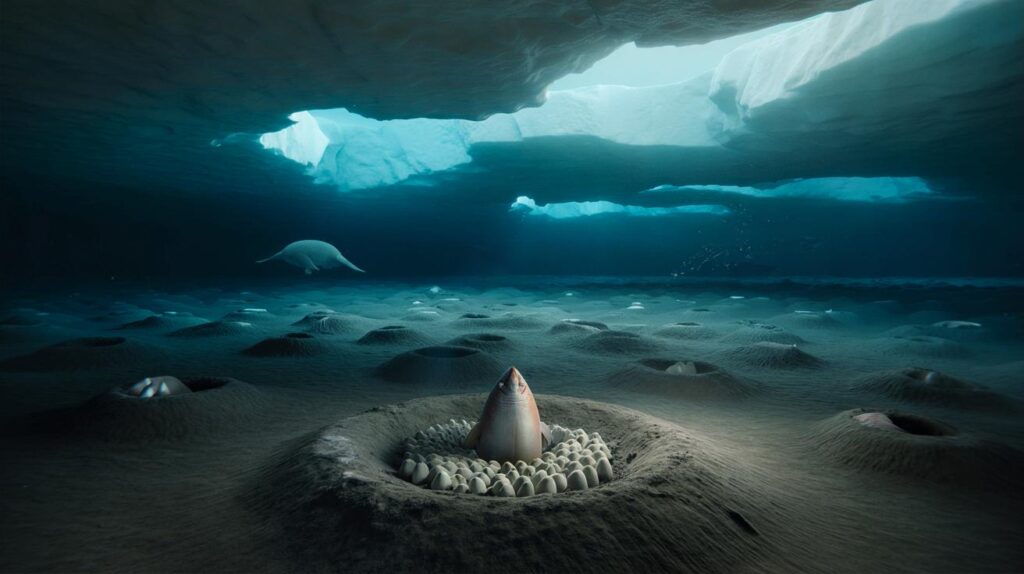
Then the screen began to fill with circles. Perfect, repeating circles on the seafloor, like craters on the moon. One scientist leaned forward, breathing out a soft swear word that fogged the glass. They weren’t rocks. They weren’t shadows.
They were nests. Thousands of them.

A hidden city beneath the ice
At first, the circles looked like a glitch. The research team aboard the German icebreaker Polarstern was just mapping the Weddell Sea floor, dragging a camera sledge called OFOBS under 1–2 meters of sea ice. The live video feed showed flat, cold mud, the kind of landscape that doesn’t ask for attention. Then the first nest appeared on screen: a shallow bowl in the sediment, neatly framed, with a single pale egg-guarding fish in the middle.

The camera drifted on — and there was another nest.
And another.
And another.
By the time the team realized what they were looking at, they had already passed hundreds. The circles kept sliding by like a conveyor belt of life. Back in the control room, someone started counting, someone else started filming. These were Jonah’s icefish — ghostly, big-headed creatures with translucent blood and bodies designed to survive in water that would freeze most animals solid.
The researchers quickly understood they hadn’t stumbled onto a random patch of breeding fish. They were travelling across what amounted to an underwater colony the size of a city. Later calculations would be almost unbelievable: about 60 million nests spread across 240 square kilometers of seafloor. That’s an area roughly the size of a large European city, except every “apartment” held fish parents and eggs.
Once the initial shock wore off, the questions rushed in. Why here? Why so many? Why had nobody seen this before, when Antarctic expeditions have been running for decades? Part of the answer lies in sheer chance: the camera sled route wasn’t designed to chase fish nests. It was a basic mapping line, the scientific equivalent of a casual stroll that accidentally crosses a hidden door.
Another part lies in the harsh logistics of this region. The Weddell Sea is hard to reach, choked with thick sea ice and violent winds, and most ships don’t linger under ice shelves with expensive equipment dangling from a cable. Under that ice, light is scarce and the water is brutally cold, which is exactly what icefish like. They have evolved antifreeze proteins and lost red blood cells, living in a niche that almost nobody else can tolerate. It turns out they weren’t hiding in a corner of the world. They were building a metropolis.
How scientists mapped an underwater metropolis by accident
The secret to the discovery wasn’t a flashy new AI or some billionaire submarine. It was something far simpler: moving slowly and watching carefully. The OFOBS sled, bristling with cameras and sonar, drifted just a few meters above the seafloor at the speed of a relaxed walk. That pace is boring, almost painfully so, when you’re staring at mud for hours. It also gives the eye enough time to see when the pattern changes.
That’s often how science actually works out here. Patience, repeat passes, and people stubborn enough to keep looking at “nothing” until nothing suddenly becomes everything.
When the team realized the scale of what they were seeing, they didn’t pivot into some glamorous, movie-style mission. They did the everyday things that quietly change science. They recorded precise GPS tracks. They stored hours of raw video. They went back and ran the same route again from different angles.
On those re-runs, they started spotting details that had blurred together in the first rush. Some nests were clearly active, with icefish fanning their eggs. Others were abandoned or empty, leaving only a depression in the mud. In a few places, curious Weddell seals drifted into frame — a hint that this enormous nursery might be an equally enormous buffet. The more they looked, the more this stopped feeling like a lucky snapshot and started looking like a whole, functioning ecosystem.
The logic behind such a massive breeding ground is both simple and brutal. Antarctic waters are tough, but they’re stable. Under the right patch of ice, the temperature barely moves, the currents are predictable, and food drifts past in steady, plankton-rich flows. That consistency is gold for a species that needs months for eggs to develop.

By crowding their nests in the same area, icefish likely exploit ideal conditions of oxygen, current, and plankton drift. It also concentrates predators, of course, but nature loves that high-risk, high-reward balance. From an ecological angle, this nursery is more than a curiosity. It’s probably a backbone: a breeding engine that could feed seals, penguins, and whales for huge stretches of the Antarctic food web. Lose the engine and the whole machine starts shaking.
What this discovery quietly changes for the rest of us
You don’t need a PhD or a research vessel to take something very practical from this story. The first is a simple method for understanding any ecosystem — including the ones in your everyday life. Start by looking for the patterns that repeat when nobody is performing for the camera. How does the river near your town change with the season? Which species seem to cluster, which vanish when the water warms or cools?
The icefish nests were found because someone bothered to map “empty” space. The same habit works on a weekend walk, a local beach cleanup, or even your balcony garden. Slow down. Notice where life piles up and where it thins out. That’s how hidden structures reveal themselves.
If you care about the ocean — or honestly just like eating fish — this discovery is also a quiet warning. We’ve all been there, that moment when you hear about some “remote” place and think: that’s far away, that’s someone else’s problem. Yet global fisheries, changing sea ice, and deep-sea mining plans don’t respect that kind of mental border.
Let’s be honest: nobody really reads a 200-page environmental impact report every single day. What you can do is pay more attention to the signals. Where does your seafood come from? Is there certification on the label? Does a new Antarctic “resource opportunity” sound a bit too eager? You won’t get it right every time, and that’s okay. Awareness rarely looks perfect on paper. It looks like messy, human choices made a little more thoughtfully than yesterday.
One of the researchers later described the moment the team understood the scale of what they’d found.
“We were just staring at the screen and someone said, ‘This can’t be right. Run the numbers again.’ We did. The seafloor was basically wall-to-wall nests. At some point, disbelief turns into responsibility.”
- Remember that remote doesn’t mean irrelevant. The Weddell nursery now appears to be one of the largest known fish breeding areas on Earth.
- Support policies that treat the deep ocean as habitat first, resource second.
- Stay curious about “boring” places. Muddy seafloors, empty-looking ice shelves, anonymous stretches of ocean — they’re often where the real surprises live.
- Talk about these finds with kids, friends, colleagues. Stories travel faster than reports.
- If you live far from the sea, your choices still ripple there. From emissions to plastic use, the lines are longer, not weaker.
Life on a planet that keeps surprising us
The Antarctic icefish nursery sits under a slab of sea ice most of us will never see, in a part of the world we only visit by satellite or streaming documentary. Yet once you know it’s there — 60 million nests, parents guarding eggs in slow, cold water — it has a way of haunting your daily life. That supermarket freezer aisle feels slightly different. So does that throwaway opinion that “we’ve already discovered everything important on Earth.”
*We clearly haven’t.*
What’s striking is how the discovery happened: not through chasing the spectacular, but by paying attention to the quiet. A camera moving at walking speed. A research team willing to reconsider what they thought they knew about “empty” seafloor. That mindset scales down to ordinary days. It lives in the way we listen to scientists, vote on ocean protections, teach kids about the poles, or simply notice the small, stubborn lives that keep going in hard places.
Maybe the most unsettling part is also the most hopeful: if something this vast could stay hidden until now, what else is still out there, working silently in our favor?
 Psychology reveals why your mood shifts after certain interactions without obvious reasons
| Key point | Detail | Value for the reader |
|---|---|---|
| Scale of discovery | ~60 million icefish nests over ~240 km² of Antarctic seafloor | Grasp how much of Earth’s life remains unseen, shifting your sense of the “known” world |
| Why it matters | Massive nursery likely supports seals and other predators, acting as a key food-web engine | Connects a remote discovery to everyday issues like food security and ocean health |
| What you can do | Stay curious, follow polar science, support ocean protections, choose seafood more thoughtfully | Turns distant research into concrete, personal levers for action |
FAQ:
- Question 1How many fish nests were actually found under the Antarctic ice?
- Answer 1Researchers estimate around 60 million active and inactive nests, spread across an area of roughly 240 square kilometers in the Weddell Sea.
- Question 2What kind of fish built these nests?
- Answer 2The nests belong mainly to Jonah’s icefish (Neopagetopsis ionah), a species adapted to near-freezing water with antifreeze proteins and almost transparent blood.
- Question 3Why wasn’t this giant nursery discovered earlier?
- Answer 3The Weddell Sea is hard to access, covered by thick sea ice, and rarely surveyed with slow, low-flying camera sleds over large areas. The discovery was essentially a lucky overlap of route and careful observation.
- Question 4Does this change how we see Antarctic conservation?
- Answer 4Yes. The sheer size and ecological role of this nursery strengthen arguments for creating or expanding marine protected areas in the Southern Ocean, especially before fishing or mining interests move in.
- Question 5How does this affect people who live far from the poles?
- Answer 5Polar ecosystems help regulate global climate and fish stocks. Discoveries like this reveal hidden “engines” that keep the broader ocean working, which ultimately affects weather, food chains, and economies worldwide.
