
Her mother stands behind her, a brush in one hand and a hair band in the other, already apologising: “Just one second, I promise.” The girl flinches before the brush even reaches her hair. This isn’t drama. It’s her nervous system sounding the alarm.
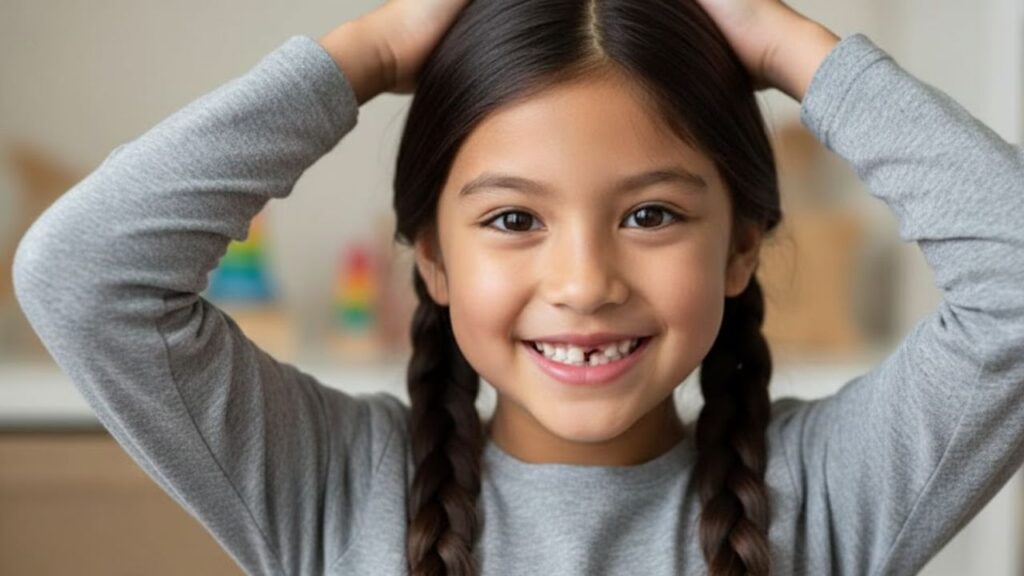
A single strand slips across her cheek, and she swats it away again and again. She wants her hair long, but she also needs it far from her face. With one hand, her mother scrolls through hairstyle tutorials—tight ponytails and glossy braids that look effortless online and feel unbearable in real life.
Then there’s a pause. A breath. The mother tries something gentler. The braid looks almost ordinary. The response is anything but.
 Never Cut a Child’s Bangs While Hair Is Wet - The “Shrinkage” Effect Can Make Them Way Too Short
Why “Simple” Hair Can Feel So Hard
In many households, mornings don’t unravel at breakfast or shoes. They fall apart at the hairbrush. One careful stroke can feel like sandpaper. A standard ponytail can feel like a clamp. For children with sensory processing difficulties, hair touching the face can be just as overwhelming as tight pulling at the scalp.

Parents are often blamed for “allowing” kids to reject hairstyles. What looks like stubbornness is usually self-protection. A loose strand on the forehead can derail focus for the entire day. A tight elastic at the crown can make sitting still or reading impossible. Hair stops being about appearance and becomes a constant negotiation with the nervous system.
On rough mornings, everyone loses. The child cries. The parent gives up. Hair stays down, the fringe creeps forward, teachers ask for “neater hair”, and the cycle returns the next day with a little more tension.
Small Breakthroughs That Make a Big Difference
In a small Facebook group for parents of autistic and sensory-sensitive children, one mother shared a photo of her daughter’s hair. It wasn’t a sleek bun or a tight braid, but a soft, wide plait resting gently along the sides of her head. “This is the first hairstyle she’s kept all day,” the caption said. The comments focused less on how it looked and more on how calm her daughter appeared.
Another parent described how her son, who hates hairbands, grew his hair long. Sports were a struggle. The usual solution—a high, tight ponytail—lasted minutes before he tore it out. A therapist suggested a loose, anchored side braid that kept hair off his face without the pulled-back sensation. He wore it through an entire soccer match. No meltdown. No clutching his head.
There’s no major clinical study on braids for sensory-sensitive kids. What exists instead are kitchen-table experiments, school-run observations, and those small morning wins that feel enormous before 8 a.m. Over time, a pattern emerges in the stories of what finally works.
Understanding Sensory Sensitivity and Hair
Sensory processing differences can cause the brain to register touch as louder, sharper, and more intense than usual. Hair is especially challenging because it’s light and constant. A strand near the eye can feel like a dripping tap in a silent room. A tight elastic at the roots can feel like constant pressure.
Nothing looks “wrong” from the outside. Internally, everything is turned up. Traditional tight braids rely on tension along the hairline—perfect for performances, but overwhelming for a hypersensitive child. What helps most is the opposite approach: minimal scalp tension with gentle anchoring along the sides.
Instead of sharp pulling, the goal is wide, low-pressure contact. Hair stays out of the face not because it’s yanked back, but because it’s softly guided into place.
The Gentle Anchor Braid That Actually Works
Hair professionals may call it a loose French or Dutch headband braid. Parents often refer to it as “the soft side braid that works.” The idea is straightforward: a braid that travels from one temple to the other, sitting low and loose, forming a natural barrier that keeps hair from falling forward.

Begin with clean, dry, or slightly damp hair. Take a wide section near one temple and divide it into three strands. Start braiding, but keep your hands a few centimetres away from the scalp. As you cross each strand, add only a small amount of hair from above the braid, not from underneath near the neck.
This allows the braid to sit like a cushioned band, not a tight rope pressed against the head. Once you reach the opposite side, secure it gently behind the ear with a soft, snag-free elastic.
Then comes the key step. Lightly pinch and pull the edges of the braid to widen and flatten it. The broader it becomes, the less it feels like a cord and the more it functions as a gentle anchor that keeps the fringe and front layers away from the face.
Making the Process Easier for Sensitive Kids
For many children, the struggle isn’t the finished hairstyle but the process itself. Small adjustments can change everything. Use a wide-tooth comb instead of a fine brush, and stop the moment you sense tension. Work with slightly textured hair—leave-in conditioner, curl cream, or day-old hair—so your fingers glide without snagging.
Explain each step before you do it so nothing feels like a surprise. Let them hold the elastic. Let them choose which side the braid starts on. If anxiety is high, try a practice run on a calm evening with no time pressure. A few low-stress attempts are often enough to break the fear.
Common Mistakes to Avoid
Pulling sections too tight can create that buzzing, helmet-like sensation that sends some kids straight into fight-or-flight. Braiding too close to the hairline tugs at fine, sensitive baby hairs. Moving too fast can feel chaotic on the scalp. Slow, light, intentionally imperfect hands almost always work better than speed and precision.
“The first time we tried the soft braid, I nearly cried,” says Emma, mother to a seven-year-old with sensory processing disorder. “Not because it looked nice, but because she forgot about her hair. She came home and it was still there. No complaints. No red marks. Just normal.”
More Than a Hairstyle
That sense of normality is what many families quietly hope for. Children who don’t have to choose between comfort and appearance. Parents who don’t have to pick between a peaceful morning and hair that looks tidy enough for school.
Choosing comfort over perfection can feel radical. Once the difference between a tight, polished style and a gentle anchor braid becomes clear, glossy tutorial standards lose their appeal. The goal shifts from being camera-ready to getting through the school day without constant discomfort.
Practically, this approach saves energy for everyone. A child who isn’t distracted by hair in their eyes has more focus for learning. A parent who isn’t redoing hair throughout the day has more patience left later on. On a human level, it sends a quiet message: comfort matters.
 Air-Drying Short Hair Often Triggers Frizz - Try This T-Shirt “Plopping” Method for Better Texture
Key Principles to Remember
- Gentle anchor braid: A loose, wide braid along the front that sits away from the scalp.
- Minimal scalp tension: Hair is guided, not pulled, reducing sensory overload.
- Child-led choices: Letting children choose direction, timing, and accessories builds trust and cooperation.
