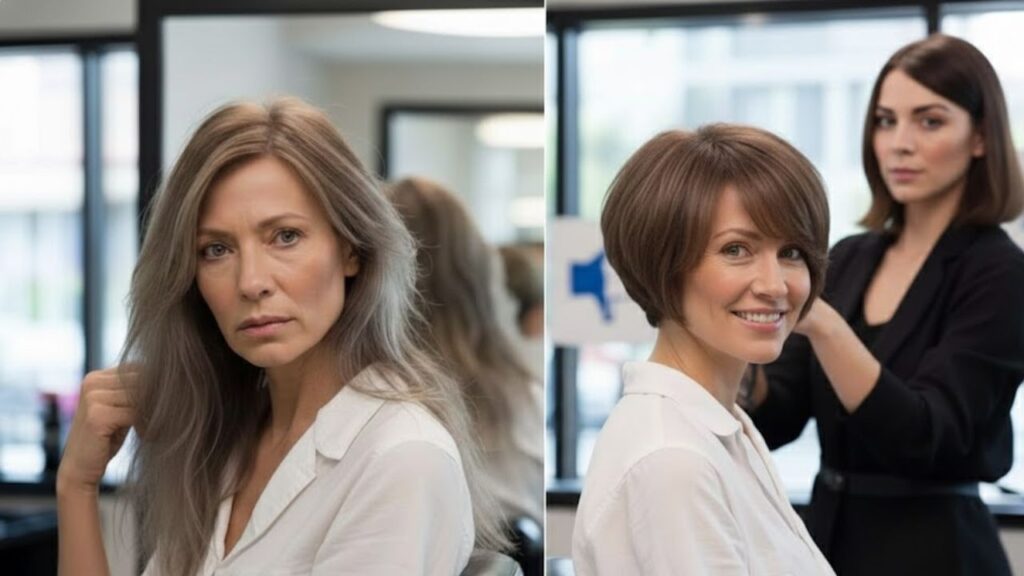
In the familiar “before” image, her hair falls long and wispy, with visible thinning at the crown. In the “after,” it’s cropped short, lifted with spray, and instantly praised as a miracle in the comments. Beneath the praise, a fierce debate unfolds. Some insist short hair is the only solution. Others push back, accusing stylists of forcing women into cuts they never wanted. Across Instagram and TikTok, these dramatic transformations keep appearing, delivering the same blunt message to women with thinning hair: go short, or nothing works. With every post, reactions grow more divided, and the question becomes harder to ignore.
When “You Must Cut It Short” Stops Sounding Like Advice
The scene rarely changes. A woman sits in the salon chair, quietly running her fingers through her hair. The stylist lifts a section, the bright light reveals scalp, and the verdict drops: “A short cut is your only option.” In that moment, it doesn’t feel like guidance. It feels final. For many women, long hair represents identity, femininity, and continuity. Being told it no longer works can feel like losing more than length—it can feel like losing a version of yourself you’re not ready to let go of.
Online, these moments are frozen into before-and-after photos. A recent viral series showed women in their 40s, 50s, and 60s transformed into ultra-short pixies. Praise flooded in alongside criticism. One 52-year-old woman wrote that she had begged to keep some length, only to be told her hair “couldn’t handle it.” Though she smiled in the photos, her comment revealed the truth: “I like it, but I don’t feel like me yet.” Another viewer summed it up simply: “Why does fixing my hair mean I have to lose it?”
 This so called anti mold plant could it be more dangerous than the chemicals we want to avoid
Why the Debate Feels So Personal for So Many Women
Statistics quietly sit behind these reactions. Research suggests that up to 40% of women experience noticeable thinning by age 50. That’s millions of women scrolling these posts, wondering where they fit. For some, a short cut brings relief—less shedding, easier styling, and fewer false promises from products that never delivered. For others, it looks like a last resort pushed too soon, before they’ve had time to adjust emotionally.

From a technical perspective, many stylists aren’t wrong. Long, fragile ends can appear stringy and emphasize thinning. Shorter cuts can create lift, reduce weight, and make hair look fuller. Products work better, blow-drying is easier, and shape becomes clearer. Stylists are trained to prioritize structure. Emotion often comes second.
Still, “the only option” is rarely true. Shoulder-length cuts with invisible layers, softly textured bobs, or strategic fringes can also disguise thinning. Subtle highlights, scalp powders, and careful layering can add dimension without sacrificing all length. The sharp divide between “short pixie” and “nothing works” often reflects a stylist’s comfort zone more than a client’s real possibilities.
Walking Into a Salon Without Feeling Cornered
There are ways to approach a haircut without feeling ambushed. Preparation matters. Bring photos of yourself at lengths you once loved, even if your hair was fuller then. Add a few realistic examples of women with thinning hair wearing styles you could actually imagine on yourself.
Before the cape goes on, speak up. Saying, “I know my hair is thinning, but I don’t want it very short” sets a boundary. Suddenly, the conversation shifts from ultimatums to options. A blunt cut between the collarbone and shoulders often strikes a balance—long enough to feel familiar, short enough to avoid see-through ends. Light, invisible layers at the crown can add lift without stealing density. Fringes should only be added if the hairline supports them; forced bangs can quickly backfire.
Why Styling and Expectations Matter as Much as the Cut
Disappointment often comes from expecting a haircut to solve everything. Thinning hair is influenced by styling habits, daily care, and overall health. Treating a new cut like your old hair usually leads to frustration. Root-focused blow-drying creates more impact than endlessly smoothing the ends. Lightweight volumizing products applied to damp hair can significantly reduce scalp visibility.
Dry shampoo, used sparingly, becomes less about oil and more about texture. Worked into the roots, it adds grip and subtle thickness. Heavy oils, harsh center parts, and flat, dark dyes often make thinning more obvious. Slightly lighter shades with soft highlights can blur scalp contrast, creating a soft-focus effect rather than a dramatic change.
Being Heard Before the Scissors Come Out
Laura, a London-based stylist specializing in fine hair, admits her approach has changed. She once told clients short hair was their only option. Now, she spends more time listening. Sometimes clients choose to go shorter months later. Sometimes they never do. For many women, that shift—from being told to being heard—makes all the difference.
Thinning hair often carries quiet shame. Hormones, stress, pregnancy, menopause, and genetics rarely feel fair. That moment when hair gathers in the shower drain can feel like a small, private loss. Naming it, talking about it, even joking about it, can soften its power.
- Decide your non-negotiables in advance and say them out loud.
- Choose one main goal per appointment, not several at once.
- Ask to see the cut half-styled, not only after a full blow-dry.
Living With Thinning Hair Beyond Perfect “After” Photos
Hair doesn’t live in the “after.” It exists in the in-between moments—the windy walk to work, the rushed ponytail, the harsh office lighting. Headlines claiming short hair is the only answer flatten a complex reality. They ignore culture, memory, and personal history. One woman’s liberation cut can be another’s nightmare.
The happiest reactions under viral photos often come from women who felt involved in the choice. They say, “I chose this,” or “I was ready.” The process matters as much as the result. For some, that journey leads to a joyful crop. For others, it means keeping some length because it still feels like home. Both choices are valid.
Practical Takeaways for Navigating Thinning Hair
Choosing a realistic length: A blunt cut around the collarbone to shoulder level often balances coverage and movement. Extremely long hair can look transparent at the ends, while drastic pixies may feel emotionally abrupt.
Layering with intention: Heavy layers remove density. Light, invisible layers at the crown preserve thickness while adding lift.
Using color strategically: Slightly lighter shades with soft highlights reduce scalp contrast. Flat, dark dyes tend to emphasize thinning under everyday lighting.
Thinning hair isn’t a failure or a mistake. It’s a change, sometimes slow, sometimes sudden. The photos will keep coming. Opinions will keep clashing. Between pressure and fear, there’s a quieter space—a mirror, a chair, and a conversation that starts with one honest question: what do you actually want to see when you look at yourself?