
The woman in the salon chair is 57, stylish blazer, great boots, tired eyes. She runs a hand through her perfectly set curls and sighs. “My colleagues keep asking if I’m close to retirement,” she tells the hairstylist. “I’m not. I’m running the team.”
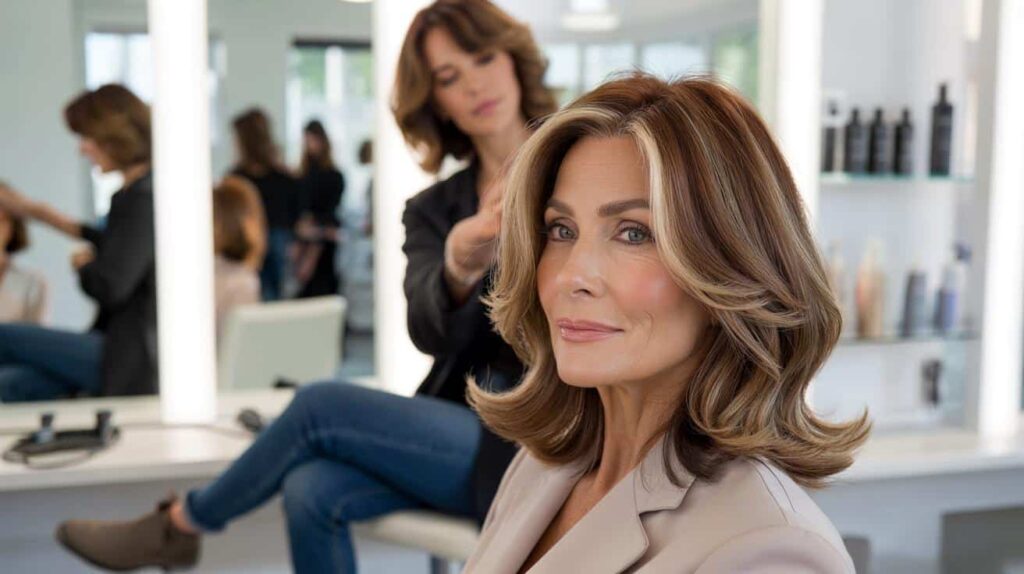
The stylist studies her hair: stiff helmet shape, dull brown with no dimension, bangs cut straight like a ruler. Nothing “old” about her face. Everything “old” about her cut.
Fifteen minutes later, they’re talking less about gray hairs and more about power, presence, the way one wrong detail can steal ten years from your reflection.
The truth lands between the mirror and the scissors.
Some hairstyles don’t just date you. They age you on sight.
 “A-line bob” haircut: this bob is perfect for fine hair and will be very trendy for back-to-school
1. The helmet-style set that doesn’t move
You know the look: hair that doesn’t sway when you turn your head. It stays put like a bike helmet, solid and reassuring… until you see yourself in a shop window and realize you look more “Sunday mass” than “effortless chic”.
Hairstylist Laura G., who’s been cutting hair for women over 50 for twenty years, calls it the “plastic bubble”. She says it’s one of the first things that makes a face look frozen, even when the eyes are still bright and alive.
Hair that’s too stiff stops reflecting light. It frames the face like a shell instead of blending with it.
One of her clients, Danielle, 63, came in with the classic weekly blow-dry: heavy spray, stiff ends, big volume on top, rounded sides. The exact same set she’d had since her kids were in high school.
In photos, Danielle looked ten years older than she felt. The shape didn’t move with her jawline or neck, it just sat there, like it had been placed on her head. When they relaxed the styling, shortened the length slightly, and let the roots have softer lift instead of a hard bump, the change was shocking.
Her colleagues thought she’d “had work done”. She hadn’t. Only her hair stopped fighting gravity.
What makes this style so aging is the lack of movement. Our faces naturally soften and lose firmness over time. When the hair is too rigid, that contrast highlights every line and shadow.
Soft, airy hair that moves actually blurs the features a little and gives the eye less to “cling” to. That’s why modern cuts use lighter products, flexible hold, and broken-up layers instead of one big rounded shape.
A slightly messy strand around the cheek looks more youthful than a perfectly sculpted, unmoving wave. This is where the illusion of freshness lives.
2. The one-length bob that hugs the jaw too hard
The chin-length bob is a classic. Timeless, clean, easy to blow-dry. The problem starts when it’s too blunt, too straight, sitting exactly at the widest part of the face with zero texture.
That razor-sharp line can cut your features in half. It emphasizes jowls, a softer jaw, and any fullness around the neck. The result is a harsh frame that drags the face down visually.
A bob can be stunning after 50, but not when it looks like a Lego piece clipped on your head.
Laura remembers a client, Ana, 54, who walked in saying, “I don’t understand, I copied a celebrity bob, but I look harder, not fresher.” Her bob was technical perfection: straight, blunt, same length all around, hitting right at the jaw angle.
On a 25-year-old with tight skin, that line carves out the cheekbones. On Ana, it simply pointed at everything she wanted to soften. Once they shifted the length just below the jaw, added micro-layers at the ends, and a tiny bit of angle towards the front, her face opened up instantly.
Same length family, totally different energy.
The logic is simple. Sharp horizontal lines cut the figure and the face. After 50, the eye is already looking for verticality and softness. A single, hard line at the jaw does the opposite of what we want: it widens, it flattens, it announces “this is where the skin is looser”.
By breaking the line with texture, or letting the front be just a little longer, the gaze slides instead of stopping. That sliding motion is what feels light, easy, younger. *The cut doesn’t need to scream “trendy”; it just needs to stop underlining the areas you’re self-conscious about.*
3. The ultra-dark, flat color with no dimension
This one hurts, because it often comes from a place of courage: “I refuse to go gray, I’m coloring everything, full coverage, dark chocolate, no white in sight.” The intention is understandable. The result, on the other hand, can be brutal.
Very dark, uniform color hardens the features and erases natural shadows. It also highlights any thinning, because the scalp suddenly contrasts against a block of deep pigment.
The stylist’s verdict is clear: **flat, inky color is one of the quickest ways to add ten years to your face.**
Take Marie, 60, who had been dyeing her hair almost black since her early 40s. At first, it looked glossy and dramatic. Over time, as her skin tone softened and more white hair grew in, the contrast became harsh.
Her friends began saying she looked “tired” and “severe”, even when she was well rested. During one appointment, Laura suggested keeping the depth at the roots but weaving in warm, fine highlights around the face and crown. They also lightened the base half a shade.
No one noticed she had “lighter hair”; they just said she looked rested. Same woman, new softness.

Pigment behaves like clothing color: black can be chic, but next to a softened complexion, it can drain light. With age, skin loses some of its natural glow, so hair that’s too dark or too matte steals the remaining radiance.
Modern color after 50 lives in the nuances. Slightly lighter around the face, a mix of warm and cool tones, and a base that matches your natural depth instead of fighting it.
Let’s be honest: nobody really does this every single day, but even a subtle tonal shift at the salon every few months can give your reflection a more luminous, forgiving frame.
4. Baby bangs and perfectly straight, thick fringe
Fringe can be magical. It hides forehead lines, brings attention to the eyes, and gives structure. But the wrong fringe does the exact opposite.
The “granny” version is short, straight across, and cut like a heavy bar. Or worse, tiny baby bangs trying to look arty, sitting high on a forehead that carries expression lines. The effect is theatrical, not flattering.
A hard, straight fringe creates a strict horizontal line right across the face. It can make the top of the face look smaller and the lower part look heavier.
One client, Sophie, 52, came to Laura after a “trend” cut she saw on social media: very short baby bangs, poker-straight, on her naturally wavy hair. On camera, under studio lights, the look was edgy. In real life, on a Tuesday morning under bathroom lighting, it was unforgiving.
The bangs shrank when they dried, exposing more forehead lines and creating a square frame above her brows. They also demanded daily styling. On the days she didn’t, they puffed up and sat unevenly.
As Laura softened them into longer, curtain-like pieces and let a few strands fall around the temples, Sophie’s face immediately relaxed in the mirror.
Fringes age you when they fight your hair’s natural texture or when they divide your face like a ruler. A softer, broken fringe, slightly longer at the sides, blends into the rest of the cut.
That little diagonal movement draws the gaze inward, towards the eyes, not straight across the forehead. And a slightly feathered, lighter fringe moves with facial expressions instead of sitting there, immobile, like a line drawn with a marker.
“The best fringe after 50,” Laura says, “looks like it might have grown there all by itself. Not like someone measured it with a tool.”
- Swap blunt bangs for a wispy or curtain fringe that kisses the eyebrows.
- Ask for soft texturizing at the ends so the fringe isn’t a solid block.
- Avoid bangs that start too far back on the head, they add unnecessary volume.
- Follow your natural cowlicks and parting instead of forcing a new one.
- Keep the maintenance low: a fringe that looks good even when air-dried is your ally.
5. Over-layered “feathered” cuts straight out of the 90s
There’s nostalgia in those wispy, highly feathered cuts from the 80s and 90s. They flick back at the ends, lots of layers, lots of spray, and a very specific shape: all direction outwards.
On mature hair, which is often thinner and drier, that avalanche of layers can kill volume instead of creating it. The top looks puffy, the ends look stringy, and the whole head takes on a dated, triangular silhouette.
The irony is sharp: a cut that once symbolized modernity now screams “stuck in time”.
Laura tells the story of Claire, 59, who’d been loyal to the same “feathered” cut for over 25 years. Every new stylist kept redoing the same thing: short crown layers, flipped-out sides, heavily thinned ends.
When they compared old photos, the cut hadn’t changed, but Claire’s hair had. It was finer and more fragile, the layers around her face broke easily and made her ponytail look thin. Once Laura removed some of the shortest layers, rebuilt a denser outline, and turned the flip into a soft bend towards the face, the effect was immediate.
Claire didn’t lose her identity. She just lost the visual timestamp.
Too many layers age hair twice: visually, by fragmenting the shape, and physically, by making the ends weaker. Modern volume is built from inside the cut, with strategic layers and smart styling, not a thousand feathered pieces.
**A few well-placed, invisible layers can lift everything without announcing themselves.** They allow the hair to fall closer to the cheeks, elongating the face instead of widening it.
The goal isn’t to erase the past, but to disconnect your hair from a precise year. When nobody can guess whether your cut is “on trend” or just quietly flattering, you’ve won.
Let your hair age with you, not against you
There’s a strange moment that comes for many women around 50. The face changes, the body shifts, but the hair often stays trapped in a decade where you felt most yourself. Letting go of these “granny” codes isn’t about wanting to be 30 again. It’s about letting the outside reflect the power and nuance you’ve actually earned.
One honest conversation with a good stylist can do more for your confidence than a drawer full of anti-aging creams. The right cut doesn’t pretend you’re someone else. It quietly edits out everything that shouts “I gave up” or “I’m hiding”.
Ask yourself: if you met you today, without the memories and habits, would you choose this same haircut? Or would you dare something softer, lighter, a little more in tune with the woman you’ve become?

| Key point | Detail | Value for the reader |
|---|---|---|
| Movement over stiffness | Flexible styling, softer shapes instead of helmet sets | Makes features look fresher and less rigid instantly |
| Soft framing, not hard lines | Adjust bob lengths, fringes, and layers away from strict horizontals | Visually lifts the face and blurs areas of concern |
| Color with dimension | Slightly lighter pieces, tonal variation, avoid ultra-dark blocks | Restores glow, reduces harsh contrast, looks more natural |
FAQ:
- Should I avoid long hair after 50?Not necessarily. Long hair can look gorgeous if the ends are healthy, the shape has some movement, and the length doesn’t drag your features down. The key is freshness, not length.
- How often should I change my haircut as I age?Think evolution, not revolution. A small adjustment every one to two years is usually enough to stay current with your hair’s texture and your features.
- Can I still have bangs if I have forehead lines?Yes, and they can be your best friend. Choose a soft, slightly longer fringe that skims the brows and moves with your expressions instead of a short, blunt line.
- Do I have to embrace my gray to look modern?No. You can keep coloring if you enjoy it. Just avoid flat, opaque shades and choose color with dimension, lighter around the face, and gentler transitions.
- What should I tell my hairstylist to avoid a “granny” cut?Explain that you want movement, softness around the face, and a shape that looks good with minimal daily effort. Bring photos that show texture and flow, not just front views.
