
The gray silhouette of the USS Harry S. Truman emerged from the morning mist like a floating city. On the Norfolk pier, families pressed against barriers, waving homemade signs and phones, scanning the deck for familiar faces. A child waved a small flag, lost interest, then waved again as the ship’s horn echoed across the water. Outwardly, it seemed like a storybook ending: the warship returns, the mission is complete, life resumes.
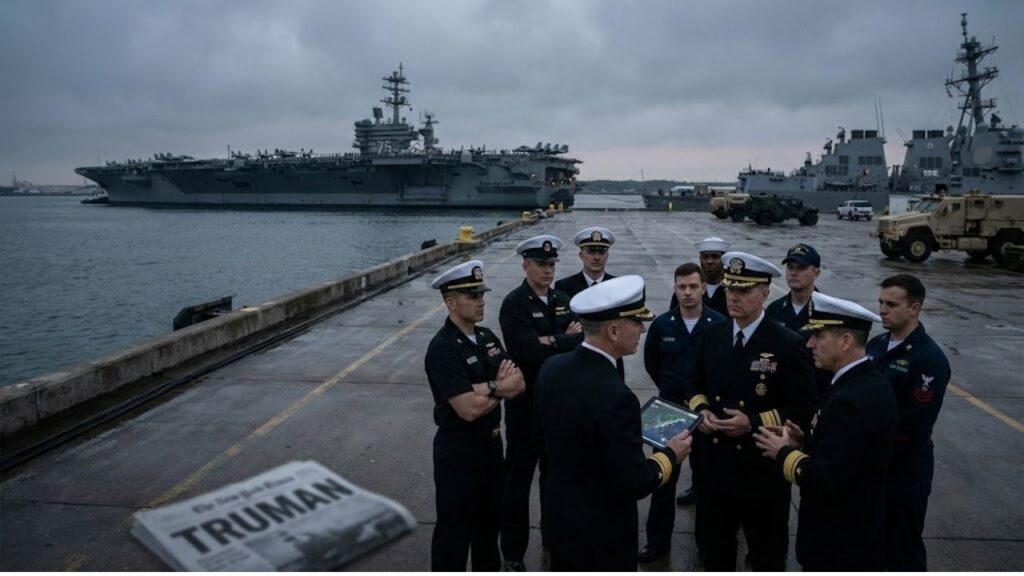
Yet for officers and analysts observing from afar, the mood was layered. Aircraft carriers still project power in photos and patriotic media. But in private briefings and late-night exchanges, one unsettling question kept resurfacing: could this symbol of American naval dominance be returning to a world where it no longer controls the seas?
Homecoming Glory and Underlying Unease
On the pier, two realities collided. Sailors stepped onto solid ground, faces sun-browned, shoulders heavy with months at sea, embodying relief and pride. Yet alongside that, experts quietly questioned the future. The Truman appeared every bit the classic American response to crises: a 100,000-ton floating airfield bristling with jets, radars, and history.

But behind the scenes, the thought lingered: would this carrier survive day three of a high-end conflict in the Western Pacific? This question, whispered rather than spoken publicly, highlighted a growing tension between tradition and emerging threats.

Shifting Threats in the Indo-Pacific
Maps of the South China Sea, Taiwan, and Japan show a dangerous reality. Anti-ship ballistic missiles like China’s DF-21D and DF-26, combined with swarms of drones and cruise missiles, transform carriers from chess queens into expensive targets. Recent war game simulations reportedly ended with US carriers “destroyed” early, their air wings struggling to respond. The Truman’s safe return stands in stark contrast to these digital warnings—a race car applauded while engineers admit the track has changed.
The Navy’s Complicated Equation
Carriers are more than weapons; they are budgets, careers, and political symbols. Congressional districts and local economies rely on their presence. Questioning carrier dominance challenges a deeply embedded narrative. For many observers, the Truman’s return underscored a gap between the Navy America has and the conflicts it may face.
Routine Comfort vs. Emerging Reality
Crew members feel a mix of pride and pragmatic realism. They understand threats like A2/AD bubbles and hypersonic missiles but still operate under routines shaped by the Cold War: cyclic flight operations, strike planning, predictable patterns, and preparations for deployments resembling the last. The tried-and-true formula—carrier plus escorts projecting airpower inland—remains comforting on slides but clashes with a world where adversaries can exploit long-range missiles, sensors, and satellites instead of building their own carriers.
This familiarity provides emotional safety, even as it misaligns with evolving threats. Adversaries like China observe every deployment, gathering data and refining counter-tactics. No Pentagon planner truly expects a Truman-style deployment to survive unchanged in a real high-end conflict near Taiwan.
The Strategic Challenge of Distance
Carriers must remain hundreds of miles from missile zones, reducing their operational impact. Air wings face longer, riskier sorties; tankers and secure communications become critical. Every mile kept back is a concession to adversary capabilities. For some, the Truman’s return resembled a veteran athlete still performing while the game itself has quietly changed.

Potential Paths Forward
The Navy cannot flip a switch to replace carriers with a fully distributed, agile fleet. But there are actionable strategies, if pursued with commitment:
- Dispersal: Reduce dependence on massive carriers, spreading combat power across smaller ships, submarines, land-based aircraft, and unmanned systems.
- Unmanned platforms: Surface and underwater drones can operate closer to enemy shores without risking personnel.
- Submarines and long-range airpower: Provide stealth and reach while minimizing exposure to concentrated threats.
For those devoted to carriers, these shifts may feel threatening to identity and tradition. The debate is not just technological—it’s human, touching careers, heritage, and collective memory. Future operations will likely integrate carriers as one component of a broader, resilient kill web rather than the center of gravity.
Learning from Rickover
Admiral Hyman Rickover said, “Good ideas are not adopted automatically. They must be driven into practice with courageous patience.” The Truman’s homecoming highlights that while the Navy has innovative concepts, it often struggles to let go of the familiar.
Signals Beyond the Surface
Observing budgets, exercises, and young officers’ perspectives provides insight into true priorities:
- Funding trends: Investment in submarines, missiles, and unmanned systems reveals future focus.
- Training exercises: Dispersed, jammed, and blind scenarios indicate preparation for high-threat environments.
- Next-generation leadership: Younger officers warn against overreliance on legacy systems, anticipating the next conflict, not the last.
The Truman as a Mirror
The public saw hugs, tears, and jets aligned on deck—tangible reminders of human dedication. Behind closed doors, planners envision scenarios where that proud hull might never return. The Navy straddles two eras: one of carrier dominance and one where visibility equals vulnerability. The Truman embodies both pride and caution—a reminder that prestige can lag behind operational reality.
Future wars reward adaptation: The Navy must evolve its practices quickly, or risk obsolescence in sensor-saturated, long-range conflict zones. The Truman’s homecoming is both a familiar ritual and a sobering checkpoint, questioning whether the fleet is prepared for the unfilmed, unprecedented fights ahead.
 This old metal accessory from the wardrobe that bird-lovers now keep protects birds in winter
Key Takeaways
| Key point | Detail | Value for the reader |
|---|---|---|
| Carriers face new threats | Missiles, drones, and sensors increase vulnerability near contested coasts | Explains why carrier deployments are riskier than they appear |
| Emotional ties slow change | Budgets, careers, and tradition resist adaptation even when risks are clear | Provides insight into institutional inertia |
| Future power relies on dispersal | Submarines, unmanned systems, and long-range aircraft create a resilient network | Illustrates what a next-generation Navy could look like |
