
The other day in a busy supermarket, I watched a man stop cold in the vegetable aisle, one hand gripping a bag of russet potatoes, the other hovering over a pile of sweet potatoes. He looked at his partner and joked, “So… which potato are we having tonight?” She laughed and shrugged. “Aren’t they basically the same?” In the end, both went into the cart, question unanswered, dinner decided.
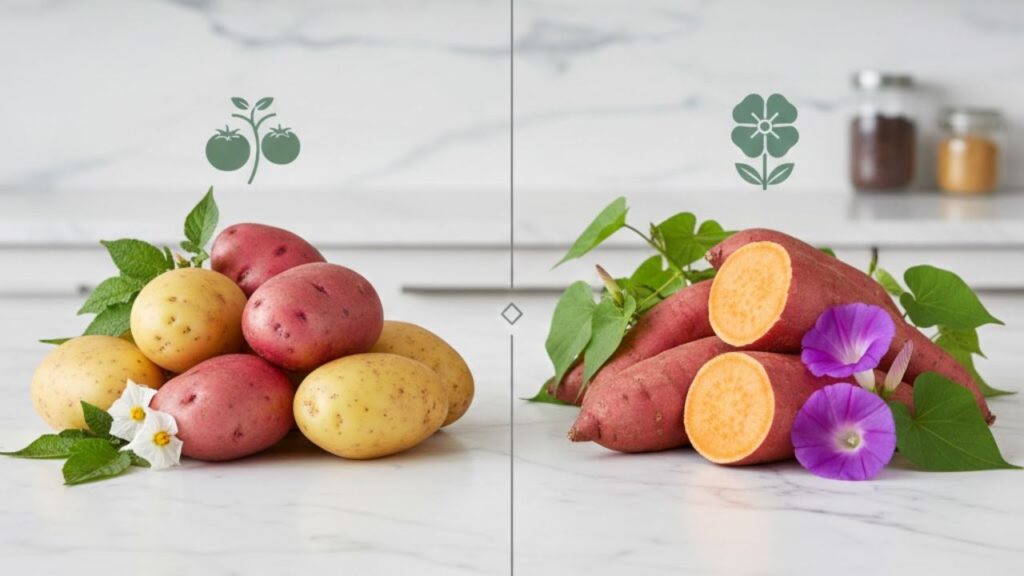
I’ve heard that same easy confusion at family tables, in diet conversations, and even behind restaurant doors. We roast them, mash them, fry them, and mentally file them under one label: potatoes are potatoes. But from a biological point of view, that assumption is almost entirely wrong.
Not Siblings at All: The Botanical Gap Between Them
A quick look at the grocery display doesn’t help. Sweet potatoes often sit right next to baking potatoes, sometimes even under a single sign. Visually, the message is simple: two versions of the same vegetable. For most shoppers, that placement outweighs anything learned in a science class. A brown tuber and an orange one get grouped together as comfort-food carbs.

Under the skin, however, they live in completely different worlds. Regular potatoes belong to the Solanaceae family—the nightshades—alongside tomatoes, peppers, and eggplants. Sweet potatoes come from the Convolvulaceae family, sharing lineage with morning glory flowers. On the evolutionary tree, that split happened so long ago they are closer to distant neighbors than relatives.

Shared Use, Not Shared DNA
Their only real connection is how we use them. Both grow underground as energy storage for the plant, both roast beautifully, and both are filling and affordable. That practical overlap is what links them in our minds. From a plant’s perspective, though, a potato is a stem tuber, while a sweet potato is a swollen storage root. They simply evolved similar solutions to the same survival problem.
Same Plate, Different Behavior in the Kitchen
Cook them side by side and the difference becomes obvious. Slice a raw russet and your knife meets a dry, chalky resistance. Cut into a sweet potato and it feels dense, slightly sticky, even squeaky against the board. Anyone who has wrestled a large sweet potato into cubes remembers that texture instantly.
- Bird lovers use this cheap February treat to keep feeders busy and attract birds every morning
- After 60, giving up these 9 habits could significantly increase your happiness, according to longevity experts
- A new set of eight spacecraft images reveals the interstellar comet 3I ATLAS in astonishing clarity
- Psychology says people who sleep in the same bed as their pets often have these 10 quiet strengths
- Hair loss: here are the best treatments to use to thicken your hair
- Bad news a 135 fine will apply to gardeners using rainwater without authorization starting January 18
- Frugal Living Expert Kate Kaden’s 6 Practical Tips for Living Below Your Means
- Using giant tortoises as ecological tools in galapagos turns wildlife into mere climate change instruments
Roast both on a single tray at 200°C (about 400°F) with the same oil and salt. Halfway through, the contrast appears: sweet potatoes start to caramelize, their edges turning glossy and dark, while regular potatoes become fluffy inside and crisp outside. They respond differently because they are built differently.
Nutrition Tells the Same Story
A plain baked potato delivers vitamin C, vitamin B6, potassium, and a lot of starch that quickly turns to glucose. A baked sweet potato is rich in beta-carotene, offers more fiber, and contains a type of starch that many people find gentler on blood sugar. That’s why sweet potatoes often show up in health-focused recipes, while russets anchor classic comfort dishes.
There’s also chemistry at play. Regular potatoes, being nightshades, contain mild toxins in their green parts and in potatoes that turn green from light exposure. Sweet potatoes don’t share that risk. Different family, different defenses.

Choosing the Right One Without Being Misled
Next time you’re staring at the potato section, pause and ask a simple question: nightshade or morning glory? For roasting, fries, wedges, and traditional mash, reach for starchy white potatoes like russets or Idahos. They puff, crisp, and soak up fat exactly as intended.
For deeper color, natural sweetness, and a creamy, almost custard-like texture, sweet potatoes are the better choice. Think of them not as a replacement, but as something closer to a bridge between a potato and a carrot.
Cooking Them With Intention
The most common mistake is treating sweet potatoes exactly like white potatoes. Their density and natural sugars mean they burn faster at high heat and turn mushy if boiled too long. They shine with acid, spice, and warmth—lime, chili, ginger, yogurt, or feta. Regular potatoes, by contrast, prefer fat, salt, and herbs. Mixing them on one tray often leaves one half undercooked and the other overly caramelized.
As one chef friend put it, “Once you know one is a stem and one is a root, you stop asking them to act the same in a pan.”
- Use regular potatoes for fries, crispy roasts, gratins, gnocchi, and classic mash.
- Use sweet potatoes for spiced trays, soups, curries, and hearty salads.
- Roast separately if texture matters—each needs its own timing.
- Store both in a cool, dark place, but keep regular potatoes out of the fridge.
- Swap thoughtfully, remembering they come from different plant families.
What Changes When You Stop Calling Them “The Same”
Once you accept that sweet potatoes and regular potatoes are distant relatives at best, meal planning shifts. A Sunday roast can feature crisp white potatoes alongside a tray of blistered, spiced sweet potatoes—two distinct stories sharing one oven.
That awareness carries into the market. You notice skins, labels, and small details most people overlook. You start to see how often we blur plants together for convenience. And when you remember that one is a nightshade stem tuber and the other a flowering morning glory root, it becomes much harder to think of them as “basically the same thing.”

Key Takeaways
- Different families: Potatoes are nightshades; sweet potatoes are morning glory relatives, explaining their different behavior.
- Different structures: A potato is a stem tuber, while a sweet potato is a storage root, affecting texture and cooking time.
- Different roles: Sweet potatoes offer beta-carotene and sweetness; regular potatoes provide fluffiness and crispness.
