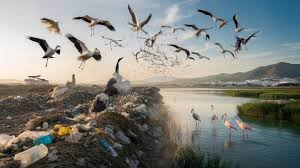
Every morning, flocks of gulls and storks rise from Andalusian rubbish tips, bellies full of waste, and head towards shimmering lagoons and tidal marshes. What looks like a normal feeding route is, in fact, a large-scale delivery service for plastic trash into protected natural areas.
Birds that act like moving conveyor belts
Plastic is usually framed as an ocean problem, pushed by wind and currents across the planet. Yet in southern Spain, scientists have shown that wings, not waves, can be just as effective at shifting our rubbish into delicate habitats.
Researchers in Andalusia followed three common scavenging birds: lesser black-backed gulls, yellow-legged gulls and white storks. All three species routinely feast on open landfills scattered between Málaga, Seville and Córdoba.

After feeding, the birds fly to nearby wetlands to rest, breed or roost. Once there, they do what birds always do: they regurgitate indigestible material in compact pellets and they defecate. Mixed in with bones, seeds and insect shells, scientists repeatedly found fragments of plastic, glass and other human-made debris.
 Sleep scientists confirm: this sleeping position can reduce depression symptoms by up to 30%
These birds behave like biological conveyor belts, lifting plastic from landfills and dropping it directly into lakes, marshes and lagoons.
The researchers combined three types of data: GPS tracks from tagged birds, counts of bird numbers in each area, and lab analyses of the pellets collected in resting wetlands. This allowed them to estimate how much plastic a whole population can move in a single year.
A hidden influx of plastic into famous wetlands
Fuente de Piedra: a flamingo haven with a plastic problem
One of the best-known sites in the study was the Fuente de Piedra lagoon in Málaga province. The salt lake hosts one of Europe’s largest colonies of greater flamingos and is internationally protected as a Ramsar wetland.
Fuente de Piedra is an endorheic lagoon, meaning water flows in but does not flow out. Everything that enters, including pollutants, tends to stay and concentrate over time.
In winter, thousands of lesser black-backed gulls migrate down from northern Europe and gather at this lagoon. Many of these gulls split their day between landfills and the lake.
The research team estimates that, on average, around 400 kilograms of plastic a year are carried into Fuente de Piedra by gulls alone.
That plastic originates chiefly from regional landfills serving Málaga, Seville and Córdoba. Once inside the lagoon, fragments can get buried in sediments, ingested by other birds or invertebrates, or broken down into smaller pieces that are even harder to track.
Cádiz Bay: three species, one shared problem
A second study focused on the Natural Park of the Bay of Cádiz, a mix of salt marshes, mudflats and tidal channels that attracts huge numbers of birds. Here, the same three species – white stork, lesser black-backed gull and yellow-legged gull – all use the same landfills and share the bay as a resting and feeding area.
By comparing GPS movement and pellet content, the scientists estimated that together these birds move about 530 kilograms of plastic into the bay’s marshes every year.
- White storks contribute large loads per individual bird.
- Gulls, especially lesser black-backed gulls, contribute more overall because there are so many of them.
- Some species deliver plastic mainly in winter; others do it year-round.
Among them, the lesser black-backed gull emerged as the main transporter in Cádiz, responsible for around 285 kilograms per year. Its dominance is due not to the size of each pellet, but to sheer abundance during the winter months.
Different birds, different plastic routes
Although they share feeding sites, storks and gulls do not move plastic in exactly the same patterns. Size, behaviour and timing all matter.
Why storks can be heavy carriers
White storks are larger than gulls. Their regurgitated pellets are bigger and can contain more material per individual bird. That means a single stork can, in theory, transport more plastic at once than a single gull.
Yet that does not automatically make storks the main problem. There are far fewer of them, and their use of landfills can change through the year. The overall impact of each species is shaped more by population size and how often they commute between rubbish tips and wetlands.
Gull colonies as plastic hotspots
In the case of yellow-legged gulls, the risk is strongest near their breeding colonies around Cádiz Bay. GPS tracks and pellet data show higher plastic delivery in those zones, where adults repeatedly travel back and forth bringing food – and unintended waste – into the colony.

Wetlands closest to landfills, and areas near dense breeding colonies, receive the greatest plastic loads.
This creates localised hotspots where pellets, faeces and abandoned nest material accumulate, raising the chance that other species, including chicks of protected birds, will come into contact with plastic.
The team also noticed differences in the types of plastic moved. White storks were the only species found carrying silicone fragments from landfills to wetlands, though the reason for this selectivity remains unclear.
From plastic pellets to food-chain pollution
The damage does not stop with the carrier birds. Large plastic pieces can cause choking, internal blockages or injuries in storks and gulls when swallowed. But smaller particles and chemical additives raise a more subtle threat.
Microplastics and associated chemicals can act as endocrine disruptors. They interfere with hormones that regulate growth, metabolism and reproduction. That can reduce fertility, weaken immune systems or alter behaviour across a range of species.
When a gull drops a pellet filled with plastic into a marsh, invertebrates may ingest tiny fragments. Fish, amphibians or wading birds can then eat those invertebrates. Over time, contaminants climb the food chain, potentially reaching top predators such as raptors or even humans, for example through seafood harvested near contaminated zones.
As plastics fragment and spread through a wetland, they become harder to see and easier to eat, quietly embedding pollution into the food web.
What can be done about landfill-loving birds?
Managing this problem is far from simple. European rules on landfills already allow for deterrent measures to keep birds away, such as netting, acoustic devices or changes in waste handling. Yet such tactics raise ethical and ecological questions, especially for protected or charismatic species.
Some colonies have grown used to relying on open dumps as a reliable food source. Sudden changes can affect breeding success or shift birds towards farmland and fish farms, creating new conflicts.
Wildlife managers must decide how far to go in discouraging birds without harming populations or simply displacing the problem elsewhere. Closing or covering open landfill cells, improving organic waste processing, and better fencing can all reduce bird access, but they need long-term planning and investment.
Why everyday choices still matter
Beyond specialised conservation measures, a large part of the solution starts long before anything reaches a landfill. The less plastic enters the waste stream, the less there is for birds to carry into wetlands.
| Action | Direct effect |
|---|---|
| Reducing single-use plastics | Cuts the volume of loose, lightweight items that birds can pick up |
| Reusing containers and bags | Extends product life and slows the flow of waste to landfills |
| Recycling correctly | Keeps valuable materials out of open dumps and back into production loops |
These small steps will not stop gulls and storks from visiting rubbish tips, but they can shrink the amount of available plastic and limit what ends up in pellets and droppings across wetlands.
Understanding a few key terms and risks
Two concepts often appear in this kind of research. An “endorheic lagoon” is a closed basin with no natural outflow. Water that flows in stays there until it evaporates. Any pollutant, including plastic, tends to accumulate, which makes such sites especially vulnerable.
The second concept is “biomagnification”. That describes a process where substances, such as certain plastic additives or persistent pollutants stuck to plastic fragments, become more concentrated at higher levels in the food chain. Predators at the top end up carrying the highest loads, even if they never touch a landfill.
In Andalusia’s wetlands, these processes now intersect with the daily movements of storks and gulls. Birds that once simply linked feeding fields and roosting marshes now connect modern landfills with globally important nature reserves – carrying hundreds of kilos of plastic with them each year.