
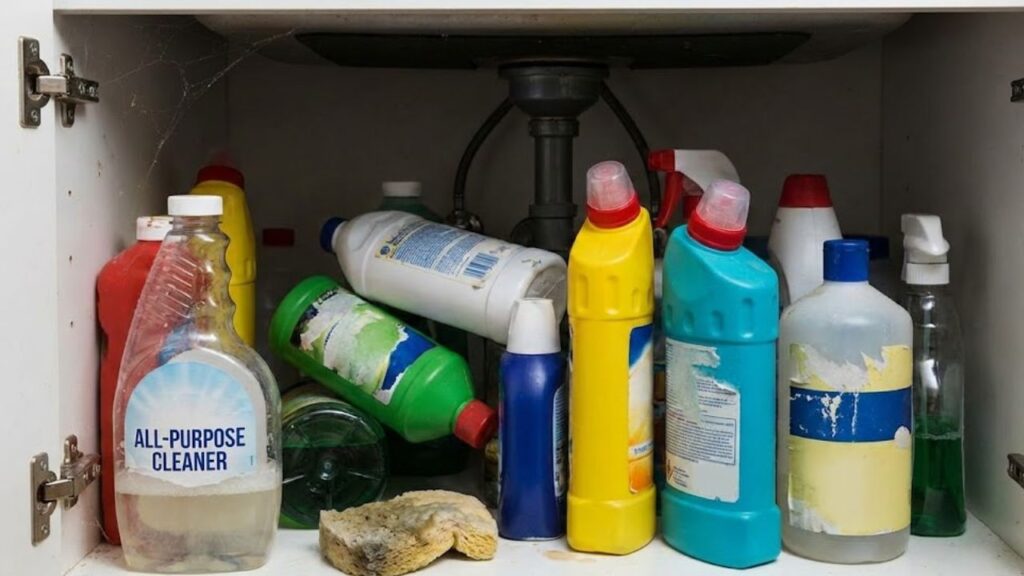
Take a look under almost any kitchen sink, and you’ll likely find the same scene: a disorganized mess of half-empty spray bottles, sticky caps, and mysterious stains on plastic. Before you even bend down, that faint chemical cloud hits your nose. We all like to feel virtuous with a collection of cleaning products—degreasers, descalers, disinfectants—proof we’re in control of our cleaning game.
Then comes the frustrating part: you scrub, spray, wait… and the results are underwhelming. Streaks on glass, limescale that just won’t budge, persistent odors. It’s not that the products have suddenly lost their effectiveness—it’s that something’s been done to them without even realizing it.
Why Your Cleaning Products Aren’t Living Up to Their Potential
Most people assume cleaning power is all about the formula: the brand, concentration, or the “kills 99.9% of germs” label. The truth is, the way we store cleaning products in between sessions has a big impact on their effectiveness on surfaces.

If cleaning agents are stored in the wrong conditions—too much light, excessive heat, or high humidity—they start to degrade over time. They may look fine on the label, but when you use them, they perform like worn-out interns instead of hardworking products.

Picture the typical setup in an apartment: all-purpose cleaner shoved under the sink next to the trash, bleach and toilet gel sitting by the radiator in the bathroom, and glass cleaner perched on a sunny windowsill. This all sounds familiar, right?
Now, consider the real-life details: summer heat pushing the temperature to 28°C, steam from showers, and temperature swings from cold nights to hot, oven-like baking sessions. Caps left half-closed because the previous user was in a rush. Over time, this mixture of factors slowly alters the liquid in each bottle. Studies show that heat and light speed up the breakdown of active ingredients, especially in disinfectants and bleaches.
The product may still look blue and foam up, but it no longer packs the punch it once did.
The Chemical Breakdown of Cleaning Agents
At a molecular level, cleaning products are quite sensitive. Surfactants, perfumes, disinfectants, and bleaches all respond to environmental conditions. Heat can make some ingredients evaporate more quickly, UV light can break molecular bonds, and humidity can trigger unwanted chemical reactions inside the bottle.
For example, bleach stored in a hot, bright bathroom loses its chlorine power over time. Vinegar-based sprays, left open in a steamy kitchen, get weaker or even contaminated. Even natural multipurpose cleaners aren’t immune—plant-based ingredients are often more fragile than synthetic ones.
What looks like a cleaning fail is often just the result of improper storage.
How to Store Cleaners for Maximum Effectiveness
The good news is, you don’t need a special lab or fancy containers to improve the life of your cleaning products. You just need three simple things: shade, a stable temperature, and dry air. The best storage location is usually a closed, ventilated cupboard away from direct sunlight, ovens, and heaters. A hallway closet or a high kitchen cabinet—away from the stove—can work perfectly.
 $2,000 Direct Deposit for U.S. Citizens in February Eligibility, Payment Dates & IRS Instructions
Group similar products together in simple bins or baskets. For example, bathroom cleaners in one bin, floor products in another, and laundry stain removers in a separate one. This will help you stay organized and prevent the accidental storage of bottles in hot spots around the house.
Let’s face it—we’ve all tried balancing on the edge of the bathtub to grab a bottle from under a hot towel radiator. It seems practical at first. Until the toilet gel becomes thicker, stronger-smelling, but somehow less effective. Heat has changed its structure.
A common mistake is treating the space under the sink as a black hole for cleaning products. That area tends to be warm from hot-water pipes, damp from leaks, and constantly opened and closed. It’s perfect for slow degradation and sticky accidents. Another problem: leaving sprays in sunny spots because they’re “used every day.” Light plus heat plus time is a recipe for weaker formulas.
Simple Storage Changes for Stronger Results
Here’s a simple way to make your products last longer and perform better: treat your cleaning supplies the same way you treat your good olive oil. A professional cleaner once said, “If you stored your cleaning products like you store good olive oil, half your problems would disappear.”
Follow a small “storage code” to make it easier:
- Dark is your friend: Keep bottles in closed cupboards, away from direct sunlight.
- Cool is better than convenient: Avoid placing products near radiators, ovens, or in boiler closets.
- Dry is better than damp: Avoid the steamy bathroom floor or wet under-sink areas.
- Close every cap fully: Partial closures speed up evaporation and leaks.
- Consider safety: Store strong chemicals on higher shelves to keep them out of reach of children and pets.
The Impact of Small Storage Changes
Once you start storing cleaning products properly, something subtle happens. You’ll notice their real effectiveness again. Glass cleaner that leaves windows sparkling, descaler that tackles the stubborn white ring around faucets, and floor cleaner that actually lifts greasy footprints in one go.
By storing products correctly, you’ll also stop overusing them to make up for their weakened strength. This means fewer chemicals going down the drain, fewer harsh smells lingering in the air, and less frustration with endless scrubbing. A small shift in how you store products leads to noticeable results on your surfaces.
It’s also oddly satisfying to open a clean, organized shelf where every product still performs as advertised.

Key Takeaways
| Key Point | Detail | Value for the Reader |
|---|---|---|
| Choose cool, dark storage | Avoid radiators, ovens, sunny windowsills, and steamy bathrooms | Products stay effective longer and work as promised |
| Close and group products | Tighten caps fully, use baskets to organize by category | Less evaporation, fewer leaks, and faster access when cleaning |
| Rethink “under the sink” | Use only for non-sensitive items in damp or warm spaces | Reduces degradation, odors, and accidental chemical mix-ups |
