
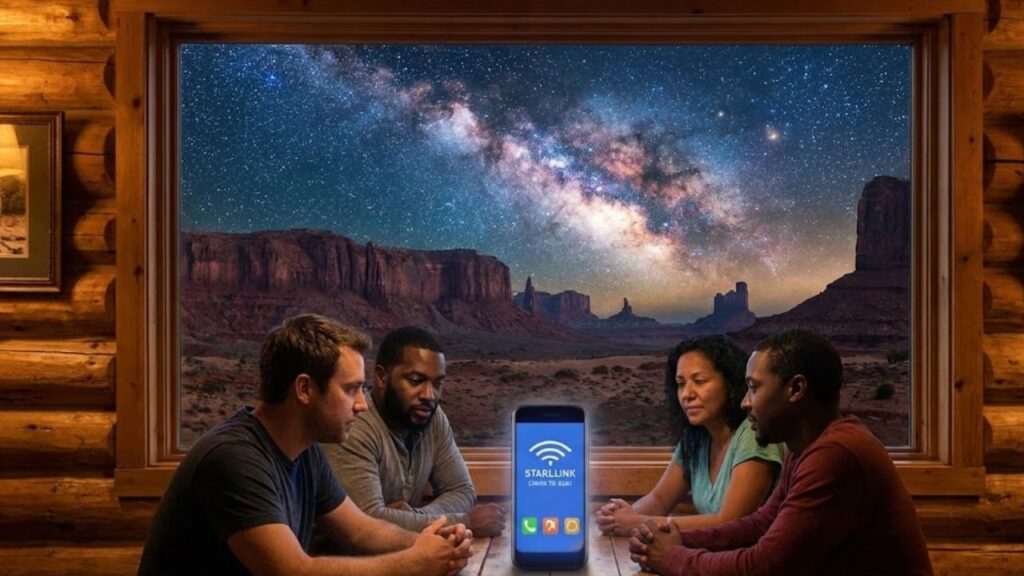
The bar’s neon sign flickered once more before going dark for good. Inside, a small group clustered around a single smartphone, its glow lighting faces like a modern campfire. Beyond the silent mountains outside, an entire regional power grid had collapsed. There was no cell signal, no 4G, and no working ISP hotlines. Yet on that one screen, a speed test cheerfully displayed 80 Mbps download, 20 Mbps upload, and a stable ping. The phone’s owner tilted it proudly, revealing an unfamiliar label: Starlink – Direct to Cell. No towers, no fiber lines, no technicians—just a phone quietly talking to a satellite, as if this had always been possible. For years, we were told it wasn’t.
Why so-called dead zones suddenly look manufactured
Not long ago, complaints about poor signal in a rural valley or out on a fishing boat were met with the same explanations. Geography. High costs. Technical limits. The language of inevitability, framed as fact. Now, those very places are receiving pings from orbit. The red and grey coverage maps once waved at press briefings now resemble excuses more than constraints. When Starlink’s early satellite-to-smartphone tests surfaced online, they landed hard. People in isolated areas shared speed tests from roads, lakes, and empty fields. The unspoken message was clear: this could have been done earlier.
Watching the impossible behave like everyday tech
Scroll through social feeds and you’ll find clips that feel unreal. A pickup truck parked in a cornfield, Wi-Fi and 4G switched off, signal bars dropping to zero. Then a new network appears. A tap. A pause. Pages load. Videos play. Calls connect. There’s no dish, no antenna, just a normal phone linking to a satellite roughly 550 kilometers above Earth. What was once framed as science fiction now acts like a routine connection on an ordinary afternoon. The emotional gap is sharp: people weren’t demanding miracles, only for basic messaging to work when it truly mattered.

The uncomfortable truth behind coverage promises
Governments weren’t entirely dishonest. Traditional mobile networks do rely on towers, licenses, and dense infrastructure. Physics and budgets are real limits. But the claim that full coverage is “technically impossible” collapses once another system starts delivering it from space. The less flattering reality is that the old model favors profit and politics over reach. Remote communities spend less, complain less, and hold less leverage. Mountain roads don’t sign contracts. The result is a selective blindness that feels like a lie to anyone standing by a window, phone raised, hoping for a single bar.

How direct-to-phone satellites change the rules
Strip away the buzzwords and the idea is almost simple. Instead of placing a tower on every hill, you place them in the sky. Thousands of small satellites form a low Earth orbit mesh, each acting like a cell antenna with a vast coverage bubble. Your phone doesn’t “see space”; it sees a familiar network ID. No special apps, no workarounds—just a signal where none existed before. The shift that changes everything is mundane: opening settings and seeing Starlink listed among mobile networks.
When coverage quietly becomes normal
The most striking part is how quickly it blends into daily life. A hiker shares a live location from a remote trail. A fisherman sends photos from miles offshore. A trucker downloads maps in what used to be a digital void. These aren’t dramatic moments, just problems that no longer happen. Flat tires, wrong turns, sudden worries made worse by a dead signal—once accepted as the cost of living far away—now look like budget decisions, not fate.
What shifts behind the scenes
The pressure on traditional players is immediate. Regulators long repeated that coverage couldn’t be guaranteed everywhere. That statement remains technically accurate. What no longer holds is the story that universal connectivity was a distant dream. Satellites don’t erase poverty, censorship, or corporate control. Signals can still be blocked, taxed, or throttled. Space doesn’t automatically mean freedom. But when usable service reaches a random valley, every remaining dead zone starts to look like a policy choice.

What this means for your phone, bills, and trust
The practical advice is simple. Watch coverage maps closely. When operators suddenly announce expanded rural service after years of indifference, ask what changed. Track where satellite-to-mobile services are approved and where they stall. On your own device, you’ll soon juggle terrestrial and satellite-backed networks. Keep screenshots and speed tests. That quiet record of before and after becomes personal evidence.
Why forgetting the past is the real risk
There’s a human tendency to forget once things improve. Decades of unreliable rural service. Full prices for partial coverage. Offshore workers told data was impossible. Over time, discomfort becomes normal. When “impossible” coverage suddenly appears, don’t just celebrate. Remember who said it couldn’t be done, and for how long.
“Every upload from a so-called unprofitable area isn’t just a demo,” a telecom engineer in western Canada noted. “It proves scarcity was curated.”
Stories and signals worth paying attention to
- New technologies exposing limits that were never purely technical
- Regulatory language shifting from “impossible” to “under discussion”
- Real-world usage contradicting years of official claims
The question every dead zone now raises
Satellite-enabled mobile service doesn’t solve inequality, but it removes one of the most convenient excuses. When a phone deep in a forest streams HD video from space, old speeches about unreachable coverage sound hollow. Governments didn’t just misjudge technology; they normalized a world where distance meant less connection and less access. Now, as satellites quietly appear in network menus, a new question emerges: which other “impossibilities” survive only because they’re comfortable to believe?
 Goodbye Natural Night Cycles The Growing Impact of Artificial Light on Humans and Wildlife
- Satellite-to-phone access proves broader coverage is possible: Real tests show usable data in former dead zones, reframing gaps as choices rather than destiny.
- Narratives are changing: The shift in official language offers leverage to demand clearer answers and better service.
- Your experience matters: Personal screenshots and stories challenge weak justifications more effectively than policy papers.
