The bar’s neon sign flickered before going dark for good. Inside, a handful of people gathered around a single smartphone, its screen glowing in the darkness like a modern campfire. Outside, beyond the silent mountains, an entire region’s power grid had collapsed. There was no cell service. No 4G. Local ISP helplines were unreachable. Yet on that one phone, a speed test app calmly displayed 80 Mbps download, 20 Mbps upload, and a stable ping. The owner smiled and turned the screen to reveal an unfamiliar label: “Starlink – Direct to Cell”.
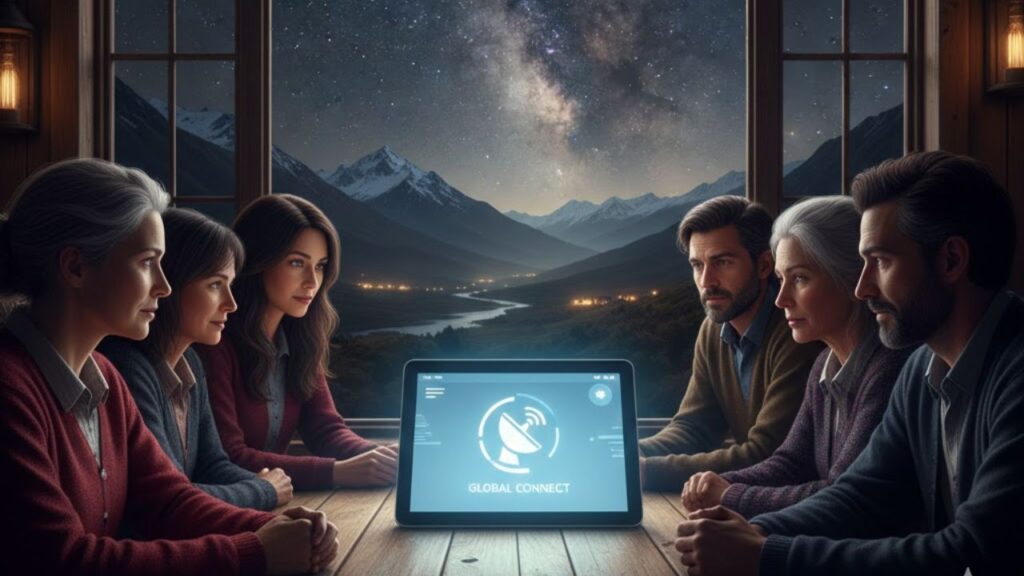
No relay towers. No fiber cables. No technicians in high-visibility jackets. Just a phone communicating directly with a satellite, as if it had always been possible. And for years, we were told it wasn’t.
When “Dead Zones” Start Looking Questionable
Not long ago, complaints about weak signals in rural valleys or offshore waters were met with the same stock replies: “geography,” “deployment costs,” “technical limits,” “not viable.” The language of inevitability, framed as impossibility.

Now, those same areas are receiving pings from orbit. The red and grey coverage maps once presented at press briefings suddenly resemble excuses rather than limits.
 Grey Hair Is the “New Facelift” and the Anti-Ageing Industry Hates It - The Truth Is Spreading Fast
Starlink’s early real-world tests of satellite-to-smartphone connectivity spread online almost instantly. Videos appeared of people on remote roads, lakes, and isolated stretches of land sharing speed tests. The unspoken message was always the same: this could have been done before.
Proof From the Middle of Nowhere
Scroll through X or Reddit and you’ll find clips that feel unreal. A pickup truck parked in a cornfield. Wi-Fi off. 4G disabled. Signal bars drop to zero. Then, a new network name appears. A tap. A brief pause. A webpage loads. A YouTube video plays. A video call connects.
No satellite dish. No external antenna. Just a standard smartphone connecting to a satellite roughly 550 kilometers overhead. What was once framed as science fiction behaves like an ordinary network on an ordinary afternoon.
The emotional contrast is stark. People weren’t asking for miracles. They just wanted basic messaging to work when a school bus was late or the weather turned bad.
The Limits Were Real, the Story Wasn’t
To be fair, governments weren’t wrong about everything. Traditional mobile networks do rely on towers, licenses, and dense infrastructure. Physics and economics matter. But the claim that “full coverage is technically impossible” collapses the moment another system delivers it from space.
The less flattering reality is that the old model prioritizes profit and political convenience, not universal access. Remote villages generate less revenue. Mountain roads don’t sign enterprise contracts. As a result, gaps persist that feel like selective blindness to those standing by a window, lifting a phone and hoping for one usable bar.
How Mobile Satellites Change the Equation
Stripped of marketing language, Starlink’s direct-to-cell approach is remarkably simple. Instead of placing towers on every hill, the tower goes into orbit. Thousands of small satellites form a low Earth orbit mesh, each acting like a cell antenna with a vast coverage area.
Your phone doesn’t recognize space. It detects a network identifier, just like any other carrier. No special hardware. No dedicated app. A signal appears where none existed the day before, as if someone finally noticed you were there.
The moment that changes everything is almost mundane: open settings, tap “Mobile networks”, and see Starlink listed as an option.
How Quietly It Becomes Normal
The shift slips into everyday life with surprising ease. A hiker shares a live location on a remote trail. A fisherman sends a photo from miles offshore. A truck driver downloads updated maps in a rest stop that used to be a digital void.
Everyone has experienced that sudden loss of signal at the worst possible moment: a breakdown on a dark road, a missed turn abroad, a health concern made worse when maps stop loading. What once felt like the cost of living remotely now looks more like a deliberate trade-off.

Pressure Behind the Curtain
For traditional players, the implications are severe. Regulators long insisted that guaranteed coverage everywhere wasn’t achievable with terrestrial networks. That statement remains technically accurate. What no longer holds is the broader narrative that universal connectivity was a distant fantasy.
Satellite networks don’t eliminate poverty, censorship, or control. Signals can still be restricted, taxed, or blocked. Space does not automatically equal freedom. But the demonstration is undeniable. When usable mobile data reaches a random valley from orbit, every dead zone begins to look like a policy decision, not an act of nature.
What It Means for Your Phone, Costs, and Confidence
The first practical step is simple: watch coverage maps closely. When operators and governments announce sudden rural expansions after years of indifference, ask what changed.
Track where satellite-to-mobile services are approved and where they remain indefinitely “under review.” That contrast reveals where resistance exists.
Soon, phones will switch between terrestrial and satellite-backed networks. Keeping screenshots, contracts, and speed tests becomes a quiet form of leverage, a personal record of before and after.
Why Memory Matters
Once technology works, it’s easy to forget how bad things were. Decades of unreliable rural coverage. Full prices for partial service. Fishermen told offshore data was impossible.
Most people don’t read the fine print daily. Operators and governments count on that. Discomfort becomes normal when it lasts long enough.
So when “impossible” coverage suddenly arrives, don’t just celebrate. Remember who said it couldn’t be done, and how long that message was repeated.
A Quiet Admission
“Every time someone in a so-called ‘unprofitable’ area uploads a video from a former dead zone,” a telecom engineer in western Canada said, “it’s not just a tech demo. It proves scarcity was curated.”
- Satellite-to-phone connectivity proves near-total coverage is achievable — real-world use shows data working in former dead zones on regular smartphones.
- Official narratives are shifting — “impossible” is being replaced by “complex” and “under discussion.”
- Your experience is evidence — speed tests and personal records challenge outdated justifications.
The Question Hanging Over Every Dead Zone
Mobile satellite service doesn’t solve inequality, but it removes one of the most convenient excuses. When a phone deep in a forest streams HD video from orbit, old speeches about never reaching full coverage sound hollow.
For years, distance from a city was treated as a reason to be less connected, less informed, less reachable. That story was repeated until it stopped being questioned.
Now, as satellite networks quietly appear in mobile settings, a new question emerges: what other “impossibilities” persist simply because they’re comfortable to maintain?