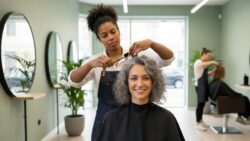
She still makes the same familiar gesture she’s had since her twenties. But now there are soft lines at the corners of her mouth and a gentler curve along her jaw. Her hair remains long, falling past her shoulders, heavy and known. Yet something feels wrong. The longer it grows, the more it seems to pull everything downward, like a curtain weighing on the structure of her face.
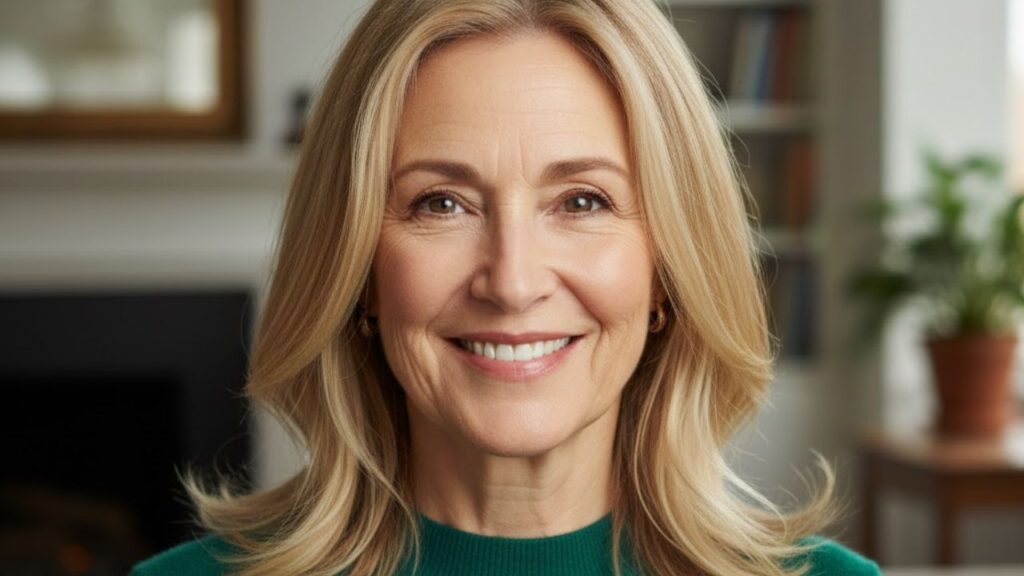
Her daughter once joked about it, half playful, half concerned. “Mum, your hair is doing you dirty.” That comment lingered. Later, scrolling through photos from family meals and holidays, she didn’t see an older woman. She saw a face being dragged down by a hairstyle that once made her feel strong.
One small detail changed everything: where the hair actually ends.

Why Extra-Long Hair After 60 Can Pull Features Downward
Long hair carries romance, especially when it’s been part of your identity for decades. After 60, however, those extra inches don’t always behave as they once did. What used to look fluid can turn flat at the roots and heavy at the ends. The hair forms a straight vertical line, guiding the eye down toward the neck and jaw.

On younger faces, that line can appear sleek or sensual. On faces where skin has naturally softened, it often mirrors every downward curve. The hair becomes a visual arrow pointing to fatigue. The effect isn’t so much “older” as it is “tired.”
In candid photos taken at awkward angles, long hair past the shoulders tends to clump and sag. Cheeks appear lower. Mouth corners seem more downturned. This isn’t just lighting. It’s length working against facial structure.
What Stylists Notice Again and Again
Hair professionals working with women over 55 see this daily. A common moment repeats itself: a client sits down, gathers her long hair forward, and admits, “I don’t feel like myself anymore.” The hair may still be healthy. The texture may be fine. But at a certain point, gravity and length start collaborating.
Many stylists keep before-and-after photos. In the “before,” hair falls well below the shoulders. In the “after,” it lands between the chin and collarbone. The change in the face is striking. Eyes appear more open. Nasolabial folds soften. The same woman suddenly looks rested and lighter. No products. Just fewer inches.
The Simple Physics Behind the Change
Longer hair carries more mass, especially at the ends. On aging or finer hair, that weight pulls volume away from the crown, leaving the top flatter. When the crown loses lift, the entire face appears lower. Straight, long lengths beside the cheeks also exaggerate any downward slope along the jaw.
Shortening the hair interrupts that vertical line. Instead of a curtain, it creates movement around the mid-face. The eye no longer travels straight down. It circles the eyes, cheekbones, and lips. That’s why the right cut can resemble a subtle, non-surgical lift. It’s not illusion. It’s geometry.
The Length That Most Often Lifts the Face
Many experts quietly agree on a sweet spot after 60: somewhere between the base of the neck and just above the collarbone. This long bob, or “lob” length, is where hair stops pulling the face down and starts supporting it.
At this point, hair can still be tucked behind the ears, tied into a low ponytail, or styled in loose waves. It doesn’t read as “short.” It remains feminine and familiar. But the visual line changes. The longest strands now align near the jaw and upper neck, reflecting light back onto the face instead of dragging away from it.
Why Softness Matters at This Length
A harsh, one-length cut at the jaw can look severe on a softer face. Gentle layering around the front, beginning near the cheekbones or just below, helps brighten the eyes. Face-framing pieces that skim the lower cheek or mouth corners create the illusion of lift, like subtle brackets holding the face upward.
A Real-Life Shift Seen in the Salon Chair
In a quiet suburban salon, a 67-year-old retiree arrived with hair reaching halfway down her back. Grey strands showed through old color. The ends were dry and thin. She held onto them tightly, saying she’d worn her hair long all her life.
The stylist showed her a candid photo taken from behind: long, limp hair weighing down a small frame. Then came a second image, a simple mock-up with hair cut to the collarbone and softly layered. She protested, but she couldn’t look away.

They cut in stages. First below the shoulders. Then a little more. When she finally saw the finished length, her hand went straight to her jaw. It hadn’t changed. The hair had simply stopped working against it.
Why the Collarbone Zone Works So Well
The collarbone sits at a visual crossroads between face and body. Ends that land here create a horizontal line that balances vertical features like the neck and nose. That quiet cue tells the eye where to focus: the lower face, jaw, and upper chest.
Hair cut higher, at mid-neck, can risk a helmet-like shape if it isn’t softened. Hair cut much lower slips back into that downward arrow effect. The middle ground allows movement, texture, and forgiving waves that flatter most faces past 60.
Finding a Lifting Cut Without Losing Yourself
A simple at-home test can help. In good natural light, pull your hair forward and use your hands to simulate different lengths: jaw, neck, collarbone. Watch how your face responds.
At jaw level, some people rediscover their cheekbones. Others feel their face looks too full. At collarbone level, many notice a gentle upward flow. Take photos of each option. On camera, differences often appear more clearly than in the mirror.
Bring those photos to your stylist and talk honestly about your routine. A cut that lifts your features but demands constant styling won’t last. Hair has to work in real daily life.
Common Mistakes to Avoid After 60
- Cutting everything to one heavy length at the shoulders, which can still drag the face down.
- Keeping thick, blunt bangs with no softness, shortening the face harshly.
- Using very dark, flat color that absorbs light instead of reflecting it around the features.
Letting Go of the Past Without Erasing Yourself
Clinging too tightly to what worked at 30 or 40 can turn a flattering style into a nostalgic costume. Hair density changes. Skin texture shifts. A once-perfect length may start to feel like resistance rather than expression.
At the same time, forcing yourself into an unfamiliar cut can feel just as wrong. Dramatic changes can shock the eye and the spirit. Trimming in stages allows both to adjust.
Rethinking Hair, Age, and Beauty Without Rules
Hair carries memory. After 60, cutting it can feel like acknowledging time. Yet for many women, choosing a slightly higher length restores a sense of control and clarity in the mirror.
Different lengths tell different visual stories. Long hair can balance strong features. A short bob can spotlight softness. A collarbone-length lob often creates a lifted, buoyant effect. None are right or wrong. What matters is where the eye is guided.
A truly lifting length doesn’t erase age. It removes visual weight between your features and the person you feel you are now.
If You’re Not Ready to Go Short
You don’t have to abandon long hair if it still feels powerful. Stronger face-framing layers, lighter pieces around the face, or soft waves can reduce vertical weight. Keeping length at the back while raising the line in front can subtly change the effect.
The final test is simple. When you catch your reflection unexpectedly, does your hair seem to pull your expression downward—or does it help lift it toward the light?

Key Takeaways at a Glance
- Very long lengths: Hair below the shoulders creates a vertical line that follows gravity, often making the face appear more tired.
- Lifting length: A cut between the base of the neck and the collarbone, with soft face-framing layers, offers a visual lift.
- At-home test: Folding hair to different lengths and taking photos helps identify the most flattering line before a salon visit.