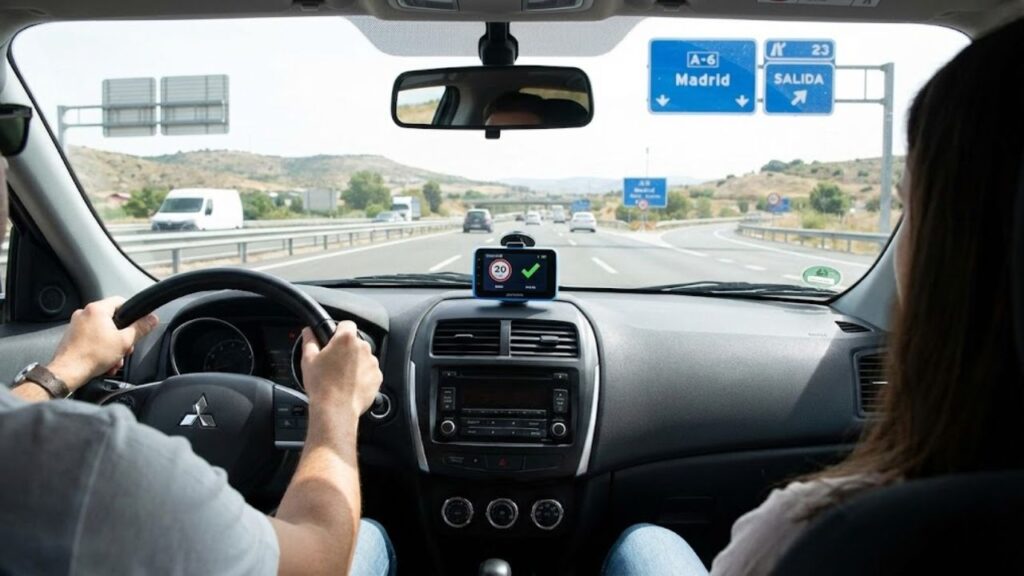
Spain is getting ready to change how drivers must signal a broken-down vehicle. The long-used reflective warning triangle, stored in millions of car boots across Europe, is being phased out. In its place comes a roof-mounted flashing beacon designed to keep drivers away from danger and improve visibility on busy roads.
Why the warning triangle is being phased out
For many years, Spain followed a familiar European rule. After a breakdown or minor collision, drivers were expected to pull over, exit the car, and walk several metres down the road to place a reflective triangle.
The idea was straightforward: give approaching traffic enough warning to slow down. The risk, however, lies in the walk itself. On high-speed motorways, stepping onto the hard shoulder or carriageway can be extremely dangerous.
Spanish authorities have recorded numerous incidents where drivers were struck while on foot near moving traffic. Stress, poor visibility, night-time conditions, and bad weather all increase the risk. From 1 January 2026, Spain will officially retire the triangle and require a new solution.

The role of the Dirección General de Tráfico
The change is being driven by the Dirección General de Tráfico (DGT), Spain’s national traffic authority. Its objective is clear: ensure drivers can stay inside their vehicles while still being clearly visible to others on the road.
This strategy has led to the adoption of the electronic V-16 warning beacon, which is designed to reduce exposure to traffic during roadside emergencies.
What the V-16 warning beacon is
The V-16 is a compact, battery-powered beacon that attaches magnetically to the roof of a vehicle. Instead of walking along the road, the driver can place it from a window or step briefly next to the car before returning inside.
Once activated, the beacon emits a bright, flashing amber light that is highly visible to approaching traffic.
The signal is designed to be seen from more than one kilometre away under normal conditions, providing earlier warning than a traditional triangle.
Why visibility is significantly improved
Early visibility allows other drivers to slow down or change lanes smoothly. Unlike a triangle, which is usually placed only behind the vehicle, the V-16 provides 360-degree visibility around the car.
This wider coverage is particularly valuable on multi-lane motorways and in poor visibility conditions, where seconds can make a critical difference.
More than a light: a connected safety device
The V-16 is not just a flashing beacon. Certified models include a GPS module and a communication system that automatically sends the vehicle’s location to traffic authorities.
This real-time data allows emergency services and traffic control centres to identify a stranded vehicle quickly. It can help speed up assistance, improve traffic warnings, and support better incident management.
- Flashing amber light visible from long distances
- Magnetic base for quick roof installation
- Automatic GPS transmission to traffic services
- No need to walk along the carriageway
Who must carry a V-16 beacon
The new requirement will be mandatory, but not universal. Spain is applying the rule first to vehicles registered within its own borders.
From 2026, only Spain-registered vehicles will be legally required to carry a certified V-16 beacon. This includes cars, vans, and many other vehicle types.
Drivers who fail to comply may face fines, typically reported between €80 and €200. Enforcement is expected to be stricter during peak travel periods such as holidays and long weekends.
What foreign drivers need to know
Vehicles registered outside Spain are not currently required to carry a V-16. Foreign drivers may continue using a warning triangle, provided it complies with the rules of their home country.

This exemption is particularly important for drivers from neighbouring countries such as France and Portugal. While they must follow Spanish laws on speed limits, drink-driving, and seatbelts, their emergency equipment can remain aligned with domestic regulations.
However, foreign motorists are free to carry a V-16 voluntarily. Some insurers and rental companies may begin recommending the device as an additional safety measure.
Why Spain is updating roadside safety rules
The V-16 reform is part of a broader European effort to modernise road safety. While modern vehicles offer strong protection inside the cabin, that safety largely disappears once a driver steps onto a fast road.
Spain’s traffic authority has highlighted serious accidents involving drivers who were hit while placing or collecting warning triangles. In many cases, the breakdown itself was minor, but the aftermath proved far more dangerous.
The guiding principle behind the V-16 is simple: during a breakdown, the safest place is usually inside the vehicle.
The connected aspect of the beacon also supports Spain’s push toward digital traffic management, using live data to improve response times and identify risk zones.
How breakdown procedures will change
By 2027, a breakdown on a Spanish motorway will look very different compared with today.
Current approach: Drivers stop, put on a reflective vest, walk 50–100 metres along the road, place a triangle, then return to the car.
From 2026: Drivers stop, activate hazard lights, place the V-16 on the roof within seconds, and remain inside the vehicle while the beacon transmits their location.
The key difference is the dramatic reduction in time spent on foot near high-speed traffic.
What other European drivers should keep in mind
Even if connected beacons are not yet required elsewhere, Spain’s decision signals the likely direction of future road safety regulations across Europe.
For drivers travelling to Spain, carrying a V-16 alongside a triangle may offer extra protection, especially on long motorway journeys or at night. The cost is relatively small compared with the potential safety benefits.
Useful terms for drivers in Spain
- DGT (Dirección General de Tráfico): Spain’s national traffic authority
- Balise V-16: the official name of the roof-mounted beacon
- Arcén: the hard shoulder, for emergency use only
Practical safety tips during a breakdown
Regardless of registration, good habits can reduce risk when something goes wrong on the road.
- Switch on hazard lights immediately
- Stop as far right as possible, beyond the solid line if available
- Keep passengers and pets inside the vehicle
- Contact emergency services from a safe position
- If equipped, activate the V-16 beacon and remain seated with seatbelts fastened
Road safety experts often note that danger increases after a breakdown, not during it. Tools like the V-16 can significantly reduce risk, but only if drivers understand that staying off the carriageway is essential.
As Spain prepares to make the beacon compulsory for its own vehicles, the move reflects a wider shift toward technology that manages not just accidents, but the critical moments that follow. For anyone planning to drive in Spain from 2026 onward, understanding how the V-16 works may be just as important as routine vehicle checks.