
For a few unsettling minutes, the center of the day will resemble a fragile twilight. Shadows will sharpen and thin, streetlights may flicker to life, dogs will cock their heads, and birds could fall silent. Above everything, the Sun will disappear behind a flawless black circle, edged with a pale, fiery halo. Across several regions of Earth, people will gather in parking lots, on rooftops, in open fields, and on balconies, staring upward through cardboard eclipse glasses and holding their breath. Some will cry. Some will cheer. Others will feel strangely lightheaded without knowing why.
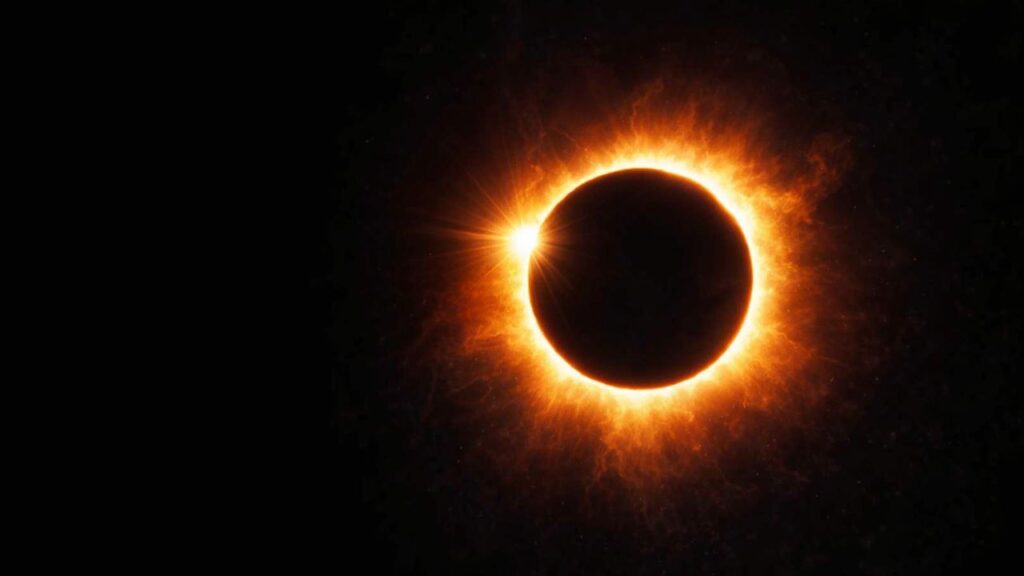
The longest total solar eclipse of the century will be more than a scientific milestone. It will become a shared moment of global wonder. Perhaps the strangest part is how gently it happens, as daylight slowly, almost politely, gives way to night.
That morning, everything will seem normal: steam rising from coffee cups, traffic clogging streets, children scrolling on their phones. Then someone will say, “It’s starting.” Conversations will trail off. Faces will tilt skyward. Small groups will drift outside. The first nibble taken from the Sun will be easy to overlook, just a neat, clean notch, as if a thumb pressed into a glowing coin. The light will still feel familiar. The sky will remain blue.

As the Moon continues its steady slide, the atmosphere will begin to shift. Colors will drain subtly in ways cameras struggle to capture. The air may feel cooler, even if the wind does not change. Nothing will happen abruptly. Instead, it will feel like someone is slowly turning down a planetary dimmer switch. We understand sunrise and sunset. We are not prepared for noon quietly pretending to be night.

Then, almost without warning, the final beads of sunlight will blink away, and the world will slip into an unreal darkness. People who have experienced totality before describe it as something that feels wrong and perfectly right at the same time. The horizon will glow as though sunset surrounds you in every direction. Stars will appear like unexpected visitors in the middle of the day. For a few stretched-out minutes, clocks will tick and cars will idle, but time itself will seem to step aside. When the Sun returns, slowly and gently, some will realize they have changed in ways they cannot fully explain.
The century’s longest shadow across Earth
At the core of this eclipse is a simple yet astonishing alignment: our Moon, small and scarred, drifting into exactly the right position to block a star nearly 400 times wider. Astronomers have determined that this alignment will produce the longest total solar eclipse of the 21st century, with totality lasting longer than any other for decades to come.
On the ground, that sounds minor. Just a few minutes. A strange pause in the day. Yet those minutes will feel expanded and charged, as though the sky itself is holding its breath.
The path of totality will cut a narrow corridor of darkness, roughly 150 to 200 kilometers wide, across several regions. Within that band, some towns will experience more than six and a half minutes of night. Most eclipses cannot offer that. Picture a coastal village where fishermen pause mid-task to stare upward, or a dense megacity where office workers spill into streets washed in blue-grey light. In rural areas, chickens may head for their roosts far too early. Elsewhere, a packed stadium might erupt in applause as the Sun vanishes, treating the cosmos like a live performance.
This unusual duration comes down to orbital geometry. The Moon’s path around Earth is not perfectly circular, so its distance varies. During this eclipse, it will be near perigee, appearing slightly larger in our sky. At the same time, Earth will be positioned favorably in its own orbit around the Sun. Together, these factors allow the Moon’s umbra, the darkest core of its shadow, to linger longer on the surface. Tiny numerical differences in space create the most dramatic light show on Earth.
How to truly experience the eclipse, not just observe it
The most important preparation is knowing your location. Totality is unforgiving. You are either inside the narrow path and see the Sun fully covered, or you are outside and see only a partial eclipse. People will study maps, monitor weather forecasts, and choose viewing spots like they are securing seats for a once-in-a-lifetime concert. The approach is straightforward: find the line of maximum totality, aim for clear skies, and arrive early. Every kilometer closer to the center adds precious seconds of darkness.
Proper equipment matters. Certified eclipse glasses are essential, as looking at the Sun during partial phases can cause serious eye damage. Inexpensive glasses are fine if they meet safety standards. Solar filters for cameras or binoculars can enhance the experience. Still, the most powerful way to feel the eclipse is surprisingly simple: look away from the Sun often.
 Goodbye Hair Dye for Grey Hair: The Conditioner Add-In That Gradually Restores Natural Colour
Watch the world around you. Notice how shadows sharpen into eerie, razor-like shapes. Look at the ground beneath trees, where crescent Suns appear through gaps in the leaves. This is the Moon quietly advertising its slow takeover of the sky.
Many focus on gear but forget about mindset. Bring extra layers, because temperatures can drop several degrees during totality. Decide where you want to stand, sit, or lie down. Set up your camera if you must, then accept what you are willing to miss while adjusting settings. Experienced eclipse chasers often recommend taking only a few photos, then putting the camera away. The real memory will live in your body: the chill on your skin, the collective gasp of the crowd, the way the air itself seems to pause.
Common missteps, quiet doubts, and real emotions
A frequent mistake is underestimating how quickly the most important moments pass. The eclipse unfolds slowly over hours, from the first bite to the final release. That relaxed pace can be misleading. Conversations continue. Phones come out. Then, suddenly, totality is minutes away and your heart is racing. The diamond ring effect, the sudden darkness, the full blackout all happen in seconds. If your attention is buried in a screen at that moment, you may miss what you came to witness.
There is also a quieter fear many do not voice: what if it doesn’t feel as magical as promised? Online, every eclipse looks flawless. In reality, clouds may interfere. Children may need attention. Work obligations may intrude. Some people travel great distances and attach private hopes to those few minutes in shadow. If the feeling arrives slowly or feels muted at first, that is normal. Powerful experiences often settle in later, once ordinary daylight has returned.
One veteran eclipse chaser described it this way: “The strangest part wasn’t the darkness. It was looking around and seeing strangers with the same expression on their faces, as if we all remembered something we’d forgotten we could feel.”
Small, intentional choices can transform the experience from interesting to unforgettable. During totality, you might:
- Take ten seconds to look away from the Sun and scan the glowing horizon
- Focus on one sound and mentally lock it into memory
- Briefly study the faces around you
- Say out loud where you are and what is happening
- Write one unfiltered sentence afterward about how it felt
A shared darkness that lingers long after
When the Moon drifts onward and daylight returns, nothing obvious will be different. Bills will still need paying. Messages will still buzz. Traffic will resume its usual rhythm. Yet something subtle often remains. Seeing the sky darken at midday can loosen our grip on certainty. You witness firsthand how even the most reliable light can vanish when geometry demands it. That sense of precision and fragility does not fade quickly.
For some, this eclipse will inspire long journeys, shared hotel rooms, and snacks exchanged with strangers. For others, it will unfold above a familiar backyard or balcony. In a world that often feels divided, millions of people pausing to watch the same shadow cross the same star carries quiet power. We may disagree on many things, but we all live under this sky.
Years from now, people will remember where they were during “that really long eclipse.” They may forget the exact duration or orbital mechanics, but they will recall the color of light on a wall, the sound of someone nearby, and the feeling that ordinary time briefly stepped aside. A long eclipse does not just dim the Sun. It brightens a corner of our awareness. That is the part people keep and quietly pass along.

| Point clé | Détail | Intérêt pour le lecteur |
|---|---|---|
| Durée exceptionnelle | Totalité parmi les plus longues du siècle, offrant plusieurs minutes de nuit en plein jour | Savoir que cette éclipse est rare aide à décider si le déplacement et la préparation en valent la peine |
| Chemin de totalité | Couloir étroit traversant plusieurs régions, avec expérience très différente selon l’emplacement | Permet de choisir son point d’observation pour vivre la nuit complète plutôt qu’une éclipse partielle |
| Expérience vécue | Chute de température, changement des sons, réactions émotionnelles parfois inattendues | Aide à se préparer mentalement, à gérer attentes et émotions, et à savourer pleinement le moment |
