
The waiting room smelled faintly of disinfectant and cheap coffee. On one side, a woman in leggings flipped through a magazine article about “gentle workouts for sore knees”, the usual mix of swimming, Pilates and stretching. On the other, a middle‑aged man in work boots sat stiffly, his hand pressed against a knee that clearly hadn’t forgiven him for the last 20 years on construction sites.
When the orthopedic specialist finally called them in, both expected the same prescription they’d heard a hundred times: avoid impact, avoid weight, avoid stairs.
What they got instead was the exact opposite.

A weight in the hand, pressure through the heel, and a sentence that’s now setting social media—and doctors’ WhatsApp groups—on fire.

When doctors suddenly say: “Load that knee”
In clinics from London to Los Angeles, a surprising sentence is starting to pop up in consultations: **“You need more load on this knee, not less.”**
For patients who have been told for years to protect, spare, and baby their joints, it sounds almost cruel. Some leave the appointment half convinced the doctor misread the MRI.
Yet the new wave of sports physicians and progressive rheumatologists are all pointing to the same thing. Not swimming. Not Pilates. A humble, old‑school weight‑bearing move that people either love or deeply fear: the squat.
Take Marta, 52, office manager, chronic knee pain for seven years.
She had done everything “soft”: aqua aerobics twice a week, endless Pilates classes, gentle yoga with bolsters and straps. The pain decreased a little, then always came back the moment she had to climb real stairs, carry real shopping bags, live a real life.
Her new physio told her something that made her laugh out loud at first: “We’re going to teach your knees to squat again.”
Three months later, she wasn’t running marathons. But she could stand up from the sofa without using her hands, walk a full supermarket without limping, and sit cross‑legged on the floor with her granddaughter. No miracle. Just progressive load, week after week.
So why are squats—specifically controlled, weight‑bearing squats—sparking such a medical war?
On one side, classic rehab protocols insist on “no pain, no load”: they fear that extra pressure on worn cartilage will accelerate damage. On the other, newer studies show that moderate, supervised loading can stimulate cartilage metabolism, strengthen the muscles that hug the knee, and change the way the joint handles daily stress.
Two truths clash head‑on: protect the knee at all costs, or challenge it enough so it learns to cope. The argument isn’t just theoretical. It decides whether a person spends their 60s walking freely… or planning their week around when their knees will give up.
The “controversial” squat that’s saving some knees and scaring others
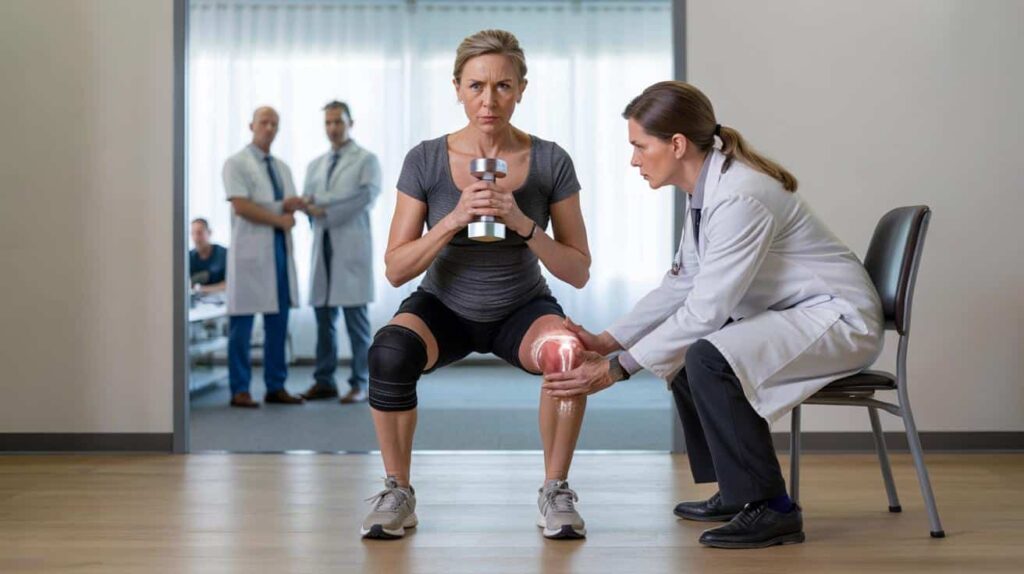
The shocking recommendation is not to throw yourself under a heavy bar like a powerlifter. The exercise that’s causing waves is far more modest: the slow, supported, **half squat with load**.

Feet hip‑width apart, toes slightly out. Hands holding a dumbbell or even a grocery bag close to the chest. Then a tiny descent, as if to sit on a very high, invisible chair. Stop before sharp pain, hold for a breath, and come back up pushing gently through the heels.
Reps are small. Sometimes just five. But they’re repeated three, four times a week. Over time, the weight in the hands goes up a little, and the angle of the knee deepens a little. That’s the “dangerous” bit some colleagues hate.
Most people rush this part. They try the movement one day, feel a pull, and decide their knees “aren’t made for this”. Or they go too low, too fast, seduced by Instagram‑perfect form. That’s when joints protest loudly.
The rehab teams who defend squats repeat the same mantra: the load must be progressive, boringly slow. Start with bodyweight, next to a chair or kitchen counter. Use the support as much as needed. Then, only when the movement feels familiar and steady, bring in a small external weight. A 2‑kg bag of rice counts.
We’ve all been there, that moment when enthusiasm wins over patience. With knees, impatience is expensive. *The joint remembers every shortcut, every “oh, it’ll be fine” decision.*
“Avoiding weight forever is not protection,” says Dr. Lena Hofstad, a sports medicine physician who works with both runners and retirees. “It’s slow deconditioning. The knee doesn’t just need space, it needs a reason to stay strong.”
To navigate this medical crossfire, many therapists suggest a simple roadmap:
- Start in a pain‑quiet phase, not on a flare‑up day.
- Use a chair, table, or door frame for balance on the first sessions.
- Keep the movement tiny: think 10–20 cm of descent, not a gym‑class squat.
- Track “after pain” more than “during pain”: if pain spikes for 24 hours, dial back.
- Pair strength days with rest or gentle walking, not more sports.
Let’s be honest: nobody really does this every single day.
Yet those who manage three short sessions a week often report something shocking of their own: stairs don’t feel like a mountain anymore.
A knee that carries, or a knee that’s carried?
This is the quiet drama hiding under the online shouting matches between doctors: what do we really want our knees to do as we age?
There’s the vision of a joint always protected by water workouts and soft mats, calm and rarely challenged. And there’s the vision of a joint that lifts shopping, stands in long lines, kneels in the garden, goes up and down metro steps without a second thought.
Neither is perfect. Both have risks. Some people will never tolerate loaded squats, because their damage is too advanced or their pain too volatile. Others discover that, against all their fears, a bit of extra weight in the hands gives them back the confidence they’d lost years ago.
The debate probably won’t end soon. Too many careers, protocols, and rehab traditions are involved. But the question now sits in living rooms and kitchens, not just in conferences: do we want knees that are wrapped in cotton… or knees that are trained to carry a life that still has weight?

| Key point | Detail | Value for the reader |
|---|---|---|
| Progressive loading beats total protection | Gentle, controlled squats with light weights can strengthen muscles and improve joint tolerance | Offers a realistic way to reduce everyday knee pain without giving up normal activities |
| Technique and timing matter more than depth | Shallow ranges, support from a chair, and pain monitoring are central to safety | Reduces fear of squats and lowers the risk of “overdoing it” injuries |
| One method will not fit every knee | Some knees thrive with load, some need modifications or alternatives guided by a professional | Helps readers personalize their approach instead of blindly following trends |
FAQ:
- Isn’t squatting bad for worn cartilage?Current research suggests that controlled, moderate load can actually support cartilage health by improving nutrient flow and muscle support, as long as pain is monitored and the movement is adapted to your range.
- What if my knees hurt during the squat?Back off the depth first, then reduce weight, and use more support. A mild discomfort around 3–4/10 that settles within a few hours is usually acceptable, but sharp or lasting pain is a sign to stop and get a professional check.
- How often should I do these weight‑bearing squats?Many physios suggest 2–4 sessions a week, with at least one rest day in between, starting with 1–2 sets of 5–8 reps and building slowly over several weeks.
- Can I replace swimming and Pilates with this exercise?Not necessarily. Swimming and Pilates still help with mobility and general fitness; the squat adds targeted strength for real‑life tasks, so the three approaches can actually complement each other.
- Who should avoid loaded squats completely?People with recent knee surgery, acute inflammation, unstable ligaments, or sudden unexplained swelling need medical clearance first, and might require different or modified exercises before trying any load.
