Europe is getting ready to deploy a vast, ultra-sensitive “ear” in space: three spacecraft flying in flawless formation, connected by laser links, designed to detect the faintest tremors in space-time that began traveling across the Universe billions of years ago.
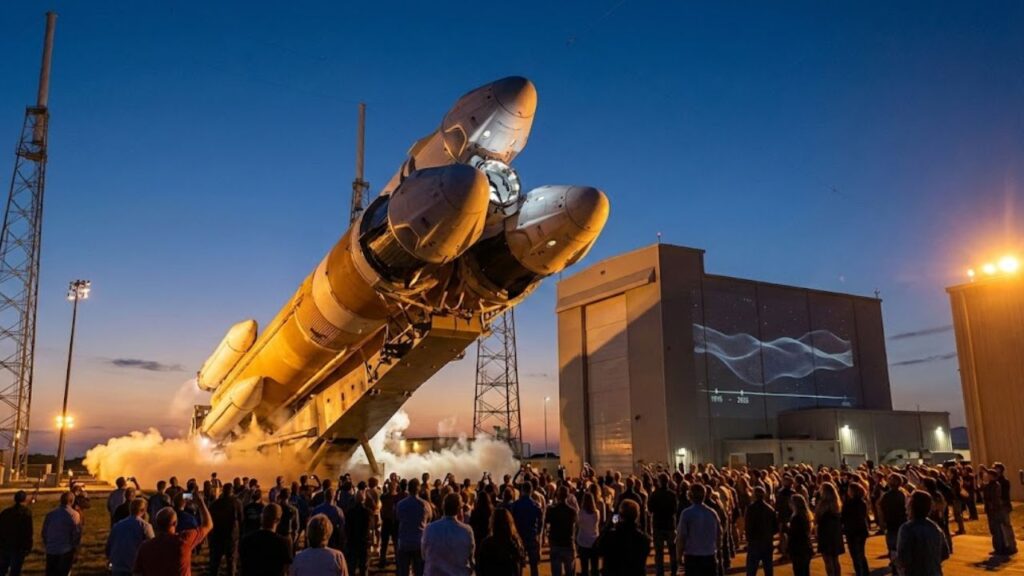
A space mission quietly revisiting Einstein’s legacy
Known as LISA, short for Laser Interferometer Space Antenna, this ambitious project is led by the European Space Agency (ESA). Its objective is to detect gravitational waves, the subtle distortions of space-time first predicted by Albert Einstein in 1916.
These waves arise when extremely massive objects interact violently, such as black holes spiraling together, neutron stars colliding, or phenomena dating back to the early Universe. Ground-based observatories like LIGO and Virgo have already captured several such events, mainly higher-frequency signals from comparatively smaller cosmic objects.

However, Earth-based detectors are limited by constant background vibrations caused by traffic, seismic activity, and weather. By moving the experiment into deep space, LISA escapes this noise, allowing it to detect the slowest and deepest gravitational signals that cannot be heard from the ground.
 The French construction giant accelerates its push into Oceania with a €183m takeover in New Zealand
The mission is designed to measure changes in distance smaller than the size of an atom across a triangular formation spanning 2.5 million kilometres per side.
How the 2.5-million-kilometre triangle operates
LISA is not a single spacecraft but a trio of identical satellites arranged in a massive equilateral triangle. Each side of this triangle measures 2.5 million kilometres. The formation will orbit the Sun alongside Earth, either slightly ahead of or behind our planet.
Laser beams will continuously travel between each pair of satellites. Inside every spacecraft are ultra-stable test masses, carefully shielded blocks of material placed in near-perfect free fall. When a gravitational wave passes through, it minutely stretches and compresses the triangle, altering the distances between these masses.
The task of LISA is to detect these variations, which are on the order of a picometre—a trillionth of a metre. At such precision, even the smallest disturbances matter, including solar radiation pressure, structural vibrations, and stray gas molecules.
Drag-free flight and making the spacecraft “disappear”
To achieve the necessary accuracy, the satellites must allow the test masses to drift freely, as though the spacecraft itself were almost absent. Instead of forcing the masses to follow the spacecraft, the system is reversed: the spacecraft follows the masses.
This approach, called drag-free control, relies on the Drag-Free and Attitude Control System (DFACS). DFACS continuously monitors the position of each test mass and activates tiny microthrusters to keep the spacecraft centered around them without disturbing their motion.
In effect, the satellite behaves like a hollow shell floating around a perfectly free object, guided solely by gravity. The microthrusters, some supplied by Leonardo, must deliver incredibly gentle and stable thrust—closer to a soft breath than a rocket burn—while operating reliably for years.
Thales, OHB, and an ultra-precise propulsion system
On 22 January 2026, Thales Alenia Space, majority-owned by the French group Thales, signed a €16.5 million contract with Germany’s OHB System AG. This agreement covers the design and delivery of LISA’s propulsion subsystem during the programme’s current B2 phase.
Over the later C and D phases, the total value of this work is expected to reach €89.5 million. From its UK facilities, Thales Alenia Space will oversee the design, manufacturing, integration, and testing of the highly specialised propulsion hardware.
Unlike conventional thrusters, LISA’s system must continuously counteract non-gravitational forces such as solar pressure, microscopic gas leaks, and internal electronic disturbances. Any instability could compromise measurements at the picometre scale.
- Continuous ultra-fine thrust instead of short, powerful burns
- Operational reliability for at least 6.5 years
- Minimal contamination to protect the test masses
- Perfect integration with DFACS and attitude control systems
A pan-European industrial effort
LISA also highlights Europe’s coordinated industrial capabilities. Beyond propulsion, Thales Alenia Space will supply avionics, control software, communication systems, and manage the spacecraft’s electromagnetic, radiation, and local gravity environment.
This work is distributed across multiple countries:
- Turin, Italy – Mission architecture and early design concepts
- Gorgonzola, Italy – On-board computer and integrated mass memory
- Switzerland – Electronics for the instrument and constellation acquisition
Every link in this chain is critical. Even a minor issue in onboard computing or electronics could degrade measurements made hundreds of millions of kilometres from Earth.
CNES and the data heart of the mission
Behind the hardware lies a powerful data-processing operation. Through its space agency CNES, France will manage the Distributed Data Processing Center, responsible for handling the daily streams of interferometer data transmitted by LISA.
 This world-famous psychologist is now certain: wabi-sabi is the best life philosophy, and here’s why
Based primarily in France and connected to partner facilities across Europe, the centre will allow scientists to extract faint gravitational signals from background noise. These signals reveal events such as supermassive black hole mergers or the combined hum of compact binary stars within the Milky Way.
Gravitational waves carry information that light cannot, originating from regions hidden by dust, gas, or extreme gravity. In Toulouse, laboratories are already testing prototype interferometers, with special attention to stray light, which could mimic real signals if not controlled.
Listening to frequencies unreachable from Earth
The mission is planned to operate for at least 6.5 years, with a possible extension of 2.5 additional years. During this time, LISA will observe frequencies between roughly 0.1 millihertz and 1 hertz, a range inaccessible to ground-based detectors.
This frequency window is ideal for detecting:
- Mergers of supermassive black holes in distant galaxies
- Compact stellar systems such as white dwarf binaries
- Possible relic signals from the Universe’s earliest moments
Building on Gaia, Euclid, and LISA Pathfinder
LISA builds directly on earlier ESA missions. LISA Pathfinder, launched in 2015, was designed to prove that test masses could remain in near-perfect free fall inside a spacecraft. The mission exceeded expectations, validating key technologies such as drag-free control and noise suppression.
Additional experience comes from Gaia and Euclid, both of which rely on extreme pointing stability and precision propulsion over long periods. Lessons from these missions feed directly into LISA’s guidance and micropropulsion systems, reducing technical risk while expanding scientific ambition.
Ariane 6 and the road to 2035
The current schedule targets a 2035 launch aboard Ariane 6. After deployment, the three satellites will move into their heliocentric orbit and gradually form the enormous triangular constellation.
Once the formation stabilizes, LISA will begin its primary task: patiently listening for the subtle stretching and shrinking of space that signals a passing gravitational wave.
Why gravitational waves are so important
Unlike light or radio waves, gravitational waves travel through matter almost untouched. They do not scatter off dust or get absorbed by gas, preserving pristine information about the most extreme events in the cosmos.
For scientists, this means new insights into:
- The mass and spin of black holes before and after mergers
- The internal structure of neutron stars
- The co-evolution of galaxies and their central black holes
- Potential clues beyond standard cosmological models
Even unexpected results would be valuable. A quieter-than-expected gravitational sky would force researchers to rethink theories of black hole formation and binary system evolution.
Key concepts behind the mission
Two core ideas underpin LISA:
Space-time refers to the unified fabric of space and time, curved by massive objects such as stars and black holes. Motion along this curved fabric is perceived as gravity.
Geodesic trajectories describe the natural paths followed by objects in free fall, influenced only by gravity. LISA’s test masses are designed to follow these paths without interference.
By monitoring how these trajectories subtly change as gravitational waves pass through, LISA can reconstruct events that occurred far away and long ago. If successful, the mission will not only test Einstein’s ideas more than a century later, but also offer a powerful new way to explore the hidden forces shaping the Universe.