For decades, governments and scientists have trusted global headcounts to guide everything from food aid to flood defences.
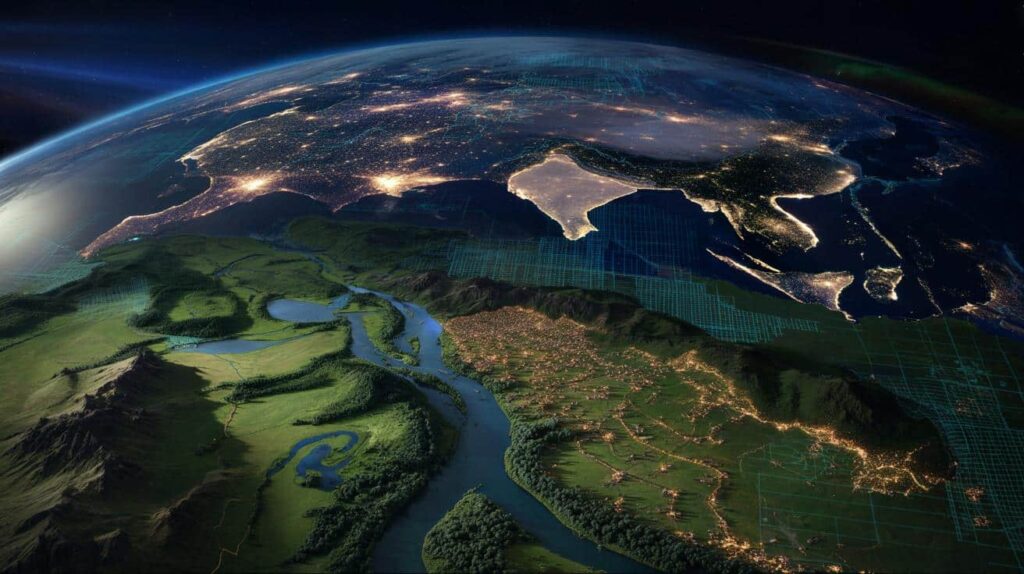
Now a new analysis hints that those familiar population figures could be missing a staggering number of people, especially in rural areas where official data is thinnest. If the findings hold up, they could reshape how countries plan for water, energy and climate risks.
Rethinking the famous 8.2 billion figure
Most major datasets currently place the global population at roughly 8.2 billion people. That figure underpins climate models, infrastructure planning and international development budgets.

A team led by postdoctoral researcher Josias Láng-Ritter at Aalto University in Finland argues those models may be badly skewed outside cities. Their work, published in the journal Nature Communications, suggests that people living in rural regions have been systematically undercounted for decades.

Across several widely used datasets, rural populations appeared to be underestimated by 53 to 84 per cent between 1975 and 2010, the study finds.
If true even in part, the real global total could be significantly higher than the official estimate. That does not necessarily mean “several more billions” of people, but it does point to a serious blind spot in how humans are mapped on the planet’s surface.
Why dams became a secret population laboratory
Counting people is surprisingly hard, especially in sparsely populated regions. Many low‑income countries lack the money, staff and transport needed to run frequent, detailed censuses. Mountain villages, forest settlements and informal communities are often missed.
Láng-Ritter’s team turned to an unexpected source of data: rural dam projects.
Flooded valleys, precise headcounts
When a large dam is built, the valley behind it is flooded to form a reservoir. Farmers, fishers and entire communities are forced to move, and developers must pay compensation.
Those compensation records require meticulous, on‑the‑ground headcounts, creating some of the most accurate rural population figures available.
The researchers gathered data from 300 such dams across 35 countries, covering the period from 1975 to 2010. For each project they had:
- Official relocation or compensation reports listing affected people
- Maps and satellite images showing the flooded area
- Timelines for when reservoirs filled and when communities moved
They then compared these local, high-precision figures with major global population products, including WorldPop, LandScan, GRUMP, GWP and GHS‑POP, for the same locations and years.
What the comparisons revealed
The contrast was striking. In many dam catchments, global datasets showed far fewer people than the relocation records listed.
In some cases, the global maps suggested lightly populated countryside, while resettlement documents recorded dense farming communities.
| Data source | Geographic focus | Typical use |
|---|---|---|
| Dam relocation data | Specific flooded valleys | Compensation, project impact assessments |
| WorldPop / LandScan / others | National and global coverage | Planning, climate models, aid allocation |
Across all projects, the researchers estimate that standard global datasets missed between around half and four‑fifths of the rural people who were physically living in those valleys before flooding.
That mismatch suggests that major mapping products may be tuned far better for cities than for countryside, where households are dispersed and harder to detect using conventional methods.
Why rural people vanish from the statistics
Several factors can lead to undercounting in sparsely populated regions:
- Infrequent censuses, sometimes only every 10 years or more
- Lack of roads and difficult terrain, limiting field visits
- Informal housing not registered in official records
- Seasonal migration and shifting agriculture
- Limited or poor‑quality satellite imagery in earlier decades
Global datasets often combine censuses with spatial models that distribute people across land according to land use, roads, lights at night and other proxies. When the raw census is weak and the modelling assumptions are urban‑centric, rural populations can be diluted or misplaced.
Underestimating rural communities risks misdirecting resources, from health clinics and schools to drought relief and road building.
Why some experts remain unconvinced
The study has sparked a cautious reaction among demographers. Many agree that rural population data could be sharper, yet doubt that the error runs into billions of people worldwide.
Stuart Gietel‑Basten, a population specialist at the Hong Kong University of Science and Technology, warned that accepting such a huge undercount would overturn decades of work by national offices and international agencies. He noted that multiple independent surveys, from household panels to vaccination campaigns, tend to converge on similar totals.

Critics also point out that dam projects are not random samples. Communities near major dams may be denser than typical rural areas because rivers attract farming, fishing and trade. If so, using them as a benchmark could exaggerate how much other rural regions are undercounted.
What both sides agree on
Despite the debate, there is shared ground:
- Rural data collection is patchier than urban data in many countries.
- Global population grids are heavily used but rarely checked against local records.
- Better cross‑checks with on‑the‑ground information would strengthen future models.
Why this matters for climate, aid and infrastructure
Population isn’t just a headline number; it shapes daily decisions by governments and aid agencies.
If rural populations are larger than expected, several policy areas are affected:
- Water management: Dams, irrigation schemes and groundwater projects depend on knowing how many people rely on each river basin.
- Disaster planning: Floodplain mapping and evacuation routes hinge on accurate counts in low‑lying villages.
- Health and education: Vaccination drives, rural clinics and school placements rely on where children actually live, not where models think they live.
- Climate modelling: Projections of future emissions and land‑use change assume certain densities of people in rural landscapes.
Misplaced people on a map can translate into misplaced budgets, leaving some communities under‑served and others oversupplied.
How scientists actually count billions of people
To understand what might be going wrong, it helps to unpack the jargon behind population datasets.
From censuses to pixels
Most modern global grids follow the same basic recipe:
- Start with national or regional census figures.
- Map where people likely live using land‑cover data, roads, settlements and lights at night.
- Use algorithms to spread the census counts across those likely locations, down to small “pixels” of land.
These pixels often measure 1 kilometre by 1 kilometre or less. Each one is assigned a population number.
When the input census is old, incomplete or politically distorted, the final grid can still look scientifically polished but be off in specific regions. That’s especially true in places with fast growth, internal migration or informal settlements.
Scenarios: what if the study is broadly right?
Suppose, for the sake of argument, that global products really do miss a large chunk of rural residents, though perhaps not as many as the upper end of the study suggests.
Several outcomes become plausible:
- Global population might be somewhat higher than 8.2 billion, even if not dramatically so.
- Per‑capita figures, such as emissions or GDP per person, would need recalculating.
- Some countries might qualify for different levels of development assistance once corrected numbers are used.
Even a 5–10 per cent adjustment in certain regions would matter for negotiations on climate finance, food security planning and global health campaigns.
Key terms and ideas worth unpacking
Rural population: People living outside towns and cities, often spread across farms, hamlets and small villages. Definitions vary by country, which can also create confusion.
Population grid: A map where the Earth is divided into small cells, and each cell gets an estimated number of inhabitants. These grids are vital for any model that needs to know where people are, such as flood risk assessments and transport planning.
Ground truth: Real‑world measurements used to check models. In this case, detailed relocation counts for dam projects act as ground truth for wider population maps.
What happens next in the headcount debate
Researchers are likely to test the Aalto team’s findings using other forms of local data: electrification projects, vaccination registries, school enrolment records or mobile network coverage maps.
Combining those sources with modern satellite imagery and machine‑learning tools could give a clearer picture of just how many people live beyond city limits, and exactly where.
Whether the true number is slightly, modestly or significantly higher than 8.2 billion, the central question is the same: are the people most at risk from climate and economic shocks being properly seen on the map?
As countries plan new dams, roads and renewable energy projects, the way humanity counts itself may matter nearly as much as the engineering itself. A misplaced decimal point today could shape who gets protection, and who is left behind, for decades to come.