It happens in the bathroom mirror on a Tuesday morning, under less-than-ideal lighting, when you’re already running late. You tilt your head, squint a little, and there it is: a thin silver thread that wasn’t there last week. You tell yourself it’s nothing, pull it out, and move on.
Months later, more of them appear. Around your temples. Along your part. The roots grow back faster than your patience. The box dyes smell harsh, salon visits cost more than you care to admit, and those “anti-aging” ads start to feel like insults.
One evening, scrolling through your phone, you stumble upon a quiet idea: What if covering gray hair didn’t mean chemicals, appointments, or empty promises? What if it was just two ingredients from your own kitchen?

Why Homemade Hair Dye is Gaining Popularity
Gray hair isn’t just about biology; it’s about timing. It appears when life is already overflowing with deadlines, kids’ homework, aging parents, and not enough sleep. That’s why the idea of adding another “routine” to your already busy life feels exhausting before it even starts.

When people hear about a two-ingredient homemade dye, their first reaction is usually skepticism. Is it a gimmick? A trick? Or is it a genuine, simple solution that respects both your hair and your wallet?
The thing is: the more complex life becomes, the more we crave solutions that are almost embarrassingly simple. Two ingredients. One bowl. Thirty minutes at home. The appeal isn’t just about color. It’s about **taking control** of something that once felt like it slipped away.
Take Claire, a 47-year-old woman from London. Her hairline was turning salt-and-pepper, and every six weeks, she was paying a fortune to her colorist. Frustrated, she tried a homemade mix just to see what would happen—dark tea, something from her spice cupboard, a towel she didn’t mind staining. She left it on, rinsed it out, and didn’t expect much.
What surprised her wasn’t a dramatic transformation, but how her grays softened into warm brown streaks—more like natural highlights than a flat, rigid color. She postponed her salon visit. Then the next one. Six months later, her hair had a new identity—not “hiding everything,” but “softening the contrast.”
How the Simple 2-Ingredient Dye Works
The logic behind this kitchen experiment is simple: Gray hair occurs when pigment-producing cells slow down or stop. Conventional dyes often force color into the hair with harsh chemicals that aggressively open the cuticle.
This two-ingredient dye works differently. One part provides a natural stain that clings to the outer layers of the hair. The other helps set and deepen the stain, offering a bit of care instead of damage.
No, it won’t turn your white hair into jet black overnight—that’s just a marketing fantasy. What it can do is blend your gray strands into your natural shade, adding depth, and slightly darkening the overall look. Less “sharp contrast at the roots” and more “something looks softer, and I can’t quite place why.”
The Two-Ingredient Recipe That’s Gaining Popularity
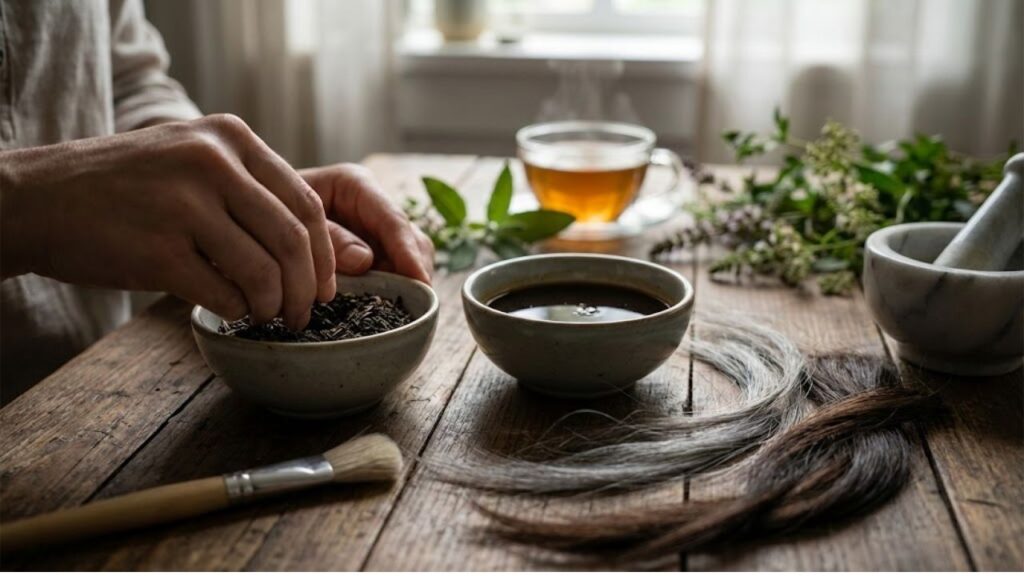
The core of this homemade dye is surprisingly simple: strong black tea and ground coffee. That’s it. No rare plants or mystery powders—just two ingredients you probably already have next to your kettle.
To make the dye, brew a concentrated black tea, let it cool, then mix it with freshly brewed, cooled coffee. This creates a “hair espresso” with rich tannins and pigments that cling particularly well to gray strands.
Apply it to clean, towel-dried hair, focusing on the graying areas: temples, part, and around the face. Then clip your hair up, wrap it in an old T-shirt or shower cap, and wait. The longer it sits, the deeper the stain.

This isn’t a one-time miracle cure; it’s a gradual process. Many people see noticeable changes after two or three applications, especially if their hair is light to medium brown.
Let’s be honest: **nobody does this perfectly every day**. Life is too messy. But the method doesn’t demand perfection. Once a week for the first month usually delivers visible results for early grays.
One woman in her early fifties shared that after using this method, her colleagues kept saying she looked “rested,” without knowing why. Her hair hadn’t turned dramatically darker. Instead, the harsh white streaks around her face had softened into a more natural chestnut tone.
What to Avoid When Using the DIY Gray Hair Dye
The most common mistake is treating this homemade solution like a chemical dye and expecting an even, uniform result. Homemade color tends to be a bit irregular, a little lived-in. And that’s its charm—it lets hair look like hair, not like plastic strands.
Another mistake is rushing the process. Applying the mix for just 10 minutes and then deciding it doesn’t work is a mistake. This blend needs time—**30 to 60 minutes**, especially for resistant gray strands.
“The first change wasn’t my color,” says Ana, 44, who’s been using the tea-coffee mix for nearly a year. “It was my relationship with the mirror. I stopped panicking at every new gray because I knew I had a simple answer waiting in my kitchen.”
How This Method Empowers You to Choose Your Gray Look
One of the greatest benefits of this two-ingredient dye is that it gives you options. You’re not bound to a rigid six-week salon schedule. You can experiment, pause, or blend. You can choose to leave some gray visible and soften the harshest contrasts.
On a Tuesday night, you might apply the mix while answering emails. On a Sunday morning, it might become a slow ritual with a podcast and a cup of coffee—the same coffee you’re putting on your hair. Some months, you might skip it entirely and watch your natural color evolve.
On a deeper level, this simple kitchen recipe speaks to something larger. It’s about **reclaiming small decisions** in a beauty world that often demands big transformations. On the screen, gray hair is either hidden completely or fully embraced in a polished, photogenic way.
Real life is messier. Roots grow at unpredictable speeds. Some days, you love your silver streaks; other days, they feel like an unwanted spotlight. In a crowded train or supermarket queue, you feel that silent comparison: my hair, their hair, my age, their age.
We’ve all had that moment when a single gray hair felt like a verdict on our lives. This two-ingredient solution hits differently. It doesn’t promise eternal youth. It offers a truce. A way to say, “I’m aging, but I still get to decide how that shows on my head.”
Key Points About the Two-Ingredient Hair Dye
- Simple formula: Uses just strong black tea and ground coffee.
- Gentle gray blending: Stains the outer layers of hair without forcing color deep inside.
- Flexible routine: Apply weekly at first, then every 2–3 weeks as needed.
Living with Gray Hair on Your Own Terms
This method empowers you to reclaim your own reflection, without rigid schedules or expectations. It’s not about hiding gray, but about deciding how it fits into your life. Whether it’s softening contrasts or experimenting with your natural color, this two-ingredient solution offers you the freedom to choose.