In late 2024, one such distant storm quietly launched a pulse of energy that would cross oceans, fuel legendary surf contests and shake up how scientists think about the way waves move and attack coastlines.
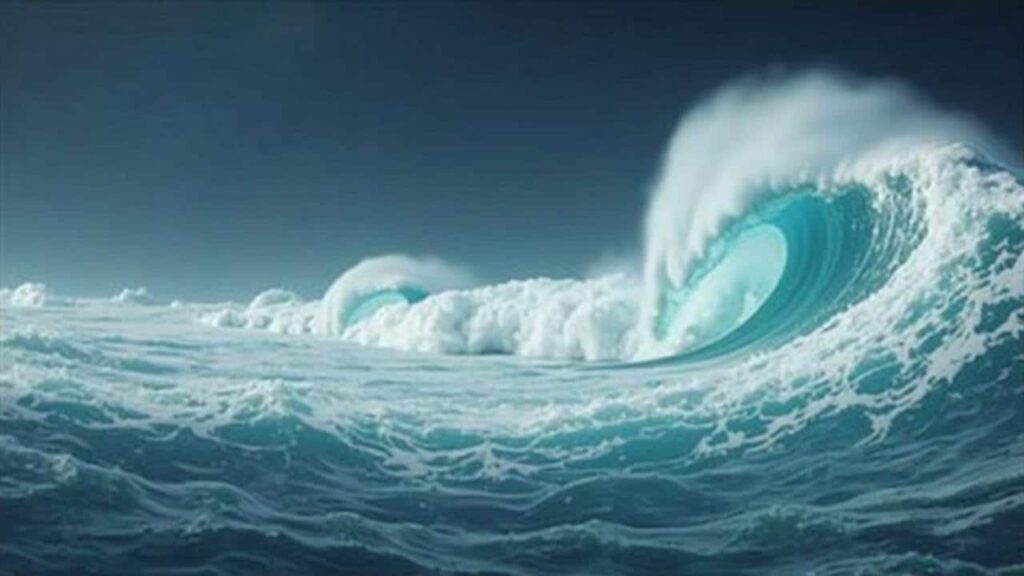
When a remote storm sends walls of water around the globe
At the end of 2024, a powerful storm named Eddie spun up in the North Pacific, far from major coastlines. It did not hit cities. It barely made headlines at the time. Yet out at sea, it was doing something extraordinary.
Average waves of more than 19 metres rolled out from the storm’s heart. Satellite data now suggest that some peaks likely reached around 35 metres high – about the height of an 11-storey building.

Vast swells from storm Eddie travelled roughly 24,000 kilometres, circling the globe and slipping through the notorious Drake Passage between South America and Antarctica.

By early 2025, this swell energy had crossed into the tropical Atlantic. Along the way it brushed the shores of Hawaii and California, where surfers suddenly saw something remarkable on the forecasts: clean, long-period waves big enough to run the famed Eddie Aikau Invitational, an event only held when conditions are considered truly exceptional.
For coastal communities, the swell brought spectacle. For scientists, it carried data that would help rewrite parts of wave physics.
Why these waves stunned ocean scientists
A team led by French oceanographer Fabrice Ardhuin, from the Laboratory of Ocean Physics and Satellite Remote Sensing, later analysed the event. Comparing Eddie to three decades of records, they found it ranked among the most intense storms of the last 34 years.
Wave heights produced by Eddie were on par with, and in some areas greater than, those from the notorious 2014 storm Hercules, which damaged sea walls and coastal roads from Morocco to Ireland.
What sets Eddie apart is not just how big the waves were near the storm, but how they behaved once they left it. Instead of quickly fading, the swell held together and kept its punch across basins.
The data show that a handful of dominant waves carried far more energy than older models predicted, concentrating the storm’s force into a few powerful hits.
Ardhuin’s group compared the observations to existing numerical models. Traditional formulas had suggested that very long-period waves – those taking up to 30 seconds between crests – should lose energy in a fairly predictable way as they travel. Eddie’s waves did not follow that script.
The satellite that changed the rules
For decades, most information about open-ocean waves came from buoys and ship reports. Both are valuable, but they barely sample the vast areas where storms generate their biggest swells. What Eddie did was finally captured with a new kind of eye in the sky.
How SWOT tracks the shape of the sea
The key instrument is the SWOT satellite, short for Surface Water and Ocean Topography. Launched by NASA and the French space agency CNES, it was designed to map lakes, rivers and the ocean surface with sharp detail.
Unlike earlier satellites that mainly measured average sea level, SWOT can detect the fine bumps and dips made by long, rolling swells with wavelengths over 500 metres from crest to crest.
- It scans wide swaths of the ocean with radar interferometry.
- It detects tiny changes in sea surface height, down to a few centimetres.
- It measures both wavelength and height of open-ocean swells.
- It revisits the same areas often enough to track travelling wave trains.
In December 2024, SWOT crossed the tracks of Eddie’s swell field. For the first time, researchers could directly observe the detailed structure of such long waves far from land, instead of inferring it from models.
A shock for long-wave energy estimates
The measurements, published in 2025 in the journal Proceedings of the National Academy of Sciences by Ardhuin, Postec and Accensi, forced a major revision.
Earlier empirical formulas overstated the energy of long waves by up to a factor of twenty, spreading that energy across too many waves instead of a smaller number of dominant peaks.

In reality, the satellite data indicate that energy bunches into a narrower part of the spectrum. A few long, tall waves do most of the work. The study compared this to a boxer throwing fewer, heavier punches rather than a constant flurry of jabs.
This matters because coastal impact depends strongly on these dominant waves. A modest-looking swell with long period can hit harbour walls or cliff bases with far greater force than local observers might expect from its height alone.
What more energetic seas mean for coasts
Understanding how wave energy travels, grows or fades is no longer just an academic question. Around the world, governments are wrestling with how to protect ports, beaches and low-lying towns in a changing climate.
Hidden risks far from the storm centre
Storm Eddie never slammed a major coastline head-on. Yet its waves still had the power to shape shores thousands of kilometres away. Long-period swells run up beaches more deeply, tug at sediment and hit coastal structures with extra momentum.
| Effect | Role of long-period waves |
|---|---|
| Beach erosion | Stronger uprush and backwash move sand offshore more efficiently. |
| Harbour safety | Resonance in basins can rock ships and stress moorings. |
| Coastal flooding | Higher run-up can push water over dunes and sea walls. |
| Offshore platforms | Large, spaced-out waves induce heavy structural loading. |
For engineers, the new findings suggest that some design standards may underestimate the forces that rare, long-period swells can exert. Breakwaters, jetties and offshore wind turbines might face harsher conditions than the historical record alone would imply.
Climate change and future “Eddies”
Scientists are cautious when linking a single storm to climate trends, but they are already running simulations to see how a warmer atmosphere could influence storms like Eddie. Warmer seas can feed more intense low-pressure systems. Shifts in wind patterns and storm tracks can change where and when major swells are born.
Local factors still matter a great deal. The shape of the seabed, the angle of incoming waves, and the layout of bays or headlands all tweak how a distant swell finally hits a specific shore. That is why two beaches only a few kilometres apart can experience very different levels of damage from the same offshore storm.
From rogue waves to “wave spectra”: a few key concepts
Stories about giant waves tend to mention “rogue waves” – isolated peaks that seem to come from nowhere. Those are usually defined as waves more than twice as high as the surrounding sea state. Eddie’s 35‑metre crests, by contrast, arose from a sustained storm-driven swell, not a single freak peak.
Researchers describe sea states using a “wave spectrum”, which shows how energy is spread across different wavelengths and periods. The new work on Eddie suggests that the tails of this spectrum, where the very longest waves live, have been misrepresented in many models.
Improved spectral descriptions of extreme waves allow scientists to better translate offshore conditions into coastal risk, from cliff collapse rates to the safe operating windows of shipping lanes.
There is also growing interest in how ocean waves interact with seafloor structures and even with seismic sensors. Large swells can generate tiny but detectable “microseisms” – background vibrations in the Earth’s crust. Refining wave spectra helps geophysicists separate storm signals from those produced by earthquakes.
How this changes life at sea and on shore
For mariners and offshore workers, more accurate wave forecasts can guide when to suspend operations, reroute ships or secure equipment. A swell with a 25‑ to 30‑second period might not look dramatic in photos, yet it can produce violent motions on large vessels or floating platforms.
Recreational users – from big‑wave surfers in Hawaii to sailors in the North Atlantic – also stand to gain from better satellite-based monitoring. Knowing that a distant storm has generated a tightly focused train of very long-period waves can shape safety decisions days before the swell actually arrives.
On land, coastal planners are starting to combine improved wave data with sea‑level rise projections. A modest rise in average water level, when combined with rarer but more energetic wave events like Eddie, can lead to “compound” impacts: flooding where it never reached before, overtopping of defences, and faster loss of protective beaches.
The titanic waves revealed by SWOT above the North Pacific are more than a curiosity. They act as moving probes, carrying information about powerful storms across whole ocean basins. Each new pass of the satellite gives researchers a sharper view of how that travelling energy shapes coasts, infrastructure and daily life along the shorelines of a warming planet.