It’s late at night. The bedroom lights are off, and the city outside is winding down. The only light left is from your phone screen as you tell yourself you’ll scroll just for “five more minutes.” One reel, a message, a news alert, and your thumb instinctively moves through the motions.
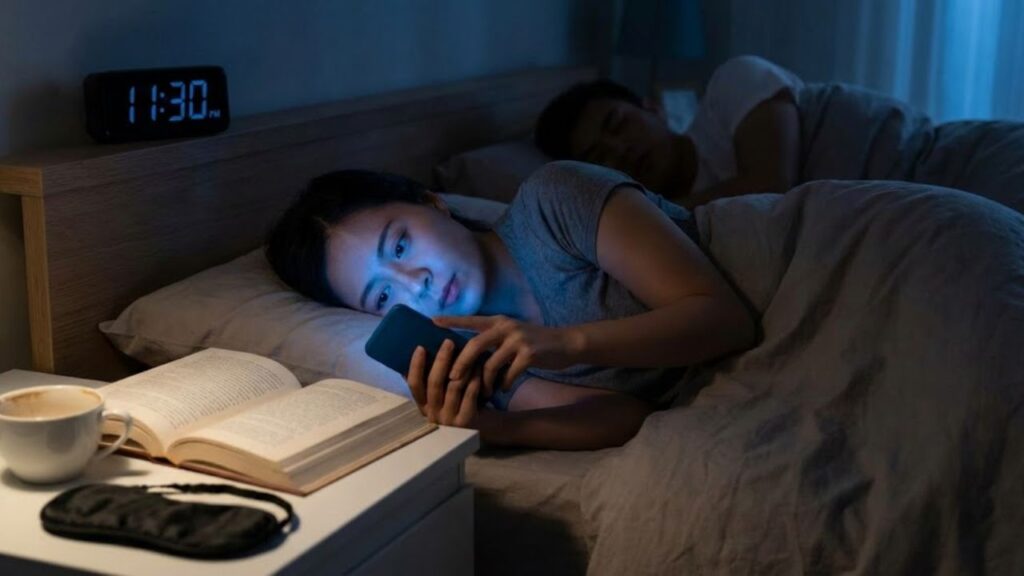
But five minutes turns into ten, then twenty. Your eyes begin to sting, but your brain feels oddly alert, buzzing with energy. Finally, you put the phone down, roll over to your side, and close your eyes. But instead of rest, the silence feels loud, the darkness seems too bright, and your thoughts race uncontrollably.
Researchers suggest that nights like these are more than just coincidence. It’s a pattern we’re all familiar with, but its cause might be simpler than we think: your phone habits.
How Your Screen Habits Are Impacting Your Sleep
For years, sleep advice has followed a familiar formula: go to bed at the same time, ensure your room is dark, and avoid caffeine in the late hours. While these tips still hold value, research suggests that there’s something even more subtle at play: our screen habits.
When and how we use our phones during the day — especially in the evening — can subtly alter our brain’s internal clock. One study, published in *Sleep Health*, tracked people who spent over four hours daily on their phones. The results showed that those with late-day screen use didn’t just go to bed later but struggled with sleep quality, falling asleep slowly, waking up during the night, and waking up feeling tired.
Further research on college students’ bedtime scrolling revealed an interesting finding. While students thought they were only scrolling for 10–15 minutes before bed, the data showed they were actually spending around 45 minutes. This gap between perception and reality is where sleep disruption happens.
Why Digital Distractions Keep You Awake
It’s not just the blue light from your screens that messes with your sleep; the content itself also plays a significant role. The constant cycle of novelty, emotional spikes from social media or news updates, and unresolved mental tasks from emails and work create a sense of alertness in your brain.
Your nervous system doesn’t distinguish between urgent work issues and scrolling through late-night news. To your body, all of these stimuli are the same, keeping you in a heightened state that delays sleep.
Simple Strategies for Better Sleep Without Giving Up Screens
Sleep researchers aren’t recommending complete digital detoxes, but instead suggesting a few simple adjustments to your phone habits. One approach, known as the “screen buffer zone,” involves setting a cut-off time — for example, 10:30 p.m. — after which your phone stays away from the bed. Keep it in another room or on the other side of the room, and spend the last hour of your evening doing low-tech activities that don’t spike your brain’s activity. Whether it’s reading a book, stretching, taking a hot shower, or even folding laundry, these activities signal to your brain that it’s time to wind down.
Trying to completely ditch screens after 9 p.m. can feel overwhelming, and for most of us, that’s not realistic. Instead, experts suggest “screen dimming.” Lower the brightness, switch to night mode, or mute group chats after a certain hour. Another helpful tweak is to move your most stimulating apps — like social media, email, or news — off your home screen. The added step of finding them creates just enough friction to make you reconsider if that’s how you want to end your day.
How Your Evening Routine Sets the Tone for Sleep
Our evenings are full of small, seemingly insignificant choices that actually send powerful signals to our brain. Each ping, scroll, or late-night message is a subtle cue to stay alert. While some nights, like during emergencies or deadlines, it’s unavoidable, there’s usually room on quieter evenings to make better decisions. The key is to notice when the quiet moments arrive and decide how to spend them.
Rather than thinking in terms of “digital detoxes,” consider how these little evening habits influence your body’s sleep-wake signals. The reality is that your screen behavior isn’t just background noise; it’s shaping the quality of your sleep in subtle yet powerful ways.
| Key point | Detail | Value for the reader |
|---|---|---|
| Timing of screen use | Late-evening phone and device use delays melatonin and keeps the brain on alert | Helps explain why falling asleep feels harder on “phone-heavy” nights |
| Type of content | Emotionally charged apps (social, news, email) trigger mental and physical arousal | Guides which apps to avoid close to bedtime for **calmer, deeper sleep** |
| Small behavioral tweaks | Screen buffer zones, moving apps, dimming screens, changing bedroom phone location | Offers concrete, realistic steps that can improve rest without a full digital detox |