
The warning arrived just after 3 a.m. inside the Jet Propulsion Laboratory in Pasadena. On one of the many screens the night crew had scanned endlessly, a thin, nearly anonymous spike rose out of the background radio noise. It lasted less than ten seconds. Coffee cups were left untouched. Conversations died mid-thought. It was the kind of silence that settles in only when something enormous might be unfolding, but no one wants to say it first.
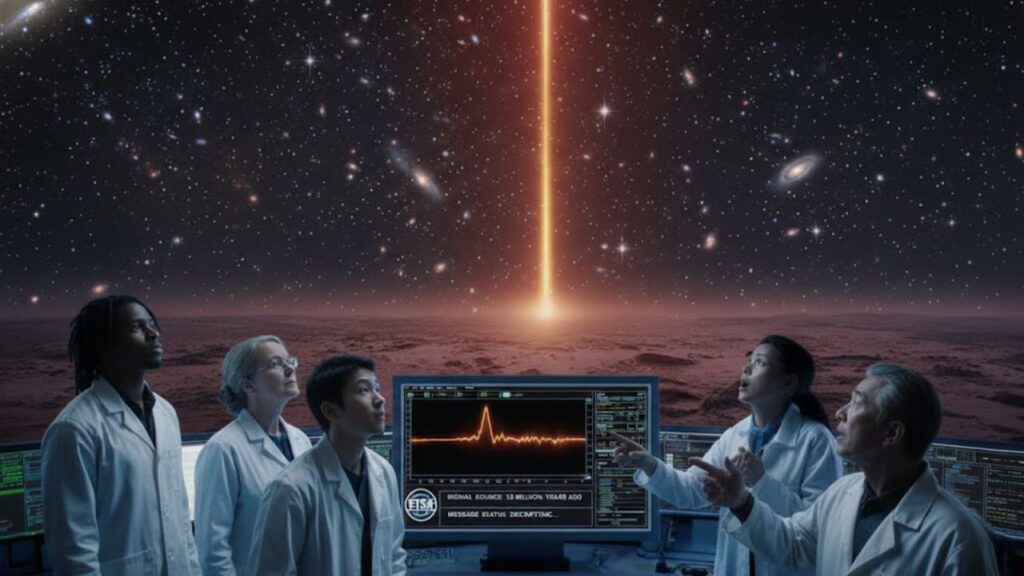
Then the data began to align: the redshift, the energy profile, the time delay. Thirteen. Billion. Years. A faint echo from an era before planets like Earth existed, before humans, before temples or scriptures. Just a young, forming universe.
Eventually, someone voiced the question now echoing far beyond that room.

What if this forces us to rethink what we believe about God?

The ten-second NASA signal that stunned researchers
On paper, the discovery sounds almost dull. A ten-second radio burst, buried deep in data from a long-running space survey. Narrow in frequency. Repeating in a pattern that doesn’t cleanly match anything already cataloged. On the monitors, though, it appeared as a sharp, bright spike—too precise to dismiss as noise, too strange to feel routine.
Astronomers are trained skeptics. Their first instinct was to blame equipment glitches, satellites, or everyday interference. Question the instruments, not the cosmos.
But each attempt to explain it away only deepened the mystery. The measured delay placed the source roughly 13 billion light-years from Earth. In other words, what we detected today began its journey when galaxies were still in their infancy.
Pause on that scale. Thirteen billion years ago, Earth did not exist. The Sun had not yet formed. Life, as we understand it, was nowhere on the scene.
Yet in 2026, a brief cosmic ping arrived like a long-lost postcard from a universe barely old enough to host stars. Officially, NASA’s internal teams describe it as an “anomalous transient event.” Privately, one scientist admitted it was “the strangest thing we can’t casually blame on our own technology.”
Satellites were checked. Military systems reviewed. Known pulsars and obscure space debris ruled out. Nothing fits neatly. Which explains why headlines leapt to the question people hesitate to ask aloud: was something trying to communicate?
Science first, speculation later
Before jumping to aliens or angels, researchers urge restraint. Space is loud. Fast radio bursts, magnetars, and stellar collapses produce dramatic signals all the time. The leading explanation remains a rare natural phenomenon from the early universe, possibly warped by matter between its source and Earth.
Still, the pattern refuses to line up perfectly with known events.
That’s where the story splits. One path is purely scientific: catalog the signal, run simulations, and aim more telescopes at that pinpoint of sky. The other path is cultural and spiritual. If the structure truly originates from such an ancient epoch, it presses on questions about creation timelines and human centrality in the universe.
The signal itself is just data. The impact lies in what that data challenges us to reconsider.
When belief encounters a 13-billion-year echo
Behind closed doors, an informal protocol is already in motion. Raw data is being shared with international research teams. Claims are being restrained. Calculations are being checked and rechecked before anyone speaks publicly.
According to one researcher, the burst is being tested against every decoding method available, from simple pattern recognition to advanced language models. Not because anyone expects a message—but because ignoring the possibility would be irresponsible.
At the same time, NASA’s outreach teams are quietly consulting religious scholars. The goal isn’t to challenge faith, but to prepare for the cultural shock. If evidence ever suggests the signal carries designed information, the conversation shifts beyond physics into questions of purpose and origin.
History offers parallels. For some believers, faith wobbled when they learned the universe is billions of years old. For others, it was seeing astronauts read Genesis while orbiting the Moon—science and belief sharing the same moment.
 Goodbye Hair Dye for Grey Hair: The Conditioner Add-In That Gradually Restores Natural Colour
As early rumors spread online, clergy across traditions felt the ripple. A priest in Brazil shared that teenagers in his congregation asked whether “God forgot to mention earlier creations.” A Muslim astrophysicist in the UK spent days answering the same question: “If life came before us, are we still special?”
This isn’t abstract theology. It’s personal, late-night uncertainty.
Faith under pressure, faith adapting
Responses from religious communities are already diverging. Some insist that any hint of ancient intelligence contradicts sacred narratives placing humanity at the center. Others argue the opposite: a larger, older universe may expand the idea of God, not diminish it.
History suggests belief systems endure shocks. Heliocentrism, evolution, and Big Bang cosmology were once seen as existential threats. Over time, they were woven into new interpretations and teachings.
The real risk isn’t sudden collapse. It’s the widening gap between rigid doctrine and emerging evidence, leaving many people alone with doubts they feel unable to voice.
Living with a universe that refuses to stay simple
If this story unsettles you, one small step can help. Write down your first, unfiltered reaction—fear, excitement, anger, curiosity. Then ask yourself which part of your belief feels threatened.
You may discover it isn’t faith itself, but a timeline, a childhood explanation, or the assumption that humans are the only story that matters. Separating those layers can clarify what truly matters to you.
Online, simplified takes spread quickly: “Signal disproves religion”, “NASA confirms ancient gods”. Few people read the underlying research.
The danger lies not in telescopes, but in oversimplification. Dismissing science as a hoax or declaring faith obsolete are both shortcuts that avoid the harder work of updating our understanding without destroying it.
As one rabbi-astronomer put it, “Every time the sky grows larger, people panic. A generation later, that larger sky feels normal.”
Better ways to respond to cosmic news
- Ask deeper questions – Move beyond “Does this end religion?” to examining which assumptions are being challenged.
- Follow the real data – Look for preprints, mission updates, and peer-reviewed research before sharing dramatic claims.
- Talk across belief lines – Scientists and believers often share more ground than headlines suggest.
- Allow emotional delay – Understanding can arrive faster than acceptance, and that gap is human.
- Leave space for awe – A brief echo from 13 billion years ago invites humility, whatever language you use for it.
A signal, a story, and the unknown between
The most unsettling detail is that we still don’t know what the signal means. For now, it remains a spike in a dataset, a location in space, a pattern that resists tidy explanation.
And yet, from those ten seconds, we’ve already spun questions about souls, scripture, and our place in an ancient universe. That impulse itself is deeply human.
Perhaps the tension isn’t between science and religion, but between two ways of handling uncertainty. One seeks fixed answers. The other accepts revision and update. Most of us live somewhere in the middle.
If the signal proves to be a rare cosmic quirk, faith will endure. If it turns out to be a crafted message from a mind older than our planet, faith will endure as well—though reshaped.
The question hanging over telescopes and temples alike is simple and profound: are we willing to let our image of the divine stretch enough to hold a universe this vast, this ancient, and possibly this full?

Key takeaways at a glance
- Age and nature of the signal – A ten-second burst traced to roughly 13 billion light-years, marked by an unusual pattern.
- Impact on belief systems – Challenges ideas about human centrality, creation timelines, and divine purpose.
- Personal response tools – Reflection, careful sourcing, and open dialogue help navigate the uncertainty.
