
The boat is eerily quiet. No engine noise, no shouting—only the creaking of the boat and the gentle slap of the waves against the hull. Three people lean over the side, arms braced and eyes focused on a shifting shadow beneath the surface. The water is almost unreal, bright and clear, and suddenly, the shadow rolls, revealing a band of metallic blue that seems more like chrome than flesh.
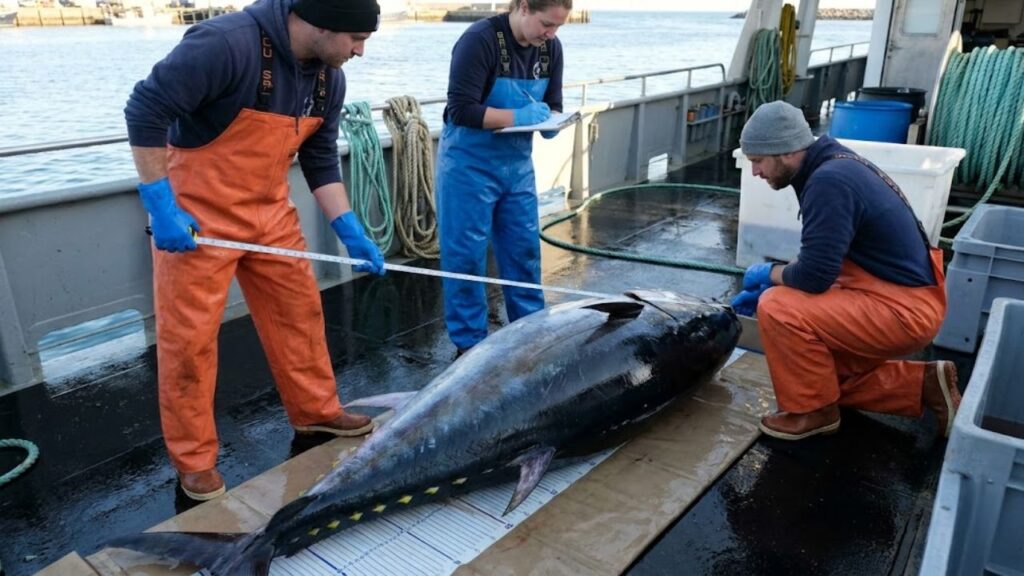
A bluefin tuna. Enormous.
The biologists don’t cheer. There’s no time. Someone calls out the length, another reads the tag number, and someone else taps on a waterproof tablet, recording the exact second. The fish floats in an underwater cradle, its tail still moving like a stubborn heartbeat.

Though no one says it, they all know—this is the kind of animal you might see once in a lifetime.
 $2,000 Direct Deposit for U.S. Citizens in February Eligibility, Payment Dates & IRS Instructions
The True Nature of a Bluefin Tuna
From a distance, a bluefin tuna is just a massive fish. But up close, its sheer size changes the air on the deck. Its body is thicker than a human torso, its head almost sculpted, with black, steady eyes and pectoral fins resembling short, rigid wings.
The one that surfaced off the coast last month was the kind of giant that old-timers say doesn’t swim these waters anymore. Nearly three meters long, with a girth so large that two scientists struggled to stretch a tape measure around its belly. No one talked about dinner. All anyone could say was, Look at the size of that thing.
This encounter wasn’t a TV crew on a trophy boat. It was a group of marine biologists running a research program, strictly following peer-reviewed protocols. Every action was carefully planned. How long the tuna could stay in the cradle, where to place the tags, and how to ensure the measuring board was positioned so the tail fin didn’t “cheat” the length.
Years of hearing dockside legends about “monsters” that weighed “easily 1,000 pounds” had finally led to this moment. Now, they had to separate bar talk from data. That meant no guessing, no rounding up for drama, and no inflating numbers for headlines.
The process was surprisingly humble for such a powerful animal. Standardized measuring boards, laser rangefinders as backups, fixed cameras, and an agreed-upon definition of “length.” Was it the total length to the tip of the tail, or fork length to the split? That simple decision could alter a record.
The Power of Peer-Reviewed Protocols
Protocols exist to prevent confusion. More than one lab, more than one ocean, and more than one generation of researchers use the same language. The numbers recorded from this giant bluefin weren’t just large—they were comparable. That’s what turned a deckside “wow” into a scientifically confirmed rarity.
The Behind-the-Scenes Process of Measuring a Sea Titan
The practical side of measuring a giant bluefin begins before the fish even appears. On the research boat, everything is prepared like a small field hospital: padded cradle, oxygenated seawater pump, sterilized tagging gear, flexible tape, rigid measuring board, and cameras with time stamps synced to GPS.
When the tuna is brought alongside, everything becomes almost surgical: minimal stress, maximum precision, and strict time limits. The fish is guided into the cradle, belly supported, gills flushed with clean seawater. A researcher calls out “start” as soon as the fish stabilizes, and from that moment, the clock begins ticking—no negotiation on handling time.
Here, the romance of “sea monsters” meets the reality of careful, precise work. One scientist checks the gills, another lines the snout against the measuring board’s zero mark, and a third stretches the tape gently along the lateral line while another records the numbers. Every action is critical.
What people don’t see in social media photos is how fast everything must happen. There’s no second chance to remeasure a fish that’s already been released. A single mistake in this process means lost data, not just a blurry photo.
Why Every Measurement Counts
Why such precision for a single measurement? Because size and estimated weight are just small pieces of a larger puzzle. Bluefin tuna are heavily fished, migratory, and capable of crossing oceans faster than most cargo ships.

To determine if a population is recovering or quietly collapsing, scientists need hard data on size, age, and growth over time. This is why protocols are published, critiqued, and refined in peer-reviewed journals. Once agreed upon, these protocols can be applied globally—ensuring that data from one sea can be compared to another, revealing trends that would otherwise remain hidden.
Turning a Measurement Into Scientific Fact
On deck, the process is nearly choreographed. First, the fish is aligned. The snout touches a rigid vertical stop, nothing flexible that could compress and shave off a precious centimeter. Then, the standard is chosen: fork length is used in most bluefin studies, from the snout to the middle fork of the tail, as it’s less affected by torn or bent fins.
The scientist at the tail reads the point where the fork meets the scale, loud enough for the data recorder to hear. A second person confirms the number. A third person takes a photo from directly above, using a fixed pole mount to avoid distortion. Every step has a purpose, and every purpose is backed by methods published in scientific papers.
This is where many “record fish” stories fall apart. Anglers may guess the length based on someone’s outstretched arms or weigh a tuna on a dockside scale. While these make for great memories, they don’t provide reliable data.
Researchers, on the other hand, are driven by a quiet frustration. The protocol is demanding, the sea is chaotic, and some fish simply can’t be measured without crossing the line into cruelty. So, they let them go, data-poor but alive. Not every research day is perfect—weather days, broken equipment, or fatigue can sometimes interfere.
The Journey of Raw Data
Once raw numbers leave the boat, they enter a new world. The data is cleaned, photos cross-checked against recorded lengths, and outliers—like this rare giant—are re-examined by colleagues who weren’t on the boat. If anything seems off, the measurement is flagged, questioned, or sometimes discarded.
“People imagine science as a single Eureka moment,” one of the project leaders later told me. “In reality, it’s a long series of small, boring decisions that protect you from fooling yourself.”
From Boat to Article: The Final Product
What comes out of this slow process isn’t a viral post—it’s a table in a peer-reviewed article. Hidden inside are often a few truly extraordinary fish, summarized simply:
- Confirmed fork length, based on standardized boards
- Estimated weight, using published length-weight equations
- Tagging outcome: successful or not
- Condition at release: vigorous, sluggish, or uncertain
- Follow-up data from satellite or acoustic tags
A giant bluefin that passes all these filters is no longer a rumor. It becomes a solid datapoint capable of influencing conservation decisions and policy changes.
The Impact of a Rare Giant
The story of this one fish doesn’t have a neat conclusion. After the measurements and tagging, the cradle was lowered, and for a moment, the tuna hung there, suspended between the boat and the sea, before it kicked once and vanished into the depths.
There was no champagne or trophy photos. Just a quiet understanding that they had met something rare and wild. And that’s the strange thing about encounters like this. A confirmed giant gives hope: some fish are still living long enough and growing large enough to reach their old, mythic sizes. But the very fact that these giants are “rare” speaks volumes about what’s been done to the oceans in the past century.
These protocols, the measuring boards, the peer-reviewed papers—they are all a human attempt to document what’s left, and perhaps influence policy before things get worse. A single oversized bluefin can move a quota negotiation, a conservation plan, or a public debate by just a few crucial degrees.
You don’t need to be a scientist to see the value in that. The tuna in your sushi, the price of a steak at a coastal restaurant, and the decision to eat less of a threatened species—or to support better management—are all tiny votes cast in a much bigger election.
Key Takeaways
- Standardized measurements use fork length and rigid boards, ensuring the difference between real data and fish tales.
- Peer-reviewed protocols allow methods to be shared and critiqued across research teams, ensuring trustworthiness in “record” tuna claims.
- Conservation impact shows that rare giants influence stock assessments and quotas, highlighting how a single measured fish can affect what ends up on your plate.
