While many polar bear populations are shrinking and starving as sea ice vanishes, researchers in Norway’s high Arctic have found a striking exception: bears in the Barents Sea region are actually gaining weight and improving their physical condition, even as the ice around them retreats faster than almost anywhere else on the planet.
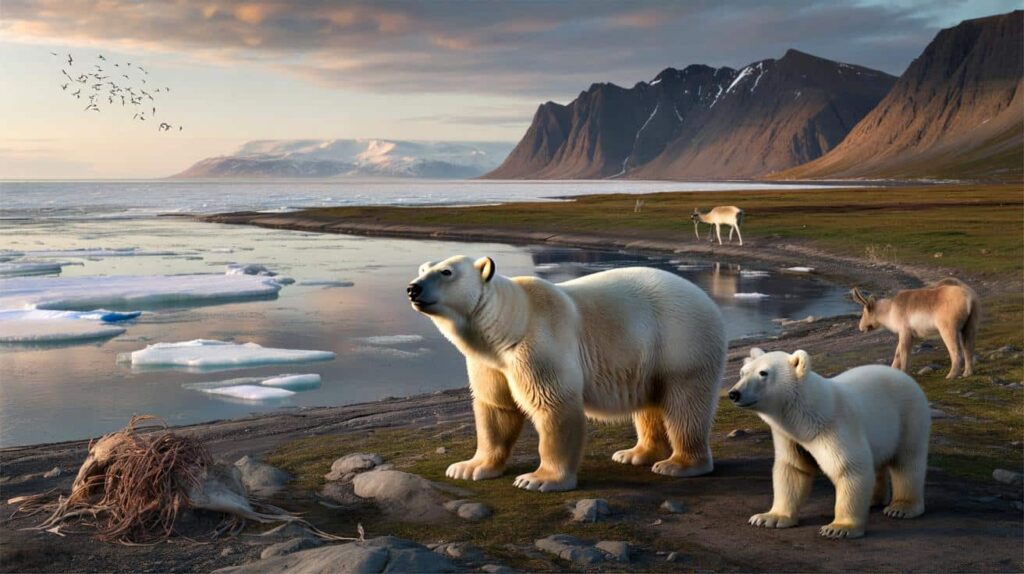
Thawing ice, unexpected bears
Across much of the Arctic, the link between vanishing sea ice and struggling polar bears is brutal and direct. Less ice means fewer chances to hunt seals, the bears’ most energy-rich prey. That has translated into thinner adults, fewer cubs and falling survival rates in places like Hudson Bay and Baffin Bay in Canada.
In the Barents Sea, off the coasts of Norway and Russia, the backdrop is even harsher. Parts of this region have warmed by up to 2°C per decade in recent decades, outpacing many other sections of the Arctic. Sea ice there has been disappearing at more than twice the rate recorded in other polar bear habitats.

Scientists expected the Barents Sea bears to show the same grim pattern seen elsewhere: less ice, leaner bodies, fewer healthy mothers and cubs.

A new study, published in the journal Scientific Reports and led by Norway’s Polar Institute in collaboration with UK and Canadian researchers, set out to test that assumption using a rare long-term dataset from the Svalbard archipelago.
The 27-year experiment written in ice
Researchers examined 1,188 body measurements from 770 adult polar bears captured and released around Svalbard between 1992 and 2019. They then compared those data with how many days per year the region was effectively ice-free.
Over those 27 years, the number of days bears spent without access to sea ice increased by roughly 100. That is a huge shift for an animal that has evolved to hunt from frozen platforms.
For the first few years, the findings matched expectations. From about 1995 to 2000, the bears’ overall body condition dipped. With more open water and less hunting time on ice, the bears appeared to be paying an energetic price.
Then the trend flipped.
After an initial decline, polar bears around Svalbard became fatter and physically better off in the next two decades, despite spending far more time in an Arctic with reduced sea ice.
By the late 2010s, the typical Svalbard polar bear was carrying more fat reserves than many of its predecessors in the 1990s, an outcome that startled the research team.
A shift from ice hunters to Arctic opportunists
The key, scientists argue, lies not in the ice itself but in the bears’ remarkable ability to change how and where they feed.
Lead author Jon Aars, who heads Norway’s Polar Bear Programme, says the most likely explanation is that Svalbard bears have been able to offset their lost time on sea ice by exploiting food on land and in coastal waters.
Instead of relying almost entirely on ringed and bearded seals caught from the ice, many bears are broadening their diets. Observations and tracking data suggest several new or increasingly important feeding strategies:
- Scavenging carcasses of walruses and other marine mammals that wash ashore
- Preying on Svalbard reindeer when the opportunity arises
- Raiding seabird colonies for eggs and chicks, especially in summer
- Taking advantage of coastal seals that haul out near land
Researchers have seen more bears spending summertime on land, particularly in western Svalbard, where they roam along cliffs, islands and beaches raiding nests of nesting birds. In eastern Svalbard, more adult females are now recorded in areas close to large seabird colonies.
Svalbard’s bears are behaving less like strict sea-ice hunters and more like flexible, opportunistic predators, tapping into whatever calories the fast-changing Arctic offers.
Why Svalbard is different from other polar bear hotspots
The study highlights that not all Arctic regions are equal when it comes to wildlife resilience. Local geography and ecology seem to give Svalbard’s bears a short-term advantage.
Several unique features stand out:
| Factor | Role in Svalbard |
|---|---|
| Steep coastlines and islands | Provide dense seabird colonies with eggs and chicks within reach of bears |
| Reindeer populations | Offer an extra on-land prey source not available everywhere in the Arctic |
| Walrus recovery | More walruses mean more carcasses for scavenging along coasts |
| Shallow coastal waters | Support seals and other marine life near shore, accessible even with less sea ice |
In contrast, polar bear groups in flatter, more isolated coastal areas with fewer alternative prey species have far less ability to switch diets. There, the loss of sea ice directly strips away the bears’ main hunting platform without offering many new food opportunities.

Scientists warn against climate optimism
Despite the seemingly upbeat picture, the researchers behind the Svalbard study are far from relaxed.
The study looked only at body condition, a crucial indicator for survival, but not at other metrics such as overall population size, cub survival or long-term reproductive success.
A healthy-looking bear is not necessarily part of a thriving population; fertility, cub survival and long-term numbers can still be sliding.
Biologists point out that in many wildlife populations, noticeable declines in survival or birth rates often come only after body condition worsens. The fact that Svalbard bears are still in good shape suggests serious demographic impacts might lag behind the current observations.
There is also no guarantee that Svalbard’s apparent resilience will last. As the Arctic continues to warm, summers could become longer, sea ice could retreat even farther and food sources that currently help the bears might change or decline.
External experts, such as researchers from conservation group Polar Bears International, stress that this study does not overturn the broader picture: polar bears as a species remain heavily dependent on sea ice, which continues to vanish due to human-driven warming.
What “body condition” really means for a polar bear
Scientists often use body condition as a shorthand for an animal’s energy budget. For a polar bear, that usually means fat.
Thick fat reserves serve several roles:
- Insulation in freezing air and icy water
- Stored energy to survive long fasting periods when hunting is impossible
- Fuel for pregnant females, which must support both themselves and their cubs in dens
Researchers measure this through body mass, girth and other indices that reflect how much fat and muscle a bear carries relative to its size and age.
A bear in good condition can skip hunting for weeks or even months and still survive. A thin bear has far less room for error and is more likely to lose cubs or fail to reproduce at all.
Future scenarios for Svalbard’s “fat” bears
Projecting what comes next for this population is tricky. The current data tell a story of short-term adaptability but leave big questions about the next few decades.
Several plausible scenarios are on the table:
- Short-lived reprieve: Bears continue benefiting from reindeer, seabirds and carcasses for a while, but these food sources get overused or shift as the climate keeps warming.
- New competition: As open water increases, other predators or human activities could move north, competing with bears for the same prey or disturbing hunting areas.
- Population tipping points: Even if individual bears remain relatively fat, subtle drops in cub survival or female fertility could quietly push the population downward.
There is also a risk that people misread this study as evidence that polar bears will adapt everywhere. The researchers are clear: Svalbard’s experience seems tied to very specific local conditions and should not be seen as a universal model for the species.
What this means for climate and conservation debates
The Svalbard findings add nuance to public conversations about climate change and wildlife. They show that responses to warming can be complex, with some populations finding temporary workarounds even under extreme pressure.
For conservationists, the study underlines the value of long-term monitoring: without nearly three decades of data, this unexpected trend would have gone unnoticed. Extended datasets allow scientists to separate short-term fluctuations from meaningful shifts and to detect subtle warning signs before a population collapses.
For anyone trying to understand climate risks, the message is less about hope and more about realism. Some polar bears, in some places, are managing to stay fat in a rapidly changing Arctic. The bigger question is how long those adaptations can hold as the ice that shaped their species continues to melt away.