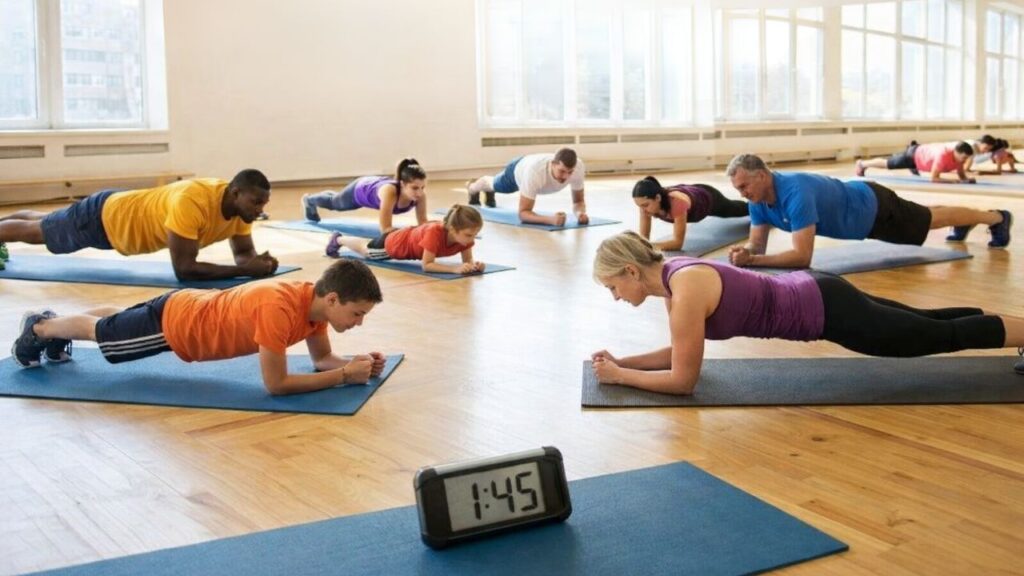
The mat feels cool beneath your arms. Your toes press down, your legs engage, and your breathing gradually becomes steady and controlled. Somewhere between the tightness in your core and the focus in your mind, a familiar question arises: how long should this hold last? Ten seconds, thirty seconds, or a minute that feels endless? Planks are often treated as a simple, one-size-fits-all exercise, but in reality, they are a dynamic relationship between your body and gravity, constantly changing as you age. What feels effortless at 18 can feel demanding at 48 and requires thoughtful care at 68. At every stage of life, your core remains the central support system that stabilizes your spine, protects your back, and allows smooth, confident movement. The ideal plank duration is not about ego or endurance—it’s about understanding your body exactly as it is today.
Understanding Plank Hold Timing
The Silent Work Happening Inside Your Core
Most workouts announce themselves loudly—weights clanging, feet pounding, breath rushing in and out. Planks are different. You align your body into a single, steady line: shoulders stacked over elbows or wrists, heels reaching back, head balanced and relaxed. From the outside, almost nothing moves.
Inside, however, there is intense coordination. The transverse abdominis tightens like a natural corset, the multifidus offers quiet spinal support, the diaphragm connects breath to effort, and the pelvic floor provides stability from below. These deep muscles thrive on calm, precise engagement, not brute force or dramatic strain.
This is why quality matters more than duration. A shaky, collapsing one-minute plank offers fewer benefits—and more risk—than a solid twenty-second hold performed with control. Time plays a role, but only up to the point where your alignment begins to fade.

Why Longer Is Not Always Better
Fitness culture often glorifies extremes—two-minute holds, five-minute challenges, viral videos of trembling bodies pushing through pain. Over time, this has created the belief that longer automatically means stronger.
The reality is more subtle. Beyond a certain point, extending a plank improves tolerance for discomfort more than it builds functional strength. Research and experienced coaches consistently point toward shorter, high-quality holds repeated regularly as being more effective for core strength and spinal health than occasional endurance tests.
Long planks are not inherently harmful, but their benefits diminish while the risk of fatigue-related misalignment increases. With age, the focus naturally shifts from “How long can I last?” to “How well am I supporting my body right now?”
Age, Gravity, and Core Strength
As the years pass, the body’s equations change. Recovery slows, tissues become less forgiving, and balance requires more attention. A plank that once felt automatic may now demand focus—and that shift reflects normal biology, not decline.
Rather than following a rigid rule, it helps to work within flexible ranges. The goal is to stop just before your form begins to unravel. Below are realistic guidelines for healthy adults without major injuries or medical concerns.
General Plank Hold Guidelines by Age
- Teens (13–19): 20–40 seconds, 2–4 sets, 2–4 days per week
- 20s–30s: 30–60 seconds, 2–4 sets, 3–5 days per week
- 40s: 20–45 seconds, 2–4 sets, 3–4 days per week
- 50s: 15–40 seconds, 2–3 sets, 2–4 days per week
- 60s–70s+: 10–30 seconds, 2–3 sets, 2–4 days per week
These ranges are reference points, not judgments. Falling above or below them is perfectly fine. What matters is the integrity of each second you hold.
How Plank Needs Change Across Life Stages
Your 20s and 30s: Strength Without Limits
In your 20s and 30s, recovery tends to be fast and tissues are resilient. This often encourages longer plank holds, and with proper form, thirty to sixty seconds can be an effective training zone.
 Goodbye Hair Dye for Grey Hair: The Conditioner Add-In That Gradually Restores Natural Colour
The main risk during these years is overlooking subtle breakdowns—hips dipping, shoulders creeping upward, or the lower back quietly straining. Dividing your effort into multiple shorter, controlled holds often delivers better results than a single exhausting attempt.
Your 40s: Power With Precision
By your 40s, the body communicates more clearly. Past injuries make themselves known, stiffness appears sooner, and strength demands greater respect.
For many, the most effective plank range now sits between twenty and forty-five seconds, repeated across a few sets. Some days support longer holds; others call for stopping earlier. The priority becomes long-term sustainability rather than pushing limits.
Your 50s, 60s, and Beyond: Smart Strength
Later decades redefine what strength looks like. Muscle mass may decline gradually, balance may shift, and recovery may take longer—but progress remains possible.
Shorter holds of ten to thirty seconds, performed with excellent alignment, can be highly effective. Modified options such as knee planks or incline planks are not shortcuts; they are thoughtful adaptations that protect joints while maintaining core engagement.
Recognizing the Right Moment to Stop
Your body always signals when a plank moves from beneficial to risky. Common signs include lower back sagging or discomfort, shoulders lifting toward the ears, breath holding, or facial tension taking over. The moment these appear, it’s time to stop.
Ending a set when form fades is not failure—it’s skilled training. Over time, this approach builds efficiency, not breakdown.
Making Planks a Sustainable Habit
Planks don’t need to be dramatic or exhausting. They can fit easily into daily routines—a brief hold before coffee, another after work, one more before bed. These small, consistent efforts accumulate into meaningful, lasting strength.
The true reward isn’t a record-setting hold. It’s the quiet confidence of standing taller, moving more freely, and supporting your body through everyday life. Hold as long as your form stays honest. Rest. Repeat. That’s where real core strength grows.