
The first sound the crew heard wasn’t a crunch. It was a deep, metallic groan that echoed through the hull — the kind of noise that silences every person on board at once. The 37-meter cargo vessel, crossing the North Atlantic, slowed as if held back by an invisible force. Then, the wheel jerked violently.
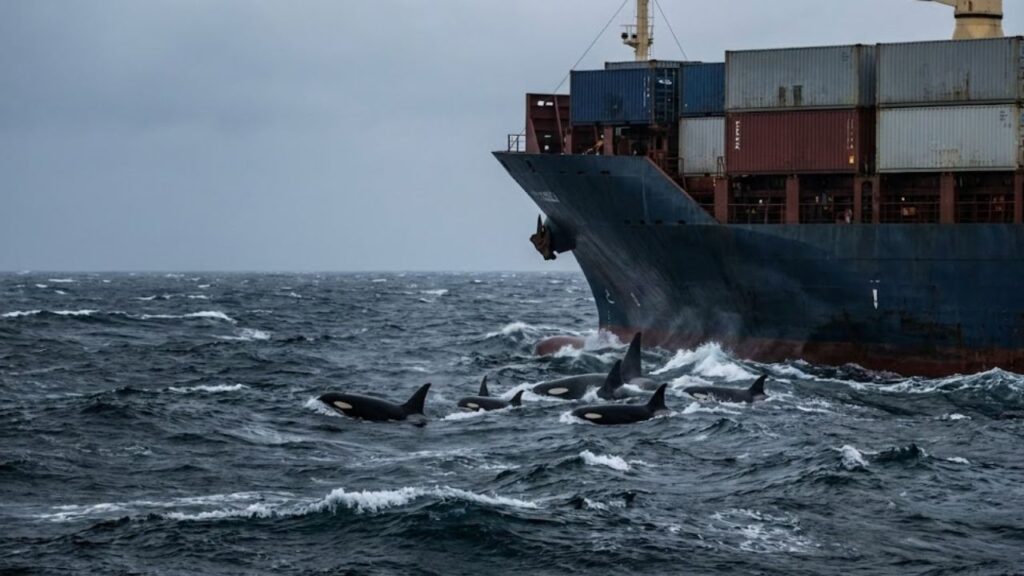
On the surface, black-and-white shadows moved with eerie precision around the rudder. One orca rammed it, another bit at the blade, and a third circled, seemingly waiting its turn. The captain quickly ordered the engines to neutral. A deckhand claimed to feel the impacts through his boots.
Minutes later, the boat drifted, its engine still running but steering disabled. The orcas disappeared as if their task was complete.

The Changing Relationship Between Orcas and Ships
For decades, orcas were just a graceful sight in the North Atlantic — a dorsal fin breaking the surface, a rare photo, or a story to tell back home. But now, captains are logging them in a new way: as hazards. Ship logs from Spain, Portugal, France, and even farther north are increasingly reporting the same unsettling pattern: pods targeting rudders.

We’ve always seen whales as the victims of ships — hit by propellers, caught in nets, or disrupted by noise. But now, this narrative is reversing. The sea lanes are still busy, but some ship crews have quietly shifted from admiration to anxiety.
While the word “war” may not be used, the term “assault” is popping up frequently in reports.
A Growing Threat
The situation gained widespread attention after a series of incidents near the Iberian Peninsula, eventually spreading into the Bay of Biscay and further across the North Atlantic. At first, it sounded like maritime folklore: killer whales targeting boat parts? Then, the videos started flooding in.
Footage shows orcas approaching from behind, almost always with the same tactic: aligning with the rudder, striking it sideways, and pushing or twisting it. On smaller sailing vessels, rudders have been completely detached. Larger yachts and commercial boats experience the same pattern, but with more force and noise.
One Spanish salvage company reports that callouts due to orca damage in certain areas have become “routine.” That word, “routine,” has raised alarms for many.
Coordinated Attacks: A New Trend
Marine biologists now talk about “coordinated actions” and “socially learned techniques.” These aren’t random bumps. Orcas seem to mimic one another, refining their attack methods and teaching the behavior to younger animals.
Some experts believe this behavior could have started years ago with an incident involving a female orca injured by a boat. Others suspect that the initial curiosity evolved into something more aggressive. Regardless, the behavior is spreading throughout pods like a trend.
The truth is clear: ships are now dealing with a highly intelligent species capable of learning and adapting faster than we can adjust our rules.
How Ships Are Adapting to Orca Encounters
On the bridge, adaptation begins with an almost invisible habit: treating an orca sighting like a storm warning. Captains crossing known hot spots now follow an internal playbook. They slow the vessel when orcas appear astern and cut engines to neutral if an encounter seems imminent. Sudden course changes that mimic fleeing prey are to be avoided.
Some commercial operators are rerouting by a few dozen nautical miles, trading fuel and time for a safer journey. Other crews have even begun practicing “orca drills,” similar to fire drills, to ensure preparedness: who goes to the stern, who monitors the prop wash, and who handles communication.
The goal is not to confront the animals, but to avoid turning each encounter into a battle for control of the rudder.

The Emotional Toll on Crews
For smaller commercial boats and work vessels, the stress is real. Crews already face storms, fatigue, tight schedules, and financial pressure. Adding a six-ton predator with a taste for steel only increases the tension. Many skippers admit they used to rush through risky zones just to “get it over with.”
This response, while human, is dangerous. Speeding up increases the force of an orca’s impact. Sudden, panicked course reversals can damage steering even without an animal’s intervention. Emerging guidelines suggest a more counterintuitive approach: stay calm, slow down, and avoid giving the orcas more to “fight.”
New Safety Guidelines Are Emerging
Though no one reads every new notice to mariners immediately, more of them now mention orca-related incidents. The emerging “unofficial rulebook” for orca encounters may seem soft for a situation born from violent collisions. One marine safety trainer summarized it during a workshop for commercial skippers:
“Treat orcas less like enemies and more like powerful neighbors in a bad mood. You don’t win by shouting through the wall — you win by not starting the argument.”
Along with this shift in mindset, practical checklists are circulating: plot recent orca encounters, brief the crew on response protocols, secure loose gear, and log every incident to help researchers.
A New Understanding of the Ocean’s Predators
What unnerves many sailors isn’t just the damage but the feeling of being watched. Anyone who’s locked eyes with an orca up close knows the sensation: you are not alone, and you are not the most intelligent being in the water.
These North Atlantic encounters force a humbling realization. Modern shipping often treats the ocean as a neutral space, simply a route to be crossed. Orcas, however, are a reminder that the sea is a living territory with its own rules — rules we didn’t create.
For coastal communities dependent on commercial shipping, the situation is complex. Ports rely on ships, but tourism boards also promote orca sightings. Children grow up adoring these animals, which now challenge metal ships on their own terms.
What’s Next for Orcas and Shipping?
Experts are debating the next steps, such as dynamic exclusion zones, altered shipping lanes, seasonal slow-down corridors, or even noise-free zones to reduce sonar interference. However, these changes will not be easy to implement. Yet, doing nothing risks allowing the whales to set the rules.
The North Atlantic has always been a negotiated space, but now the negotiation is visible.
If these coordinated attacks continue, we might someday tell future generations about the moment when orcas began to rewrite our shipping routes. No longer myths, but real-world issues reflected in fuel costs, repair bills, and insurance premiums.
Whether we see orcas as avengers, pranksters, or just highly focused problem-solvers, they are forcing shipping companies, regulators, and scientists into the same conversation. This could be a pivotal moment in how humans coexist with apex predators.
The coming years will reveal whether we respond creatively or try to deny the situation. One path aims to outsmart the orcas, while the other seeks to live with them. Either way, the days of viewing an orca’s dorsal fin as just a social media snapshot are rapidly ending.

Key Takeaways
- Orca attacks are coordinated: Pods are repeating rudder-targeting tactics across the North Atlantic, showing a learned behavior.
- Ships are adapting: Operators are adjusting routes, reducing speed, and rehearsing “orca drills” to avoid collisions.
- Future sea rules are being discussed: The debate over dynamic exclusion zones, altered shipping lanes, and coexistence with orcas is just beginning.
