
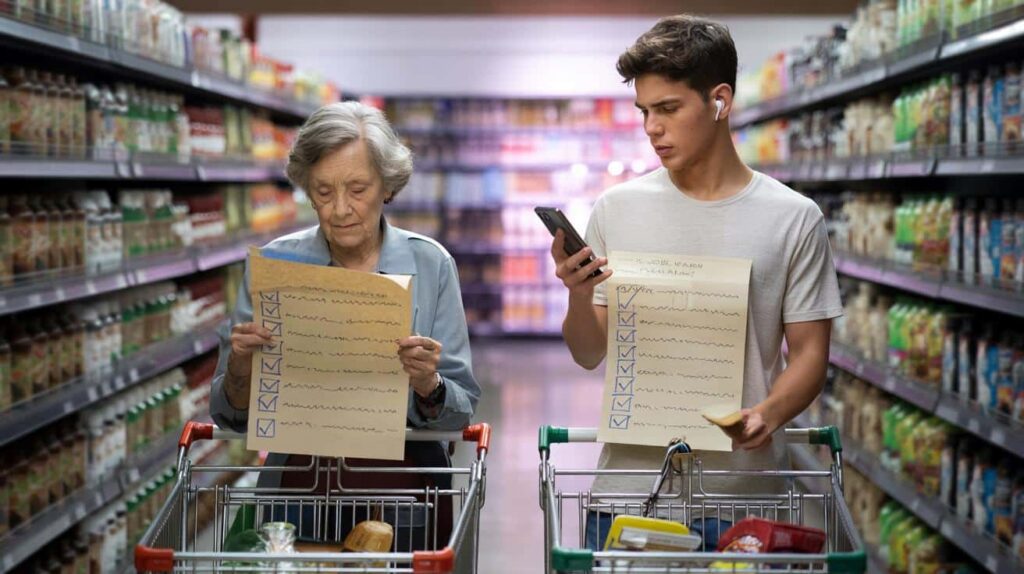
Behind her, a teenager sighs, eyes glued to his phone, earbuds in, contactless card ready. She has a paper list, folded and refolded, with every item ticked in blue ink. He scrolls his notes app and mutters that his battery is dying. Two worlds in the same aisle, bumping trolleys, silently judging each other.
Outside, at the bus stop, an older man checks his paper timetable, then glances at the actual street, scanning for the bus with a practised eye. The students next to him stare at a glitchy app and complain that “the system is broken”. He shrugs, adjusts his watch, and relaxes. He has already built his margin of error into the day.
Who looks outdated here – and who is quietly winning the mental game?

Why “old‑fashioned” habits survive in a world that mocks them
Ask any group of twenty‑somethings and they’ll have a long list of “boomer behaviours” they love to imitate. Writing everything in a physical diary. Always sitting at the same spot at the table. Keeping paper bank statements in a labelled folder. It looks rigid from the outside, almost comically so. Yet watch closely and you’ll see something else: less fumbling, fewer last‑minute panics, a kind of calm that doesn’t quite fit our frantic, notification‑driven era.

What younger people call “stuck in their ways” often looks, to a psychologist, like a carefully built autopilot. Habits that seem laughably old‑school are quietly doing a big job in the background: cutting down the number of choices a brain has to make, hour after hour. That’s not stubbornness. That’s strategy.
Take the classic “same breakfast every day” grandparent. Online, that’s an easy meme. In real life, it’s a striking example of mental load management. Oats, half a banana, one mug of tea. No daily debate over smoothies, cereals, intermittent fasting windows or protein targets. Their morning starts almost automatically. Decision count: near zero. Stress level: lower than you’d think.
Now contrast that with a twenty‑something scrolling food videos in bed, overwhelmed by options before they’ve even put a foot on the floor. What looks like “freedom” comes wrapped in micro‑decisions: what to eat, what to wear, which playlist, which route to work, which app to check first. A small 2023 survey from a UK mental health charity found that younger adults report far higher “decision fatigue” than older ones, even though older participants often face heavier life responsibilities.
The older group didn’t say life was easier. They said their days were more predictable. That’s a quiet but telling difference.
Psychologists describe this gap as a clash between novelty and cognitive relief. Younger people are culturally pushed to chase the new: new shows to binge, new productivity tools, new wellness trends. Older adults, especially those who’ve lived through several “next big things”, have a different reflex. They ask, consciously or not: what can I make automatic, so my brain is free for what actually matters today?
Neuroscience backs this up. Every choice, even tiny ones, draws on limited cognitive resources. Routines and repeated patterns turn parts of life into low‑effort scripts. That can look boring from the outside, but mentally it’s like closing background apps on an overloaded phone. Less lag, fewer crashes. *More bandwidth for the unpredictable stuff that really needs your full attention.*
It’s no coincidence that a lot of these older habits cluster around daily logistics – keys, meals, bills, appointments. The unglamorous stuff that wrecks a day when it goes wrong, and disappears when it runs smoothly.
Everyday “old people habits” that secretly protect the brain
Watch an organised 70‑year‑old arrive home and you’ll notice a tiny choreography repeated every time. Keys always in the same bowl by the door. Glasses folded onto the same side table. Mail stacked in one specific spot on the counter. It’s not a personality quirk; it’s an offloaded thinking task. No wondering where things went, no frantic pat‑downs before leaving again. The home itself holds the memory.
Another favourite: the paper calendar in the kitchen. Names, appointments, birthdays, colour‑coded in pen. At a glance, the month unfolds. There’s no login, no forgotten password, no Wi‑Fi dropout. Younger relatives may grin and offer to “set them up with Google Calendar”, but hidden in that old‑fashioned wall display is a deep sense of control. You don’t scroll a kitchen calendar. You stand there, present, and look.
On a rainy Tuesday in Manchester, 32‑year‑old Hannah found herself phoning her mum in a quiet panic. She’d missed a dentist appointment, double‑booked a work call, and agreed to a friend’s birthday drinks all in the same evening. Everything lived in different apps, none of them checked at the right time. Her mother listened, then said calmly, “Love, you need a boring notebook.”
She meant what she’s always used: one cheap notebook by the kettle, everything written by hand, one line per thing. No categories, no fancy bullet journal spreads. Just one place, one habit. Three months later, Hannah still laughs about her “mum diary”, but she hasn’t missed a single appointment. Young colleagues tease her about “going analogue”. She shrugs, because her evenings feel lighter. That’s how it starts: with one unsexy, stable routine that just works.

Psychologists often talk about “externalising” memory. Instead of carrying everything in your head, you park it somewhere reliable – on paper, on a hook, in a repeated sequence of actions. Older adults, who grew up before the age of cloud storage and infinite tabs, built their lives around this principle without calling it by name. They didn’t trust devices, they trusted repetition.
What looks like fussiness – checking the stove twice, locking the door in the same order, laying out clothes the night before – reduces one of the most corrosive forces in modern life: low‑level anxiety. Every time you don’t have to ask, “Did I forget something?”, your nervous system gets a tiny rest. Accumulated over years, that matters. A predictable sock drawer can’t fix the world, but it can make leaving the house feel 10% less chaotic. That’s not nothing.
How to borrow the best of “old‑school” habits without living in the past
If you’re drowning in decisions, start small and concrete. Pick one daily friction point – mornings, commuting, going to bed – and create a shamelessly simple routine around it. That might mean eating basically the same breakfast on weekdays, laying out your clothes at night, or having a fixed, boring lunch order when you’re busy.
Then repeat it. A lot. The goal isn’t to become robotic; it’s to free up mental space. Once a habit feels so familiar you barely think about it, you’ve hit the sweet spot. You’re doing what lots of older adults already do: shrinking the number of questions your brain has to answer before 9am. And no, it doesn’t make you less creative. It gives your creativity a clearer runway.
If this sounds rigid or depressing, you’re not alone. Many younger readers worry that routines will box them in, or make life feel dull. They’ve grown up hearing that flexibility and spontaneity are signs of success. The trick is not to copy everything your grandparents did, but to steal their logic.
Choose a few areas where you want to feel lighter – food, finances, social life – and design “lazy defaults”. One simple budget check you do the same day each week. One night that’s always for staying home. One way of tracking tasks that doesn’t depend on the latest trending app. Soyons honnêtes : personne ne fait vraiment ça tous les jours. Still, doing it more often than not is what shifts the load.
Psychologist Dr Emma Westbrook, who works with burned‑out professionals in London, puts it this way:
“A lot of my younger clients are exhausting themselves chasing flexibility. Their parents and grandparents look rigid, but they’re often the ones sleeping better at night. The brain loves a bit of predictability. It doesn’t make you old; it makes you less fried.”
There’s a quiet relief in admitting that making fewer choices can be a form of self‑care. That doesn’t mean abandoning tech, or pretending you’re living in 1978. It means treating your attention as something finite, not an endless stream companies can tap with every ping and pop‑up. Some readers push back here and say they “need” their usual level of chaos to feel alive. Fair. Just notice how much of that chaos is actually draining you, not energising you.
- Start with one “non‑negotiable” routine and protect it for a month.
- Move at least one task from your head to a physical object or space.
- Ignore anyone who mocks your system; they don’t live inside your brain.
Rethinking who is really “behind the times”
On social media, older adults are often framed as the ones who “don’t get it” – the new features, the shifting language, the endless content stream. Yet when you shift the camera off the screen and into real kitchens, buses and waiting rooms, another picture appears. The people mocked for their paper habits and repetitive days are often the ones whose minds aren’t constantly sprinting.
We rarely talk about that trade‑off out loud. The cost of always being reachable. The pressure to respond instantly. The silent exhaustion of checking five apps just to meet someone for a coffee. Older adults didn’t grow up with that background noise, and many are quietly refusing to add it now. Their “old‑fashioned” ways are less about nostalgia, more about survival.
On a bad day, the routines of an older neighbour or parent can look like stubbornness. On a good day, they look like a blueprint. A reminder that life doesn’t have to be managed like a never‑ending group chat, open 24/7. One fixed walk at the same time every morning. Phone calls instead of twenty scattered messages. Lists in a notebook instead of tabs across three devices. These aren’t moral choices, just practical ones. But they add up.
On a train somewhere tonight, an older woman will fold away a crossword, close her bag, and simply sit, looking out of the window. The teenager across from her will juggle three apps, two chats and a half‑watched video, and tell you he’s “just chilling”. Both are unwinding in their own way. Only one of them, though, will stand up at their stop with a brain that feels a little less overloaded. That quiet difference is worth paying attention to, whatever age you are.

| Point clé | Détail | Intérêt pour le lecteur |
|---|---|---|
| Routines réduisent la fatigue décisionnelle | Habitudes stables comme le même petit‑déjeuner ou le même trajet libèrent des ressources mentales | Moins de stress invisible, plus d’énergie pour les vraies priorités |
| Externaliser la mémoire | Utiliser carnets, calendriers papier, emplacements fixes pour objets clés | Moins d’oubli, moins d’auto‑culpabilisation, esprit plus tranquille |
| Créer des “defaults” personnels | Choisir des options standards pour l’argent, les repas, le planning social | Simplifie le quotidien sans sacrifier la liberté réelle |
FAQ :
- Do routines make life boring?Only if you let them take over everything. A few solid routines free up energy so your spontaneous moments feel better, not smaller.
- Is using a paper diary really better than an app?Neither is “better” in general. Paper removes notifications and distractions, which can be a relief if your phone already runs your day.
- Can younger people truly benefit from “old‑school” habits?Yes. The brain mechanisms are the same at 25 or 75. Predictable patterns and external memory lighten the mental load at any age.
- What if my job demands constant flexibility?You may not control your work tempo, but you can anchor mornings, evenings or weekends with simple, repeatable rituals that act as a counterbalance.
- Is it too late to change my habits?Not really. Start with one tiny routine that feels almost silly in its simplicity. Keep it up, then build from there. Habits are slow, but they’re never closed off.
