
Around 4:45 p.m., the first flakes showed up like they always do: shy, uncertain, almost cute. People snapped photos at red lights, kids pressed their faces to bus windows, and somewhere a weather app buzzed with a red alert nobody really read. By 6 p.m., the forecast was clear: heavy snow overnight, whiteout conditions by dawn, travel “strongly discouraged.”
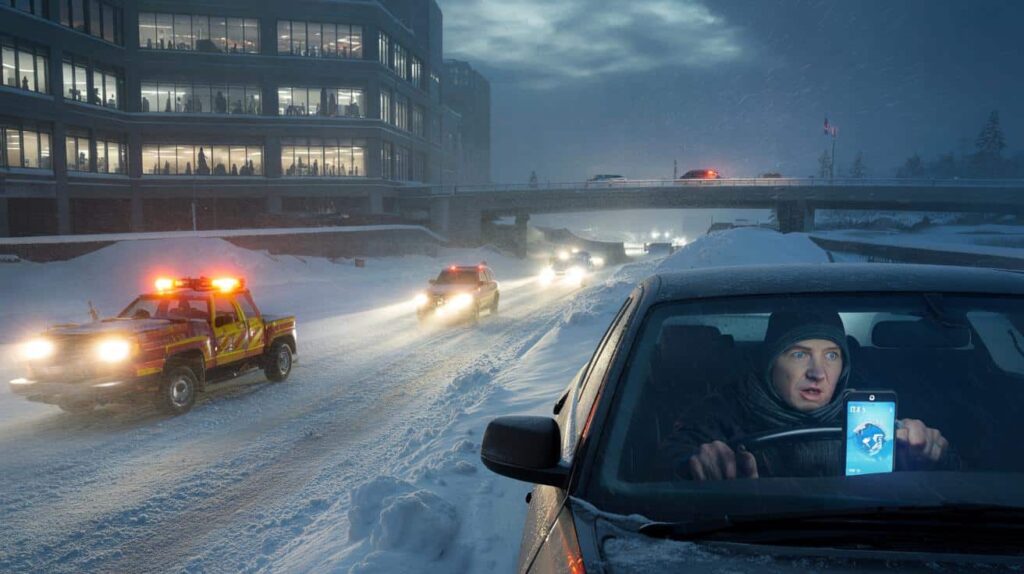
At the same time, email inboxes were filling with a different kind of warning. “Offices will remain open.” “All staff expected on site.” “Plan extra travel time.”
Two realities, one night.

As plows line up at the depot and salt trucks hum to life, a quieter tension is building in living rooms and group chats across town.

Who gets to stay home tomorrow, and who has to gamble with the road.
Storm warnings vs. office memos: two worlds colliding
By early evening, local officials were standing in front of maps streaked with blue and purple, voices steady, telling residents to avoid nonessential travel after midnight. The words have become a winter ritual: “If you don’t have to drive, stay home.” Behind those calm sentences sits a simple picture – jackknifed trucks, ambulances crawling through slush, parents stuck on freeways while schools call early closures.
A few miles away, HR departments were finalizing very different messages. Attendance required. Schedules unchanged. “Business as usual.” The snow is treated like a background detail, not a central character. One push notification begs people to stay off the roads, another quietly insists they get on them anyway.
Take Elena, who works at a call center on the edge of town. She lives 35 minutes away on a good day, along a highway that becomes a skating rink whenever snow decides to get serious. At 5:12 p.m., her phone buzzes with a weather alert: 8 to 12 inches overnight, wind gusts up to 40 mph, “near-zero visibility possible.”
Eight minutes later, her manager’s email drops in: “We plan to remain fully operational. Please plan your commute accordingly.” Elena stares at the screen, remembering last year’s storm. She spent three white-knuckled hours crawling home as tow trucks yanked cars from ditches. By the time she pulled into her driveway, she was shaking so hard she could barely turn off the ignition.
This is the quiet disconnect of modern winter life. Public safety messaging treats roads like a shared resource that must be protected. Corporate messaging treats those same roads like a private hallway between home and desk. The logic is familiar: if we close every time there’s a storm warning, businesses suffer, productivity drops, customers complain.
Yet storms don’t negotiate with quarterly targets. A forecast of heavy snow isn’t a gentle suggestion; it’s a high-stakes coin flip with real bodies in real cars. The strange thing is how normal this split has become – mayors pleading on TV for people to stay home, while thousands mentally rehearse how early they’ll have to wake up to dig out and still punch in on time.
How people actually navigate the “stay home / show up” conflict
When the alerts are screaming “do not drive” and your boss is politely hinting “you better drive,” the first thing people do isn’t rational at all. They start bargaining with the weather. Maybe the forecast is exaggerated. Maybe the heavy snow won’t hit my side of town. Maybe if I leave at 5 a.m., the plows will be ahead of me.
The more practical move begins a few hours before bed. Check your route on a map and mentally divide it into risk zones: that hill that never gets salted, the narrow bridge, the unlit stretch past the industrial park. Call a co-worker who lives nearby and compare options: carpool, remote login, delayed start. Sometimes you don’t need a grand plan; you just need a backup that lets you sleep.
We’ve all been there, that moment when you’re staring at your boots and your phone at 6:10 a.m., trying to decide if your anxiety is justified or if you’re just being dramatic. Employers usually underestimate that psychological load. They see attendance; you see the black SUV that fishtailed into your lane last winter.
A smart habit on nights like this is to document clarity before the storm hits. Ask your manager – in writing – what the policy is if road conditions become “unsafe” as defined by local authorities. That way the decision at dawn isn’t just your personal courage versus a blizzard. Too often, people internalize the risk as a character trait: “Am I tough enough to go?” when the real question is, “Is this risk reasonable for anyone right now?”
Let’s be honest: nobody really does this every single day. But whenever you can, layer your choices. Save the emergency hotline number from your city or county. Screenshot the weather alert and any traffic bans before going to sleep. If your region sometimes issues travel restrictions, know the threshold: is it 6 inches of snow, visibility under a quarter mile, or official “snow emergency” levels.

When you wake up and your driveway has disappeared under a white wall, that prep becomes less about drama and more about data. You’re no longer the lone employee “overreacting.” You’re someone aligning your decisions with explicit guidance from the same public officials your boss will hear quoted on the radio during their own drive in.
The plain truths nobody likes to say out loud
A quiet fact hangs over nights like this: some jobs genuinely can’t stop. Nurses, paramedics, utility linemen, public transit drivers, plow operators – their “stay home” option barely exists. They keep the city’s lights on while the rest of us argue about email policies and VPN access.
For everyone else, the real battle isn’t with snow. It’s with workplace culture. A culture where coming in sick used to be a badge of honor now treats driving through a blizzard as the same kind of loyalty test. There’s an unspoken message: storms are for children and retirees; adults show up. That kind of thinking quietly ignores who has an older car, who can’t afford winter tires, who lives far from bus lines. The storm hits unequally, even when the snow falls on every roof.
Middle managers often get stuck in the worst position. They watch the same press conference where the mayor begs people to stay home, then answer to senior leaders who say, “We can’t afford a closure.” Employees flood their inboxes with photos of snowed-in streets, and somewhere in between, a soft line emerges: “Use your judgment, but we’re open.”
That phrase sounds flexible, yet it puts all the risk on the worker. Use your judgment… and bear the consequences if your judgment conflicts with mine. If you’re dreading that conversation, you’re not alone. It helps to keep your language very specific: road conditions on your actual street, the local travel advisories on your route, your exact commute time. Broad fear is easy to dismiss. Clear conditions are harder to argue away.
“Public officials ask people not to drive for one simple reason,” explains a veteran highway patrol officer. “Once the roads are packed with nonessential traffic, our margin for keeping anyone safe shrinks to almost nothing.”
*That margin is exactly what vanishes when “business as usual” meets a full-blown winter storm.*
- Ask for a remote option before the storm hits – Bringing it up calmly the day before is easier than pleading at 6 a.m.
- Document local alerts – Screenshots of weather warnings and travel advisories give weight to your safety concerns.
- Know your non-negotiables – If visibility drops below a certain point, or if emergency services warn against travel, decide in advance what you will and won’t do.
- Talk in specifics, not fear – “My road is unplowed and we’re under a travel advisory” lands better than “I don’t feel safe.”
- Remember that cars and bodies are harder to replace than meetings – That’s the quiet truth behind every storm advisory.
What tonight’s storm quietly reveals about how we work
The snow that starts falling tonight isn’t just frozen water. It’s like a highlighter moving across invisible lines in our cities. Who can decide not to drive without fear of losing their job. Who has a boss they trust to weigh safety over optics. Who is expected to risk a ditch on the freeway just to sit in the same office chair they could easily reach by video call.
Storms make those lines visible for a few hours. The empty parking lots at companies that pivoted to remote work. The overfull lots at places that refuse. The buses sliding by half-empty streets while parking garages quietly fill.
Heavy snow has a way of slowing everything down, including the stories we tell ourselves about dedication and seriousness. When the roads disappear, a meeting suddenly looks less like a mountain and more like what it really is: a 30-minute conversation that can happen anywhere.
Maybe that’s why so many people feel stirred up on nights like this, checking the forecast more often than they need to, refreshing the company chat, swapping rumors of possible closures. Everyone is trying to read the same thing between all those lines: does my workplace see me as a person in a car, or as a seat that has to be filled no matter what falls from the sky.
There’s no tidy answer that fits every job or every storm. Some people will head out before dawn with backpacks full of snacks and blankets in their trunks. Others will send that nervous email saying they don’t feel safe driving and then wait, heart pounding, for a reply.
Between them runs a simple, stubborn question that doesn’t melt when the snow does: on the days when the world clearly says “slow down, stay put, be careful,” who gets to listen – and who still has to pretend the weather is just scenery on the commute.
| Key point | Detail | Value for the reader |
|---|---|---|
| Weather alerts vs. work demands | Officials urge people off the roads while some employers insist on normal attendance | Helps readers name the tension they feel between safety messaging and job expectations |
| Preparing before the storm | Clarifying policies, mapping risky parts of the commute, collecting official advisories | Gives practical steps to reduce stress and support safer decisions in the morning |
| Speaking up about safety | Using specific conditions and documented alerts instead of vague fear | Offers language and strategies to negotiate with employers more confidently |
FAQ:
- Question 1Can my employer legally require me to come in during a heavy snow alert?
- Question 2What should I say if I don’t feel safe driving but the office is “open as usual”?
- Question 3Is it reasonable to ask for remote work only on major storm days?
- Question 4How do I know if the roads are truly unsafe or if I’m just anxious about driving?
- Question 5What can managers do differently when officials are urging people to stay home?
