
When I first saw the new images of interstellar comet 3I ATLAS, “science” wasn’t the first thought that crossed my mind — it was “surveillance.” The comet appears as a faint smear against the blackness of space, but on a laptop screen, it feels strangely intimate, like someone zooming in too close on a stranger’s face in a crowded subway. Captured in eight frames by spacecraft far from Earth, this icy visitor seems out of place, like a trespasser in our Solar System.
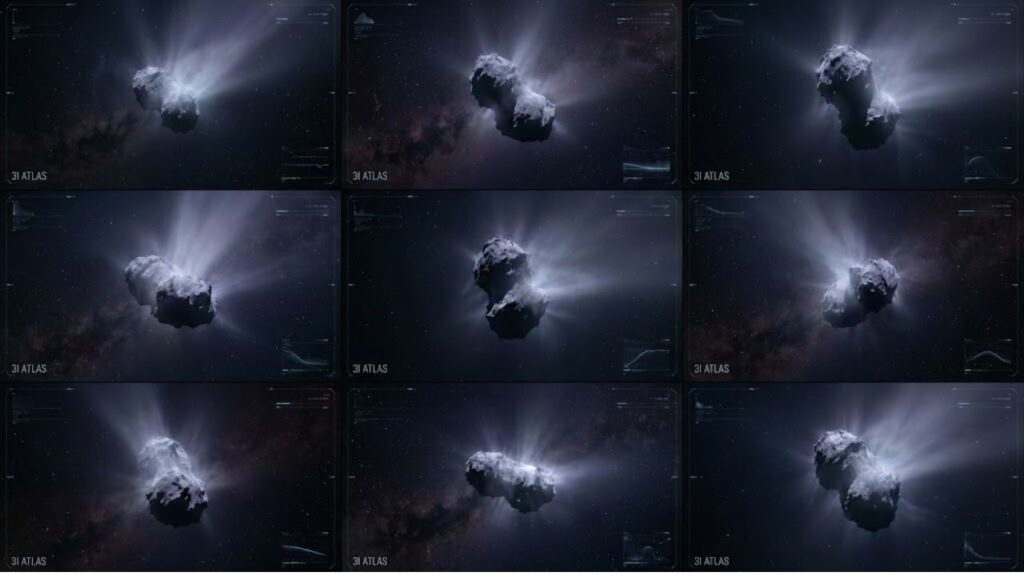
For astronomers, these images are the culmination of years of waiting, and the results evoke a mix of awe and unease. The comet, once a mere trace in charts and graphs, now stares back with a clarity that feels almost personal. You can almost feel the universe looking back at you.
A Comet Out of Place: 3I ATLAS Comes Into Focus
The latest images of 3I ATLAS freeze its motion as it crosses our Solar System, capturing a visitor from deep space with stunning precision. Until now, this comet was a blurry silhouette, a faint trace on scientific instruments. But in these frames, its nucleus sharpens, its tail stretches, and its faint envelope glows with a clarity rarely seen in such distant objects.

What was once a mere streak on a sensor has now transformed into an object with clear edges, presence, and even scars. The imaging process required meticulous planning, as spacecraft adjusted their angles over several nights, tracking the comet’s path across the backdrop of distant stars. Each exposure captured a slightly different angle, as sunlight scattered off dust and ice particles.

Back on Earth, engineers worked tirelessly to refine the raw data, peeling away noise until the final mosaic emerged. The result isn’t a polished space agency illustration but a raw, almost clinical image that makes the vast distance between us and the comet feel very real.
The Unsettling Nature of Interstellar Visitors
What makes these images unsettling is not just their sharpness, but their context. 3I ATLAS is only the third known interstellar object to pass through our Solar System, following ‘Oumuamua and comet Borisov. Unlike most comets, 3I ATLAS will never return. Its path takes it through our system just once before it escapes, never to be seen again, like a car that never slows at the intersection.
These images remind us that space is not a quiet, isolated neighborhood. It is a crossroads where objects we didn’t create, don’t own, and barely understand pass through. The clarity of these images is a rare opportunity to glimpse something alien, fleeting, and profoundly distant.
How Spacecraft Captured a Runaway Visitor
To get these eight images, mission planners treated 3I ATLAS not as a routine target but as a fast-moving object on the run. They had to calculate its position hours or days in advance, then synchronize spacecraft to focus on the exact patch of sky at the right moment. Timing was critical: too early, and the comet would be too faint; too late, and it would slip away, leaving behind a blurry streak.
This challenge is akin to trying to photograph a fast-moving car at night. You pan, you press the shutter, and instead of capturing the car, you get light trails. For space scientists, however, every second counts, and mistakes can waste an entire night of observation. The team had only a narrow window to capture the comet’s brief appearance, and any misstep could have ruined the opportunity.

Capturing the Moment: A Difficult Task in Deep Space
Experienced teams rarely get multiple chances to capture an interstellar object speeding through our Solar System. To improve their chances, they relied on what they had learned from studying comet Borisov, refining algorithms to predict brightness, motion, and how the comet’s coma would evolve as it interacted with sunlight.
Scientists referred to the final image set as “uncomfortably detailed,” as if the data had shifted from distant curiosity to a direct encounter. The images show not only the comet’s physical structure but how sunlight reshapes its outer layers in real-time, transforming it from a simple object into a dynamic visitor.
Why These Eight Frames Mean More Than Science
As you stare at the images of 3I ATLAS, you begin to see something beyond a comet. There’s a subtle wrongness in its tail and dust halo — a sense that this object doesn’t belong here. Our local comets follow predictable patterns, shaped by billions of years in the Sun’s influence. This comet, however, carries the fingerprint of a different star system, a distant cosmic neighborhood.
Looking at 3I ATLAS isn’t just like observing a rock or ice ball; it’s like seeing someone else’s leftovers, something that doesn’t belong to us. That’s what gives these images their emotional weight: this isn’t a rehearsal for a future mission or a test of new technology. It’s the real thing. Once 3I ATLAS leaves, we won’t get another chance. These eight frames are all we have — a time capsule of a fleeting visitor.
Why Astrobiologists Are Fascinated by These Images
Every grain of dust on 3I ATLAS has been somewhere else, under different stars and different conditions. As sunlight hits the comet, it releases tiny particles into space, some of which drift through our Solar System. We may not breathe them in or touch them, but our instruments can detect the chemistry, offering a rare glimpse of material from another star system.
For astrobiologists, these images aren’t just beautiful; they are a roadmap to material from beyond our cosmic neighborhood. The dust, gas, and changes in brightness tell the story of a world we will never directly see.

Key Insights from These Extraordinary Images
- Interstellar origin: 3I ATLAS follows a hyperbolic trajectory, cutting through the Solar System once and never returning. It is a true outsider.
- Unprecedented clarity: Eight meticulously planned spacecraft images reveal the comet’s structure, movement, and activity with extraordinary detail.
- Scientific treasure: The comet’s dust and gas provide valuable information about another star system, helping scientists learn about distant worlds.
