
The first time I saw someone baking banana peels, I honestly thought it was a joke. A friend pulled a tray out of the oven, and instead of cookies or vegetables, there they were: long, brown-golden skins, crackling like autumn leaves. Her kitchen smelled faintly caramelized, a bit like dried fruit and tea. She grabbed one with tongs, broke off a piece, and tossed it into a jar on the counter as if this was the most natural thing in the world. “You’re still throwing yours out?” she asked me, eyebrow raised. The question stung more than I expected. Because yes, my banana peels were in the trash, again. And suddenly, they felt like a tiny daily failure I hadn’t noticed.
Something very simple was happening here, but it was about to change the way I look at a boring banana peel.
A weird kitchen trend that actually makes sense
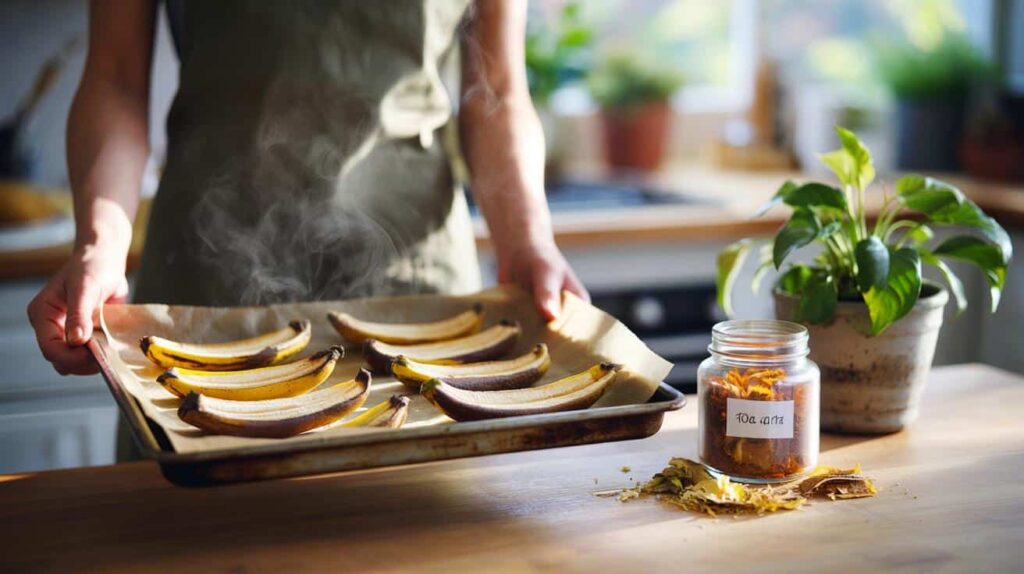
Scroll through social media this week and you’ll see them everywhere: trays of banana peels baked like chips, laid out on parchment paper, lined up like a tiny army of brown boats. It looks a bit absurd at first. Yet people keep sharing the trick because it hits a sensitive nerve: food waste, cluttered bins, that vague guilt we feel when we throw good things away without a second thought. Suddenly, the peel becomes the star of the fruit. Not the part you eat distractedly at your desk, but the part that usually dies in a plastic trash bag.
One viral video starts with a close-up of a sad kitchen bin overflowing with yellow curls and coffee grounds. Then a quick cut: the same peels, washed and lined in a tray, sliding into an oven at 180°C (350°F). Thirty minutes later, they emerge darker, drier, almost leathery. The creator crumbles them between her fingers and sprinkles the pieces into houseplant pots, over a balcony herb box, and into a small jar labeled “peel boost”. The comments below are wild. People share photos of their own plants that “finally woke up” after months of looking tired. Others confess they’ve started storing peels in the fridge just to do this once a week.
 Boiling lemon peel, cinnamon and ginger : why people recommend it and what it’s really for
Behind the quirky trend, there’s basic logic. Banana peels are naturally rich in potassium and other minerals that plants love. Fresh, they’re messy, slimy, smelly, and they attract fruit flies. Baked, they dry out, lose much of the odor, and break down more slowly and cleanly in the soil. The oven essentially turns a sticky waste into a tidy, shelf-stable “ingredient” for your garden or houseplants. It’s not magic fertilizer and it won’t fix dead soil overnight. Yet it transforms a problem—organic waste that rots fast—into something usable, storable, and oddly satisfying.

The 30-minute banana peel trick, step by step
The method that’s spreading is surprisingly simple. You eat your bananas as usual, then keep the peels aside on a plate instead of heading straight to the bin. Give them a quick rinse under cool water, rubbing gently to remove any leftover fruit or sticker glue. Pat them dry with a clean cloth or kitchen paper. Then lay them flat on a baking tray lined with parchment, yellow side up, without overlapping them too much. Preheat your oven to around 180°C (350°F), slide in the tray, and let the heat do its job for about half an hour. The peels should turn darker, a bit crisp at the edges, and much lighter in weight.
Once they’re out, let them cool completely. You can then break them by hand into small pieces or blitz them quickly in a blender or coffee grinder until you get coarse flakes. Those pieces go into a glass jar or tin, preferably somewhere dry and dark. A teaspoon sprinkled into the soil of a houseplant, mixed lightly into the surface, is usually enough. In the garden, some people stir the crushed peels into their compost, others tuck a small handful into the hole when planting flowering shrubs or roses. Let’s be honest: nobody really does this every single day. It becomes a small weekly or bi-weekly ritual, like watering plants or wiping the kitchen counter.
 6 minutes of darkness get ready for the longest eclipse of the century that will turn day into night
This is where many people go wrong: they rush, or they exaggerate. They toss in fresh, half-rotten peels and end up with moldy pots and fruit flies doing aerial acrobatics in the kitchen. Or they bury huge chunks too deep, which can attract pests and leave pockets of rot. The trick is moderation and patience. Think “seasoning”, not “meal”. A light top-dressing of baked peel crumbs breaks down slowly, especially when the soil is already moist and alive with microbes. If your plants are delicate, or your space small, start tiny—one plant, a pinch of peel, and give it a few weeks. You’re not trying to win a gardening contest, just nudging your environment a little in the right direction.
“When people start baking their banana peels, I know something has shifted,” laughs urban gardener Tessa Moreau, who runs balcony gardening workshops in a dense city neighborhood. “They’ve crossed that line from passive consumer to curious tinkerer. They’re not just buying plant food; they’re asking, ‘Wait, what do I already have in my bin that my plants might love?’”
- Dry, don’t dump – Baking shrinks odors and slows decay, so your home stays fresher while your soil gets gentle nutrients.
- Use small amounts – A teaspoon for a pot, a handful for a planter. Your plants don’t need a banana avalanche.
- Watch your plants – Leaves, growth, and color will tell you more than any magic recipe on social media.
- Pair with real care – Light, water, and good soil still matter more than any peel trick.
- Stay flexible – If you notice mold or gnats, pause, aerate the soil, and use less next time.
More than a hack: a tiny shift in how we see waste
What’s striking with this trend isn’t just the gardening side. It’s the quiet satisfaction that shows up in the comments from people who tried it. A young dad shares a photo of his kid laying banana peels on a tray “like little surfboards” and calls it their Saturday morning experiment. A student living in a tiny studio posts her one surviving peace lily, finally looking alive, next to a jar of dried peels labeled in shaky handwriting. These aren’t expert gardeners. They’re just people who got tired of filling the bin and started to ask what else could be done with what they already had. *It’s a small act, but it pushes back against that feeling that everything goes straight from supermarket shelf to garbage bag.*
There’s no miracle in a baked banana peel. It won’t erase poor soil, bad watering habits, or total neglect. Yet there’s something comforting in this modest, repeatable gesture. You take a thing that used to disgust you after five minutes on the counter and you give it another life. You let your oven hum for half an hour and suddenly your waste drawer feels a little emptier, your plants a little better cared for, your kitchen a bit more like a place of invention. It’s a micro-resistance to throwaway culture, happening right next to your fruit bowl. We’ve all been there, that moment when you hover over the trash and suddenly hesitate, thinking: maybe I can still use this.
That hesitation might be the real trend worth spreading.

| Key point | Detail | Value for the reader |
|---|---|---|
| Simple baking method | Rinse peels, bake 30 minutes at 180°C (350°F), cool and crumble | Turns daily waste into a clean, easy-to-store plant booster |
| Gentle plant support | Sprinkle small amounts on potting soil or mix lightly into garden beds | Offers extra nutrients and care without buying special products |
| Mindset shift | From throwing away peels to treating them as a resource | Reduces guilt around waste and encourages creative, sustainable habits |
FAQ:
- Question 1Do I have to use organic bananas for this trick?
- Question 2Will baked banana peels really replace commercial fertilizer?
- Question 3How often can I add baked peel crumbs to my houseplants?
- Question 4My kitchen is small and hot—can I dry the peels without an oven?
- Question 5What if my plants don’t seem to react or change?
