
The cold arrived quietly at first. A sharper breeze on the school run, a thin glitter of frost stealing across car windows, that strange blue light you only see on mornings when the air feels like glass. Then the phone alerts began pinging: “Polar blast incoming”, “Arctic breakdown earlier than normal”, “February shock freeze on the way”. On social media, charts of tangled jet streams and swirling purple blobs raced past, sandwiched between latte photos and football scores.
Yet alongside the anxiety, something else is bubbling: irritation. Some meteorologists say, yes, an unusually early arctic breakdown really is forming this February. Others roll their eyes and accuse **climate alarmists** of turning rare atmospheric patterns into end-of-the-world headlines.
Caught between those two camps is everyone just trying to work out one simple thing.
What does this actually mean for our lives?
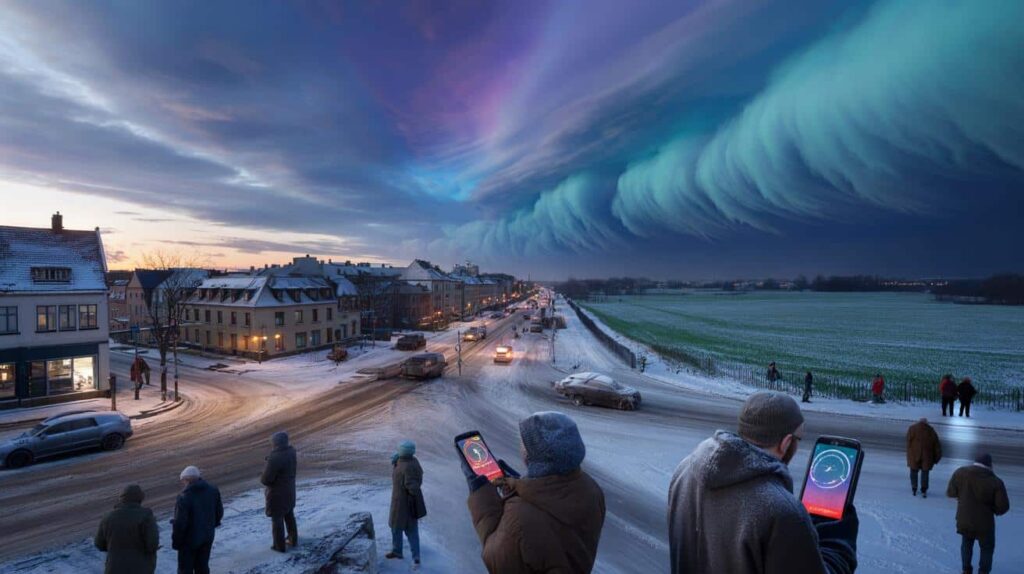
What an “early arctic breakdown” really looks like on the ground
A true arctic breakdown doesn’t feel like a dramatic movie scene at first. It sneaks in as a subtle realignment of the atmosphere, the kind that only weather nerds notice on long-range charts. Then one morning your breath hangs heavier in the air, and the wind has teeth. Meteorologists describe it as the polar vortex losing its grip and arctic air spilling south, earlier than seasonal norms.
This February, several major forecasting centres are flagging patterns they haven’t seen in decades. For many people, that translates into one thing: a winter that felt almost done suddenly snapping back with brutal force.
In parts of North America and Europe, the warnings are already shifting from “cooler spell” to “significant cold risk”. A Canadian forecaster in Montreal posted a model run showing temperatures crashing by 15°C in 48 hours – the kind of swing that bursts pipes and empties supermarket shelves. In northern Germany, farmers are being advised to delay early planting they’d pencilled in after a mild January.
If the arctic breakdown locks in, some regions could see snowstorms forming over relatively warm ground, creating heavy, wet snow that drags down power lines. The last time a similar pattern appeared so early in the year, rail services in parts of the UK crawled to a halt and emergency shelters quietly filled overnight.

Meteorologically, the mechanics are pretty simple. High up in the stratosphere, winds that usually circle the pole can weaken or split, allowing chunks of cold air to wobble south like a lopsided spinning top. At the same time, the jet stream starts to buckle, steering that air directly over continents packed with people and infrastructure.
Climate scientists point out that a warmer background climate can load the dice for more extremes: milder spells, then sharper snaps back to cold. Critics push back, saying folks are reading too much climate drama into a pattern that has always appeared from time to time. Both agree on one thing though. When the atmosphere rearranges itself this fast in February, weather gets weird.

The tug-of-war: data, drama, and who to trust
If you want to stay sane over the next few weeks, start with one simple method: separate the forecast from the framing. The forecast is the raw science – the model runs, the temperature maps, the probability ranges. The framing is how that data gets turned into a headline, a TikTok, or that breathless Facebook post from your uncle who’s “just asking questions”.
A useful habit is to glance at where the information comes from before reacting. National meteorological services, serious climate labs, long-established forecasters: they’ll often speak in probabilities, not certainties. When you see “could”, “range”, “scenario”, you’re closer to reality than when you see **guaranteed deep freeze** in 72-point font.
We’ve all been there, that moment when you rush to the grocery store because you read a thread saying “historic blizzard incoming” and three days later you’re eating weather-apocalypse pasta in calm sunshine. It doesn’t mean the threat was fake, but the emotional volume was dialled up way too high.
Real meteorologists make mistakes, but they rarely promise the exact snow depth on your street ten days from now. It’s the hybrid space – influencer-forecaster accounts, aggressive clickbait sites – where nuance gets stripped away. *That’s where an “unusually early arctic breakdown” can morph into “the coldest February of your lifetime” in a single swipe.*
Some experts are genuinely frustrated right now. They say their cautious language about “signals not seen in decades” is being cherry-picked to feed a broader climate panic. Others within the same field argue the opposite: that downplaying these rare patterns lulls people into thinking the climate system is still steady and familiar.
“We’re seeing a configuration of the polar vortex and jet stream that we don’t get often in February,” one European climate researcher told me. “That doesn’t mean ‘panic’. It means ‘pay attention’.”

- Look for timeframes: next 3–5 days are usually solid, beyond that is scenario territory.
- Compare two or three reputable sources before you share anything dramatic.
- Ask: is this describing weather (days to weeks) or climate (decades)?
- Notice adjectives: “unprecedented”, “historic”, “record-shattering” often signal hype.
- Remember that *uncertainty* in a forecast is a feature of honesty, not a flaw.
Living with the chill while the arguments rage on
Whatever side of the climate debate people are on, the cold – if it hits – will be very real. One practical approach is to quietly get “one step ready” without spiralling. That might mean bleeding a radiator, knowing where the extra blankets live, or checking the battery in that old flashlight you swear you’ll replace every year. Let’s be honest: nobody really does this every single day.
For families, a simple checklist on the fridge can turn vague anxiety into concrete action. Kids love being given a “storm job”: collecting candles, charging power banks, feeding the pets early before the worst of the weather.
A common mistake in seasons like this is all-or-nothing thinking: either you ignore the warnings entirely or you behave like a bunker is the only rational response. The middle ground is boring but effective. Keep an eye on updates every day or two, not every hour. Talk to neighbours who may struggle if icy streets cut them off.
There’s also the quiet emotional load of yet another “unusual” season. For older people who remember more predictable winters, this stop–start, freeze–thaw pattern can feel unsettling. Being gentle with each other’s reactions – the worrier, the sceptic, the one who jokes about it – matters as much as stocking up on de-icer.
Some atmospheric scientists worry that every strong cold snap gets seized by climate sceptics as proof that global warming is a hoax, while every heatwave becomes a symbol for looming catastrophe. That tug-of-war is exhausting for anyone just trying to understand the world they live in.
As one veteran forecaster told me off the record: “My job is to tell you what’s likely in the next two weeks. The climate story matters, but if I say ‘bundle up’ I’m not auditioning for a disaster movie.”
- Short-term: follow official notices about ice, snow, and power disruptions.
- Medium-term: notice how often “unusual” shows up in seasonal summaries.
- Long-term: seek out climate explainers that use data, not just dramatic metaphors.
- Personal: keep a rough weather journal; patterns feel different when you track them.
- Social: share solid sources in group chats when the scary maps start flying around.
Between the charts and the chill in your bones
There’s something strangely intimate about weather talk. It’s the small talk we default to, yet right now it’s also the front line of a bigger conversation about how fast our world is shifting. This early arctic breakdown – if it unfolds as the models hint – will be experienced in a thousand tiny ways: the shock of stepping onto a frozen pavement in shoes meant for spring, the anxious scroll through bus delay alerts, the quiet argument over whether we’ve “always had winters like this”.
You don’t need to pick a permanent side in the climate culture war to pay attention to what’s happening outside your window. You can hold two thoughts at once: that some headlines wildly exaggerate, and that the atmosphere is sending signals we haven’t seen so clearly in decades.
What people will remember, years from now, may not be the exact numbers on some distant weather map. They’ll remember how this February felt in their own body – the bite of the wind, the hush of a city under sudden snow, the uneasy sense that ordinary seasons are getting just a little harder to read.

| Key point | Detail | Value for the reader |
|---|---|---|
| Early arctic breakdown basics | Rare February pattern tied to polar vortex shifts and jet stream buckling | Helps you grasp what forecasters mean beyond the scary headline |
| Media vs. meteorology | Raw forecasts often get amplified into dramatic climate narratives | Gives you tools to spot exaggeration and find reliable information |
| Practical response | Moderate preparation, neighbourly support, emotional awareness | Turns vague fear into simple, concrete steps you can actually use |
FAQ:
- Question 1What exactly is an “arctic breakdown” in February?
- Question 2Does an early cold spell contradict global warming?
- Question 3Are climate alarmists really exaggerating the current signals?
- Question 4How far ahead can meteorologists reliably predict this kind of event?
- Question 5What’s the most sensible way to prepare without panicking?
