
The first sign wasn’t a dramatic headline or a flashing warning on a weather app. It was an eerie silence over a frozen lake in northern Finland, broken only by the faint crack of thinning ice in late January—weeks earlier than the locals remember. An elderly fisherman noticed the shifting surface and shrugged, as if there were no words left to describe something so out of place.
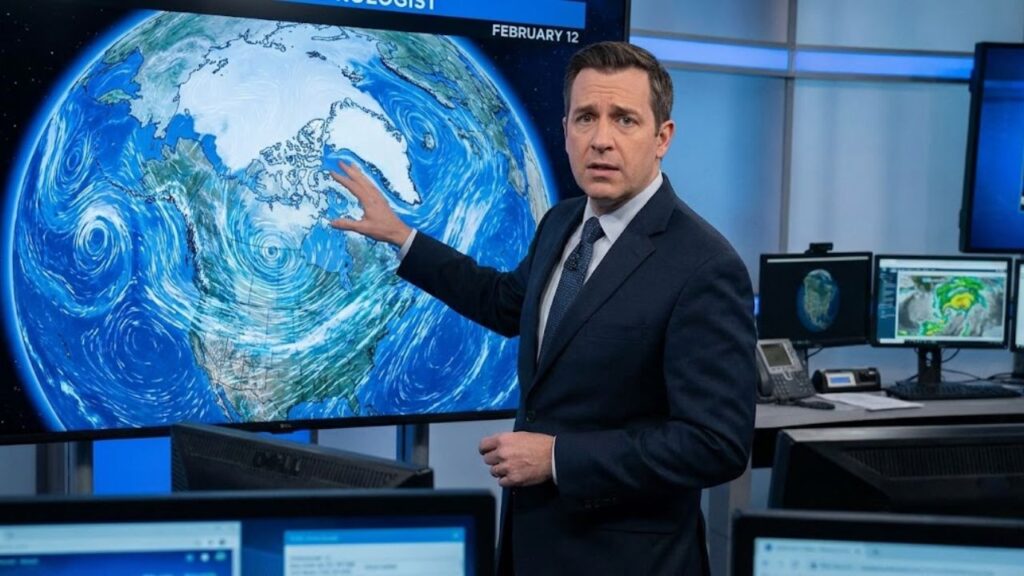
Meanwhile, meteorologists have been monitoring a similar event much higher up in the atmosphere, but on a planetary scale.
In February, while most people are scrolling through routine forecasts, the Arctic is starting to unravel in a way the atmosphere hasn’t shown in decades. The rules of the sky are changing.

The Ground-Level Reality of an Early Arctic Breakdown
On weather maps, the anomaly looks like a swirling blue whirlpool over the pole. But on the ground, it feels much less abstract. One week, you’re enjoying an oddly warm day in your city, and the next, you’re digging out your gloves and watching traffic slow to a crawl through an unexpected snowstorm.
 Scientists identify the age when happiness drops sharply and the explanation is not what you think
This February, that transition could be more extreme.
The Arctic’s usual winter stronghold of cold—the polar vortex and the surrounding winds that contain it—is weakening and wobbling ahead of schedule, pushing frigid air south in unstable bursts.
We’ve all experienced that moment when we step outside in February, expecting mild weather, only to be slapped by air that feels straight from Siberia. Now imagine that, but spread over regions that haven’t seen this kind of disruption in years.
In parts of Europe, long-range models are forecasting repeated cold waves after what was expected to be a spring-like start to the year. Over North America, forecasters are observing the jet stream bending like a loose rope, allowing Arctic air to plunge deep while sending unexpected warmth into northern Canada and Greenland. Some cities could swing from record highs to dangerous wind chills in less than a week.
What’s Actually Breaking Down? The Science Behind the Shift
Up at 30 kilometers above the surface, the stratospheric polar vortex has started to weaken and split earlier than usual. This disruption ripples downward, pulling at the jet stream, which is a fast-moving river of air that steers storms.
When the jet stream falters, exaggerated weather patterns form: blocking highs that linger over one region, stubborn lows dumping snow in another, and sharp divides between warm and cold air masses.
Experts say the current atmospheric “fingerprints”—from pressure patterns over the North Atlantic to unusual warmth over the Arctic Ocean—haven’t been seen like this since the 1990s or early 2000s.

How to Adapt to a Sky That Can’t Make Up Its Mind
The first practical move in a month like this is surprisingly simple: shorten your planning horizon. Instead of relying on a 10-day forecast that promises steady weather, check back frequently for 3–5 day updates.
Update your mental calendar too. February may feel more like a mix of late March and deep January, depending on where you live.
Prepare for fluctuating temperatures by layering clothes that can easily be added or removed. Keep your commute flexible and ensure your devices are charged, especially in case of a sudden blackout caused by icy weather.
Many of us fall short here. We hear “possible Arctic blast,” glance out the window at bare sidewalks, and dismiss it until the first icy road or burst pipe. Let’s face it: we don’t always act on these warnings immediately.
Meteorologists say one of the biggest household mistakes is assuming that power grids and water pipes will keep functioning no matter how extreme the conditions. A small investment in insulation sleeves for exposed pipes, a backup battery for your phone, and a bag of sand or salt for the driveway—these are simple, inexpensive steps that can help you stay calm when the weather takes a turn.
“I’ve been tracking the Arctic since the late 1980s, and the timing and structure of this breakdown really stands out,” says an atmospheric scientist at a major European weather center. “We’re not just seeing a cold snap. We’re watching the entire Northern Hemisphere weather pattern flip in a way that used to be a once-in-a-decade event.”
Practical Tips to Navigate Unpredictable Weather
- Track Short Windows: Rely on 3-5 day forecasts, not long-range predictions.
- Prepare for Temperature Swings: Keep both winter and early-spring wear ready in your closet.
- Protect Your Basics: Insulate pipes, check flashlights, and maintain a small food and water reserve.
- Follow Trusted Sources: Rely on national meteorological agencies and local forecasters over viral weather maps.
- Check on Neighbors: A quick text to an older neighbor before a cold plunge can make a bigger difference than any app.
The Future of Unpredictable Winters
The unsettling part of this story isn’t just that February 2026 (or the next similar winter) could bring a sudden freeze after teasing warmth. It’s the realization that these broken, erratic weather patterns are becoming the new normal for winters in a warming world.
The Arctic is warming about four times faster than the global average, causing sea ice to melt that used to lock in cold air and stabilize the polar vortex. As that “lid” weakens, the atmosphere finds new, chaotic ways to redistribute energy, sometimes sending springlike warmth to one region while freezing another.
No one is getting a straightforward winter anymore, just different variations of strange.

| Key point | Detail | Value for the reader |
|---|---|---|
| Early Arctic breakdown | Polar vortex weakening and wobbling weeks ahead of a typical schedule | Explains why forecasts feel unreliable and swings are more violent |
| Jet stream distortion | Deep bends allow Arctic air to plunge south and warm air to surge north | Helps anticipate sudden cold snaps or warm surges where you live |
| Practical adaptation | Shorter planning horizon, basic home prep, attention to local alerts | Concrete steps to stay safer, calmer, and less surprised by extreme flips |
