
At 5:47 a.m., the Atlantic lies in a half-sleep. The sky carries the dull shine of cold steel, and the air tastes of salt and diesel. Along the breakwater, engineers and dockworkers stand quietly, hands buried in pockets, eyes fixed on a massive shape emerging from the fog. A construction barge drifts forward, carrying the first tunnel segment of a project meant to challenge geography itself.
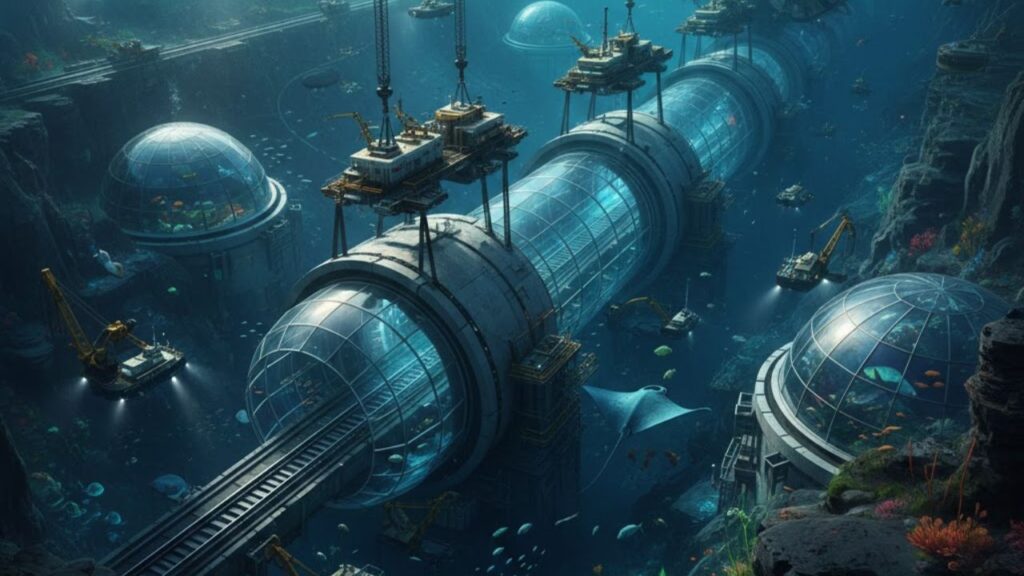
Beneath that pale, rolling surface, survey beacons blink on the seabed, marking the future line of a railway designed not just to cross water, but to connect continents. A man in a hard hat lifts his phone, squints, and murmurs, half amused, half serious: “This is where the world map shifts.” He isn’t wrong.
The Moment the Seabed Became a Worksite
For something this consequential, the pier feels strangely subdued. A crane sweeps slowly, warning tones echo, and crews guide a prefabricated tunnel section into place like a Lego block the size of an apartment building. Steel meets salt spray. Radios crackle with short commands.

There are no ceremonies, no cameras, no ribbons—just the quiet start of an underwater rail line intended to stitch continents together through a tunnel stretching hundreds of kilometers. For two decades, this project existed only as simulations and colored lines on screens. Today, it finally meets cold water and ancient rock.

A Vision Meant to Outlast the Sky
The ambition rivals humanity’s greatest infrastructure feats. The idea is simple and staggering: board a train in one continent and arrive in another without ever seeing daylight. The railway will pass through a pressurized tunnel buried deep beneath the ocean floor, with some sections deeper than the Eiffel Tower is tall.
Sensors already blanket the route—acoustic markers, vibration monitors, cameras sitting in total darkness. Their data streams into control rooms on multiple continents, where operators track seismic lines instead of social feeds. One engineer described seeing the tunnel alignment for the first time on a 3D scan: “It felt like drawing a scar across the planet.”
What finally pushed the project from concept to construction was a hard truth: the old system is fragile. Planes wait. Ships stall. Storms, pandemics, and congested ports expose the limits of surface travel. A tunnel at extreme depth doesn’t negotiate with weather. It simply runs.
Building Railways Where Light Never Reaches
This time, even seasoned engineers admit they’re in new territory. The process resembles surgery more than construction. First, autonomous survey machines crawl across the seabed, mapping fault lines, ridges, and unstable sediments. Along the safest path, drilling vessels bore pilot shafts deep into the crust.
These openings are reinforced with steel, grout, and structural foundations. Some tunnel sections advance outward from land, pushing beneath the sea. Others are assembled in dry docks, sealed, floated into position, and then lowered with precision into prepared trenches before being buried.
The railway itself will pass through a double-tube system, with an emergency service tunnel between them. Drones patrol the interior, and maintenance vehicles run on dedicated tracks.
Designing for Every Possible Failure
Underwater megaprojects are unforgiving. Small errors can multiply into catastrophic costs. Past tunnels taught painful lessons: corrosion, thermal stress, microscopic leaks that grew into major problems. This time, redundancy is the rule.
Each segment is packed with sensors tracking pressure, humidity, vibration, strain, and water chemistry. The system watches for subtle changes—tiny signals that hint at future trouble. Automation does what humans can’t: monitor everything, all the time.
Life Beneath the Waves Still Counts
Unlike land projects, underwater construction doesn’t face protest signs—but it still affects living systems. Environmental teams spent years studying whale calls, fish migrations, and drilling noise. One surprising finding: in many seasons, the ocean is already loud, dominated by global shipping lanes.

By burying much of the rail link beneath the seabed, planners argue they’re replacing surface disruption with a quieter, hidden artery. As one marine biologist put it, “We’re not working in a pristine ocean. The real issue is whether this changes it less than what already exists.”
- Seabed surveys improved fault-line maps for future quake alerts.
- Quiet periods are enforced during whale migration seasons.
- Fiber-optic cables will double as global seismic sensors.
- Emergency refuges inside the tunnel are spaced like underground stations.
Rewriting How We Travel and Trade
This project isn’t just physical—it’s psychological. Modern travel is built around waiting: queues, security checks, turbulence. A deep-sea tunnel changes that rhythm. You board a train, keep your shoes on, sit down, and let the world pass in darkness.
The plan includes high-speed passenger trains by day and freight and autonomous cargo at night. End-to-end journeys between continents could fall below eight hours, city center to city center. Without altitude changes, jet lag softens, and travel feels less like an ordeal.
Economically, the ripple effects are already forming. Cities near tunnel portals are planning logistics hubs, data centers, and research campuses. Real estate listings quietly advertise future access, much like highway exits once did.
The Uneven Shape of Progress
There’s also unease. Major corridors tend to concentrate power, leaving smaller ports and towns off the grid. History shows how communities fade when routes bypass them. Progress favors straight lines, and straight lines often overlook the edges.
Engineers acknowledge a deeper truth: projects like this are built on trust. Trust in geology. Trust in software. Trust that future governments won’t neglect invisible maintenance.
As one senior manager said, “This tunnel will outlive us. We’re not just building infrastructure—we’re making a promise.”
- Funding guarantees embedded in international treaties.
- Public dashboards showing real-time safety data.
- Open engineering standards for future generations.
- Independent oversight that includes scientists.
When the Extraordinary Feels Ordinary
On the pier and in control rooms, the work feels almost mundane. Crews argue over bolt torque and weather windows. Spreadsheets track millimeter shifts in the seabed. No one is delivering grand speeches.
Yet this quiet labor is reshaping how continents relate. When distance becomes a long train ride instead of a heroic journey, “faraway” problems feel closer. Future generations may see the pre-tunnel era as quaint—or as the moment we buried too much beneath the sea.
For now, one thing is clear: a new kind of border is being drawn, not on maps, but beneath them. The first trains are years away. Budgets will swell. Timelines will slip. But the leap from idea to action has already happened.
Deep below the waves, a robotic arm drills into ancient rock, clearing space for a future commute. It doesn’t care about headlines or debates. And someday, when a passenger looks up from their seat and sees only their reflection in the window, the most surprising thought may be how normal it all feels.

| Key point | Detail | Value for the reader |
|---|---|---|
| Scale of the project | First deep-sea rail tunnel explicitly designed to link entire continents, running beneath the ocean floor | Helps you grasp why this could reshape travel and global trade, not just offer a new route |
| Construction methods | Combination of seabed trench segments and deep-bored tunnels, packed with sensors and automation | Gives you a concrete sense of how such an “impossible” structure is actually being built |
| Long-term impact | Potential to cut flights, reroute shipping, and change which cities, ports, and regions thrive | Lets you anticipate economic, environmental, and lifestyle shifts that may affect your own future |
