
Not a soft hush, but a dense, metallic stillness, broken only by boots ringing on steel and the low pulse of distant machinery. You’re walking along the frozen docks of Severodvinsk, facing an aging giant: a rust-streaked submarine hull, its bronze-toned lines still oddly graceful. A naval officer in a worn coat gestures toward the water and remarks almost offhandedly, “That one… she was faster than all the rest.” Before you sits a submarine that once tore through the depths at over 80 km/h—faster than many surface warships and unsettling even to its creators.
A Radical Dream: A Submarine Faster Than Torpedoes
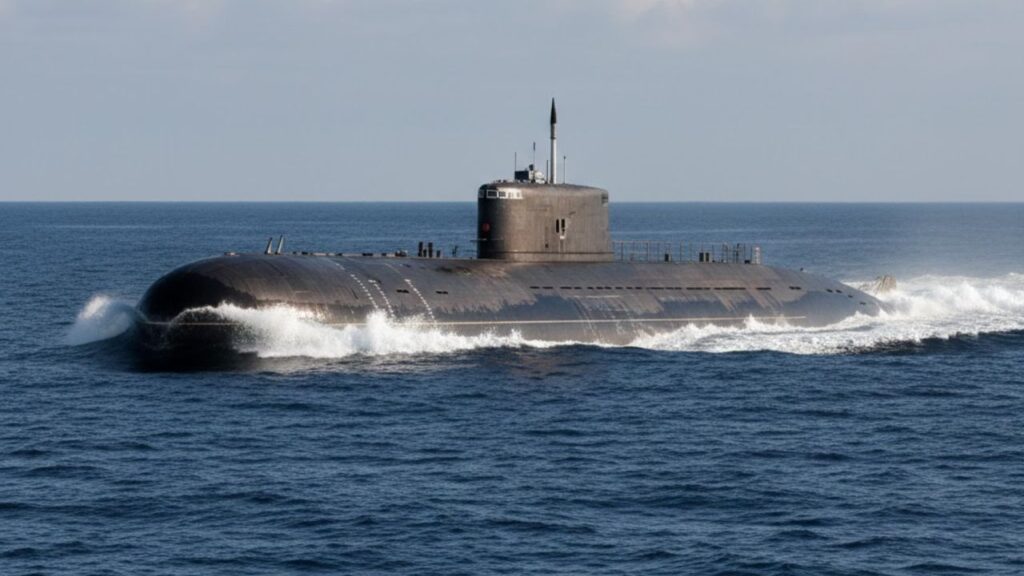
On the drawing board, the Soviet K-222—originally designated K-162—looked like a direct challenge to physics itself. Launched in 1969, this Papa-class nuclear submarine was built with a single obsession: unmatched underwater speed. Beneath the surface, speed drains energy and amplifies noise, yet Soviet engineers chose to push both limits at once. What emerged was a long, sleek predator with a light, golden-hued hull and a reactor system closer to rocket engineering than traditional shipbuilding. This wasn’t a patrol vessel. It was a sprinting machine.
The Trial That Shocked NATO
Veterans still recount the legendary December 1970 sea trial. K-222 plunged into the icy North Atlantic and accelerated far beyond what NATO navies believed possible. Instruments logged bursts of 44–45 knots—more than 80 km/h—obliterating every previous underwater speed record. Sonar operators reportedly thought their equipment was malfunctioning. One NATO captain later said the submarine “sounded like a freight train”, a deafening roar that rattled both gear and nerves. For a brief moment, K-222 wasn’t merely a vessel—it was a statement.

The Titanium Advantage — And Its Cost
The secret behind that blistering speed was a titanium pressure hull. Exotic, difficult to weld, and brutally expensive, titanium is light, strong, and non-magnetic. These properties gave K-222 a superior power-to-weight ratio and a reduced magnetic signature. Combined with a powerful OK-7 nuclear reactor and advanced steam turbines, raw energy was converted directly into underwater velocity. But speed demanded payment.

At top velocity, the hull vibrated violently. Systems rattled, comfort vanished, and noise levels exploded. Cavitation and friction wrapped the submarine in a roaring shell of sound. The very feature that made K-222 legendary also made it exposed: any sonar in range knew exactly where it was.
Life Inside the Fastest Submarine
Stepping aboard K-222 in the 1970s wouldn’t feel like entering a sleek future, but a tight, echoing maze. Control panels, pipes, valves, and reactors were packed into a compact hull, with sailors sleeping wherever space allowed. During high-speed runs, crew members reported objects leaping from shelves. Meals became balancing acts. In the engine rooms, the air itself seemed to vibrate, as if the metal were alive. This boat was built to break limits, not provide comfort.
- Veterans recalled titanium welding as an art form, requiring endless testing and patience.
- Shipyard crews faced failures and setbacks that never left classified files.
- Sailors lived with the knowledge they were inside a prototype pushed to its edge.
A Laboratory Disguised as a Weapon
Officially, K-222 carried anti-ship missiles meant to threaten Western carrier groups. Unofficially, everyone understood it was also a full-scale experiment. Each time the throttle opened, the submarine wasn’t just rehearsing war—it was collecting data. The strategic vision was clear: if a submarine could outrun torpedoes and close on targets before defenses reacted, the rules of naval combat would shift. Speed meant surprise.
 Daily training after 50 rebuilds chest muscle better than bench press with safer joint positioning
Reality proved less forgiving. At over 40 knots, the submarine could be detected from great distances. The dream of a silent hunter clashed with the thunder of this super-fast machine. Extreme speed was possible, yes—but without stealth, it became a tactical contradiction.
From Record Holder to Warning Sign
K-222 stands as a textbook example of how far engineers will go simply to see if something can be done. To tame titanium, Soviet teams reinvented their methods: special welding chambers, ultra-pure atmospheres, custom tools, and new protective gear. Every weld carried risk. Every flaw could spell disaster. Innovation demanded not just money, but sleepless nights and constant tension.
In hindsight, analysts often describe K-222 as a brilliant exaggeration—what happens when one metric is pursued too relentlessly. The submarine spent surprisingly little time in active service. Maintenance was punishing, repairs costly, and its strategic value awkward. Eventually, she was laid up and scrapped in the 2010s, leaving behind photographs, stories, and a speed record no other nuclear submarine has surpassed.
Why K-222 Still Matters
Standing on that cold dock years after the submarine’s dismantling, the feeling is mixed. There’s admiration for the engineers who wrestled with titanium, reactors, and hydrodynamics at the edge of possibility. There’s also doubt—about where brilliance ends and excess begins. Modern submarines no longer chase 80 km/h. They prioritize silence, endurance, and adaptability.
Yet the ghost of K-222 still drifts through naval design bureaus as a reminder: sometimes, to find balance, you first have to overshoot. More than a Soviet relic, this story reflects a deeply human impulse—to push the needle into the red simply because we can, and then reckon with the consequences.

- World speed record: Approximately 44–45 knots (80+ km/h), still unmatched by other nuclear submarines.
- Titanium hull experiment: Exceptional strength and performance paired with extreme cost and technical difficulty.
- Strategic lesson: Raw speed without stealth exposed design limits and reshaped future submarine priorities.
